













Close
SATEXPO 2026
Saturday, February 28, 2026
CABSAT 2026

SK Telecom and Samsung Electronics Advance in Bringing Korea Closer to 5G Standalone Commercialization

Note* - All images used are for editorial and illustrative purposes only and may not originate from the original news provider or associated company.

Subscribe

- Never miss a story with notifications

- Gain full access to our premium content

- Browse free from any location or device.

Media Packs

Expand Your Reach With Our Customized Solutions Empowering Your Campaigns To Maximize Your Reach & Drive Real Results!

– Access the Media Pack Now

– Book a Conference Call

Leave Message for Us to Get Back

Related stories

Open RAN Architecture Transforming Telecom Markets

The telecommunications industry is currently undergoing a structural transition from proprietary, vendor-locked hardware to an open, software-defined ecosystem. By decoupling the hardware and software components of the radio access network, operators can foster a more competitive marketplace, accelerate the deployment of 5G infrastructure, and achieve a level of operational flexibility that is essential for the next generation of digital services.

5G Advanced Networks Accelerating Enterprise IoT

The evolution of 5G into its "Advanced" phase represents a critical milestone for industrial connectivity, offering the reliability and precision required for mission-critical operations. By combining dedicated private networks with edge computing and high-density sensor arrays, enterprises can create a seamless digital nervous system that drives the next wave of smart factory innovation and autonomous logistics.

6G Innovation Shaping Future Telecom Networks

The transition from the current 5G landscape to the nascent world of 6G represents a monumental shift in the fabric of global connectivity. By integrating artificial intelligence directly into the network architecture and exploring the untapped potential of the Terahertz spectrum, the next generation of wireless technology will bridge the gap between physical reality and digital simulation, enabling a truly hyperconnected world.

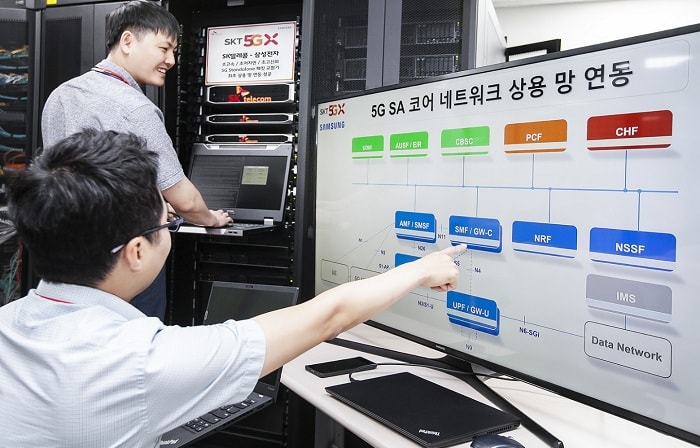
SK Telecom and Samsung Electronics announced the successful completion of Korea’s first interoperability assessment between 5G Standalone (SA) Core and other commercial network systems over a 5G network. This successful result brings the two companies one step closer to 5G SA commercialization.

The 5G SA Core, jointly developed by SK Telecom and Samsung Electronics, not only supports technologies including network slicing and function modularization based on 3GPP standards, but also offers additional functions that operators have been using since LTE, include billing, subscriber management and operational convenience system. The interoperability assessment is the final stage for verifying the validity of 5G SA data transmission, signifying that the SA system is ready to be launched for commercial service.

Both companies implemented several cutting-edge technologies in the 5G SA Core that has been used for the interoperability. The technologies include Data Parallel Processing technology that performs QoS and transmission control simultaneously; Data Acceleration technology that classifies and distributes similar traffic types; and Path Optimization technology that automatically delivers data traffic to Mobile Edge Computing (MEC) platform.

“Along with the initial phase of NSA rollout, SK Telecom has been continuously focusing on researching and developing the SA technology in order to provide customers a differentiated service quality with innovative products, which will be launched in the first half of next year,” said Park Jin-hyo, Chief Technology Officer and Head of ICT R&D Center at SK Telecom. “By strengthening bilateral collaboration with Samsung, SK Telecom will drive and lead highly innovative 5G technologies and solutions.”

“The fundamental structure of 5G SA is built on a completely new configuration, successfully delivering the most optimized 5G service to customers and enterprises across numerous industries,” said Jaeho Jeon, Executive Vice President and Head of R&D, Networks Business at Samsung Electronics. “Maintaining Korea’s leadership in network innovations through continuous investments in next-generation technologies is important to Samsung and SK Telecom, and the companies will continue to collaborate on developing and commercializing 5G SA.”

Once 5G SA is commercialized, data processing efficient will be improved by threefold, allowing efficient control for supporting massive data traffic. Moreover, 5G SA system is highly optimized for emerging next generation services such as Autonomous driving, Smart Factory, Smart Farm, and AR/VR.

For the past five years, the two companies have been collaborating on LTE and 5G development, which ultimately led to this successful 5G SA Core interoperability test. Some of other accomplishments include the commercialization of Virtualized LTE Core and Packet Optimization system; and they have completed the development of 3GPP Rel. 15 based SA Core in July last year, and successfully launched 5G NSA commercial service in April this year.

Latest stories

Related stories

Open RAN Architecture Transforming Telecom Markets

The telecommunications industry is currently undergoing a structural transition from proprietary, vendor-locked hardware to an open, software-defined ecosystem. By decoupling the hardware and software components of the radio access network, operators can foster a more competitive marketplace, accelerate the deployment of 5G infrastructure, and achieve a level of operational flexibility that is essential for the next generation of digital services.

5G Advanced Networks Accelerating Enterprise IoT

The evolution of 5G into its "Advanced" phase represents a critical milestone for industrial connectivity, offering the reliability and precision required for mission-critical operations. By combining dedicated private networks with edge computing and high-density sensor arrays, enterprises can create a seamless digital nervous system that drives the next wave of smart factory innovation and autonomous logistics.

6G Innovation Shaping Future Telecom Networks

The transition from the current 5G landscape to the nascent world of 6G represents a monumental shift in the fabric of global connectivity. By integrating artificial intelligence directly into the network architecture and exploring the untapped potential of the Terahertz spectrum, the next generation of wireless technology will bridge the gap between physical reality and digital simulation, enabling a truly hyperconnected world.

TELUS Confirms Acquisition of New 3800 MHz Spectrum...

On February 09, 2026, TELUS went on to announce...

Subscribe

- Never miss a story with notifications

- Gain full access to our premium content

- Browse free from any location or device.

Media Packs

Expand Your Reach With Our Customized Solutions Empowering Your Campaigns To Maximize Your Reach & Drive Real Results!

– Access the Media Pack Now

– Book a Conference Call

Leave Message for Us to Get Back

Translate »