




















From the pipes beneath a house to the insulation around electrical cables, from medical devices to everyday consumer goods, one material quietly turns up almost everywhere: PVC. Its remarkable versatility has made it one of the most widely used plastics in the world, and much of it is shaped through pvc injection molding. Yet behind this everyday material lies a process that demands genuine expertise. What makes PVC so useful, and what does it take to mold it well?
What makes PVC such a valuable material
A combination of useful properties
Polyvinyl chloride, universally known as PVC, owes its popularity to a rare combination of qualities. It is durable and long-lasting, resistant to moisture, chemicals and corrosion, and naturally flame retardant, which makes it suitable for applications where safety matters. It also offers good electrical insulation and stands up well to weathering, all at a cost that remains highly competitive compared with many alternatives. This blend of performance and affordability explains why PVC has become a default choice across so many industries rather than a niche material.
Rigid and flexible: two materials in one
One of PVC’s most useful characteristics is its adaptability. In its rigid form, it is strong and stable, ideal for pipes, fittings, profiles and structural components. By adding plasticizers, manufacturers can make it soft and flexible, suitable for cable insulation, tubing, seals and a host of pliable products. This ability to range from hard and rigid to soft and bendable, depending on how it is formulated, effectively gives engineers two materials in one, dramatically expanding the range of products PVC can serve.
Where PVC injection molding is used
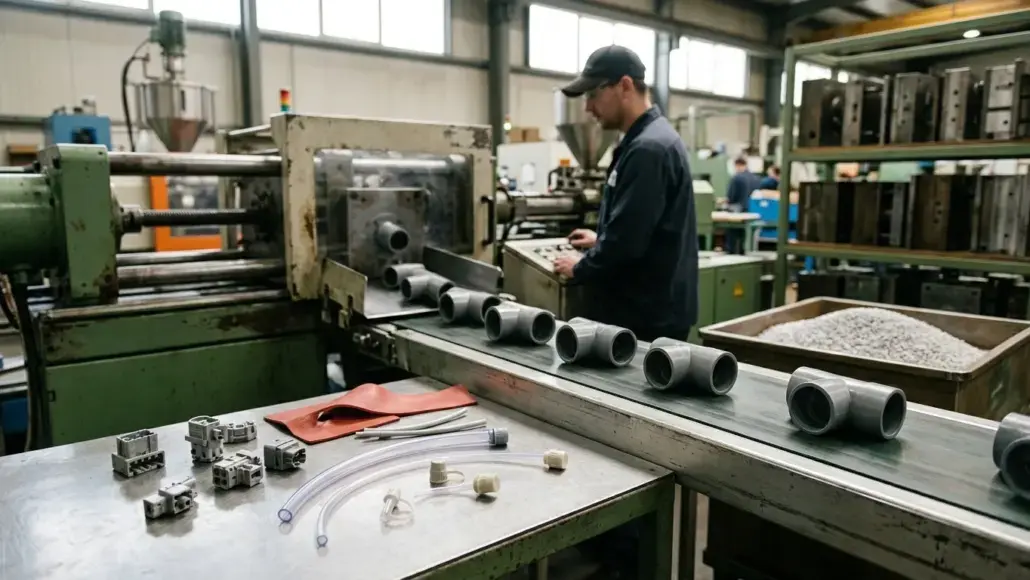
The applications for molded PVC span an enormous range of sectors. In construction and plumbing, it forms pipe fittings, connectors and a wide variety of building components valued for their durability and resistance to water. In the electrical industry, its insulating properties make it a natural choice for housings, conduit parts and cable components. The material also appears throughout medical devices, consumer products, automotive parts and industrial equipment, wherever its particular mix of properties suits the job.
What unites these diverse applications is the demand for parts that are reliable, consistent and cost-effective in volume, exactly what injection molding delivers. Whether the requirement is for rigid components that must hold their shape under stress or flexible parts that need to bend and seal, PVC molding produces them to consistent standards at the scale modern industries require. This breadth of use is a direct reflection of the material’s adaptability and the efficiency of the process that shapes it.
Why molding PVC takes real expertise
A material that demands careful handling
Despite its many advantages, PVC is not the simplest plastic to process, and this is where experience becomes essential. The material is sensitive to heat and can degrade if it is overheated or held at high temperatures for too long, which requires precise control of processing conditions throughout the molding cycle. Working with PVC successfully means understanding its behaviour intimately and managing temperature, timing and flow with care, something that comes only with genuine familiarity with the material.
The right equipment and know-how
Because of these characteristics, molding PVC well calls for appropriate equipment and proper technique. Manufacturers experienced with the material know how to set up the process to handle its sensitivities, how to achieve consistent quality, and how to avoid the problems that can arise when PVC is processed carelessly. This expertise is not a minor detail but the difference between parts that perform reliably and those that fall short, which is why the choice of a knowledgeable partner matters so much for PVC work specifically.
Choosing a partner for PVC work
Given the particular demands of the material, selecting a manufacturer with real PVC experience is worth the effort. A partner who works regularly with PVC will understand its formulations, know how to mold both rigid and flexible grades, and bring the process control needed to produce consistent, high-quality parts. Asking about a manufacturer’s experience with PVC specifically, rather than plastics in general, gives a useful sense of whether they have the depth of knowledge a successful project requires.
A capable partner also adds value beyond the molding itself, offering guidance on material grade selection, part design and the considerations specific to PVC applications. This kind of expertise can help a business avoid missteps, choose the right formulation for the job, and arrive at a component that performs as intended. For any project that hinges on the qualities PVC offers, working with people who genuinely understand the material is one of the most reliable ways to ensure a good outcome.
A material worth understanding
Ultimately, PVC has earned its place as one of manufacturing’s most versatile and widely used plastics, capable of being rigid or flexible, durable and affordable, and suited to an enormous range of applications. Injection molding is the process that brings all of this to life at scale, provided it is carried out with the care and expertise the material demands. Understanding what PVC offers, where it is used and why molding it well takes genuine skill puts any business in a stronger position when a project calls for this remarkably adaptable material.