

















Close
SATEXPO 2026
Wednesday, April 8, 2026
CIOE 2026

Deutsche Telekom and EWE sign contract for joint venture Glasfaser NordWest

Note* - All images used are for editorial and illustrative purposes only and may not originate from the original news provider or associated company.

Subscribe

- Never miss a story with notifications

- Gain full access to our premium content

- Browse free from any location or device.

Media Packs

Expand Your Reach With Our Customized Solutions Empowering Your Campaigns To Maximize Your Reach & Drive Real Results!

– Access the Media Pack Now

– Book a Conference Call

Leave Message for Us to Get Back

Related stories

Non-Terrestrial Networks Expanding Telecom Infrastructure

Non-terrestrial networks are redefining the boundaries of global connectivity by incorporating satellites, high-altitude platforms, and drones into the existing cellular framework. This expansion addresses the inherent limitations of ground-based towers, offering a resilient and comprehensive solution for rural coverage, emergency communications, and disaster recovery on a worldwide scale.

Satellite Integration Accelerating 5G and 6G Networks

Modern telecommunications are undergoing a profound shift as space-based assets merge with terrestrial cellular infrastructure to deliver ubiquitous high-speed connectivity. This evolution addresses the geographical limitations of traditional base stations, creating a unified global network capable of supporting the next generation of mobile technology and massive machine-type communications.

Satellite Backhaul Enabling Scalable Telecom Operations

Satellite backhaul has emerged as a cornerstone of modern network design, providing a flexible and cost-effective alternative to terrestrial fiber and microwave links. This technology allows telecom operators to bypass the physical constraints of ground-based infrastructure, facilitating rapid expansion into rural and underserved markets while maintaining a high standard of data transmission and service reliability.

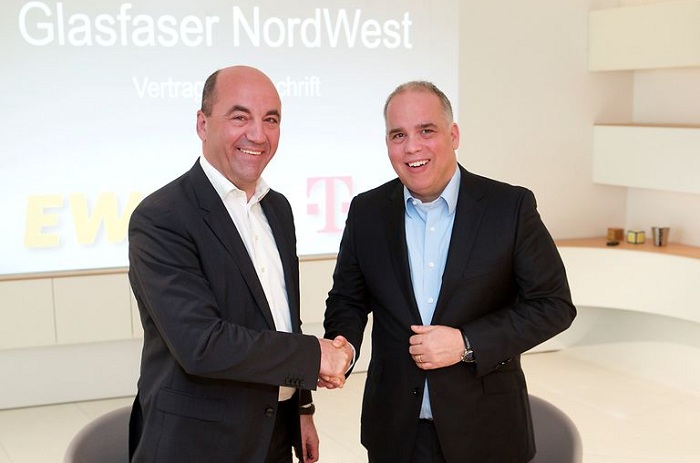
Deutsche Telekom and energy and telecommunications company EWE signed a contract that establishes a joint venture between the two companies, representing the next step in their collaboration. The joint venture is called “Glasfaser NordWest” (“NorthWest Optical Fiber” in English). The two companies also formally notified Glasfaser NordWest with Germany’s Federal Cartel Office.

Glasfaser NordWest aims to provide up to 1.5 million households and business locations with fast internet. The company will be active in parts of Lower Saxony, North Rhine-Westphalia, and Bremen. All customers will be offered fiber to the home (FTTH). The two partners expect to invest up to two billion euros over an approximately ten-year period.

“No one invests as much in digital infrastructure as Deutsche Telekom,” says Dirk Wössner, Board of Management member responsible for Germany. “We’re Germany’s digitalization engine and we’re shifting into high gear. Glasfaser NordWest will capture enormous synergy effects, because we will plan and build the fiber-optic infrastructure together. This means we’ll have greater capacity utilization in the operating phase. It also means we’ll be able to connect households that would have been uneconomical otherwise. The new joint venture is logical and a manifestation of our collaboration-based strategy. Ultimately, we are still convinced that we have to team up with other companies to digitalize Germany – and without any regulatory intervention. Our partnership shows: FTTH expansion without regulation works. We’re boosting expansion and we’re willing to cooperate with competitors. We don’t need regulatory intervention.”

“We are thrilled with this important step in our partnership,” says Stefan Dohler, CEO of EWE. “In northwest Germany, EWE is known for fast internet and the digitalization of rural areas. We’ve already achieved a lot on our own, but we want to offer even more fast internet connections to as many people in our home region as possible. By teaming up with Deutsche Telekom, we can achieve this goal more quickly. Everyone in northwest Germany stands to gain from this joint venture. Glasfaser NordWest will build the infrastructure, creating the foundation for digitalization, and customers can then choose their provider. The services from the new infrastructure will be available to all interested telcos under the usual commercial terms.”

The joint venture does not have an expiration date. Deutsche Telekom and EWE had already signed a non-binding declaration of intent in December 2017, signaling interest in the joint venture. The two companies plan to register the joint venture based in Oldenburg as soon as they receive approval from the cartel office.

The two partners will build the infrastructure through a competitive selection process, acting as general contractor. In the first two years after the joint venture is founded, Glasfaser NordWest will designate the expansion areas in advance. The two parent companies, Deutsche Telekom and EWE, will carry out the upgrades. After this period, Glasfaser NordWest will also offer the expansion areas for bidding by third parties through a selection process. Once the lines have been laid, EWE, Deutsche Telekom, and all other interested telcos will compete directly for the respective customers.

Fiber-optic lines will become available to the first customers in the expansion area in 2020.

Latest stories

Related stories

Non-Terrestrial Networks Expanding Telecom Infrastructure

Non-terrestrial networks are redefining the boundaries of global connectivity by incorporating satellites, high-altitude platforms, and drones into the existing cellular framework. This expansion addresses the inherent limitations of ground-based towers, offering a resilient and comprehensive solution for rural coverage, emergency communications, and disaster recovery on a worldwide scale.

Satellite Integration Accelerating 5G and 6G Networks

Modern telecommunications are undergoing a profound shift as space-based assets merge with terrestrial cellular infrastructure to deliver ubiquitous high-speed connectivity. This evolution addresses the geographical limitations of traditional base stations, creating a unified global network capable of supporting the next generation of mobile technology and massive machine-type communications.

Satellite Backhaul Enabling Scalable Telecom Operations

Satellite backhaul has emerged as a cornerstone of modern network design, providing a flexible and cost-effective alternative to terrestrial fiber and microwave links. This technology allows telecom operators to bypass the physical constraints of ground-based infrastructure, facilitating rapid expansion into rural and underserved markets while maintaining a high standard of data transmission and service reliability.

Cloud Integrated Satellite Networks Transforming Telecom

The synergy between cloud computing and satellite communications is creating a more agile and responsive telecommunications framework. By virtualizing ground stations and moving network functions into the cloud, operators can provide high-speed data processing and real-time connectivity to global enterprises regardless of their location, driving a new wave of digital transformation.

Subscribe

- Never miss a story with notifications

- Gain full access to our premium content

- Browse free from any location or device.

Media Packs

Expand Your Reach With Our Customized Solutions Empowering Your Campaigns To Maximize Your Reach & Drive Real Results!

– Access the Media Pack Now

– Book a Conference Call

Leave Message for Us to Get Back

Translate »