

















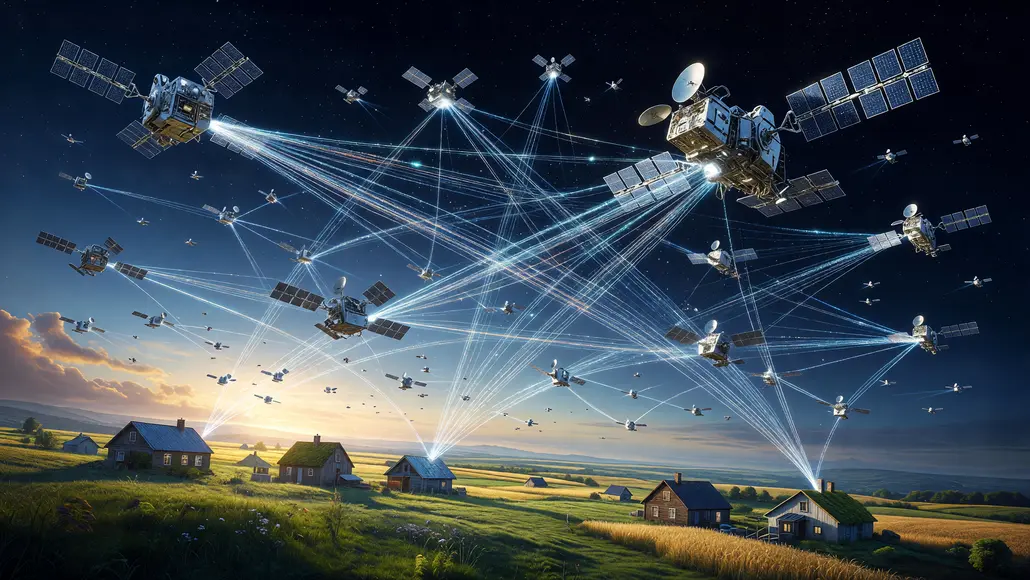

The world of telecommunications has historically been anchored to the earth, dependent on an extensive grid of fiber optic cables and microwave links connecting towering steel structures. While this terrestrial infrastructure has successfully connected billions, it has also left billions more in a state of digital isolation. As the demand for universal access grows, the industry is looking skyward to find the solution. The emergence of non-terrestrial networks expanding telecom infrastructure is more than just an incremental upgrade; it is a fundamental shift in how we conceive of connectivity. By integrating satellites, High Altitude Platform Systems (HAPS), and even low-altitude drones into a unified architecture, we are finally moving toward a world where the concept of a “dead zone” is a relic of the past.
The Technological Architecture of NTN
Non-terrestrial networks, or NTN, represent a multi-layered approach to signal distribution. Unlike traditional satellite systems that often functioned as standalone networks for specialized maritime or aviation use, NTN telecom is designed to be an integral part of the broader cellular ecosystem. This means that a standard 5G device can potentially communicate with a base station on the ground or a satellite in orbit without the user needing to switch devices or even notice a change in service. Non terrestrial networks expanding telecom infrastructure rely on various layers of space and aerial assets, each serving a specific role in the overall network topology.
The technical backbone of NTN involves a complex interplay between transparent and regenerative payloads. A transparent payload acts like a simple mirror in the sky, reflecting signals from a ground terminal to a user. A regenerative payload, however, performs on-board processing demodulating, decoding, and routing data within the satellite itself. This advanced capability is a cornerstone of non terrestrial networks expanding telecom infrastructure, as it significantly improves signal quality and allows for more efficient routing between different satellites in a constellation using Inter-Satellite Links (ISLs). These laser-based links allow data to hop across the sky, bypassing terrestrial congestion entirely.
The Low Earth Orbit (LEO) Revolution
The most significant driver of this expansion is the deployment of massive constellations of Low Earth Orbit (LEO) satellites. Unlike geostationary satellites that sit 35,000 kilometers above the equator and suffer from noticeable signal delay, LEO satellites orbit just a few hundred kilometers up. This proximity allows for latency that is comparable to terrestrial fiber, making them ideal for real-time applications like video conferencing or online gaming. As these constellations grow, non terrestrial networks expanding telecom infrastructure are providing a high-capacity backhaul for ground-based towers and direct-to-device connectivity in areas where towers are absent.
The sheer volume of satellites in these LEO constellations often numbering in the thousands ensures that at least one satellite is always visible from any point on Earth. This constant visibility is critical for maintaining a stable connection as the earth rotates and the satellites move at speeds of over 27,000 kilometers per hour. To manage this, ground terminals and smartphones must utilize sophisticated antenna technology, such as Phased Array Antennas, which can electronically steer their beams to track moving satellites without any mechanical parts. This level of hardware innovation is what makes the large-scale rollout of non terrestrial networks expanding telecom infrastructure economically and technically feasible.
High Altitude Platform Systems (HAPS) and Drones
While satellites provide the broad “umbrella” of coverage, HAPS and drones offer a more localized and flexible middle layer. These platforms, which can include solar-powered aircraft or stratospheric balloons, operate at altitudes of 20 kilometers, well above commercial air traffic but far below space. HAPS can stay aloft for months at a time, providing focused coverage over a specific city or rural region. In the context of non terrestrial networks expanding telecom infrastructure, these platforms act as temporary or semi-permanent base stations that can be deployed rapidly to handle massive events or provide surge capacity during emergencies.
HAPS are particularly useful in providing ultra-low latency services because they are much closer to the user than even LEO satellites. They can also carry heavier and more power-intensive telecom equipment, effectively acting as “floating cell towers.” For a telecom operator, deploying a HAPS platform can be a much faster and cheaper alternative to obtaining permits and building physical towers in a densely packed urban area or an environmentally protected forest. This flexibility is a key advantage of non terrestrial networks expanding telecom infrastructure, allowing the network to grow and adapt alongside the needs of the population.
Bridging the Rural Connectivity Gap
One of the most profound social impacts of non terrestrial networks expanding telecom infrastructure is the potential for true digital inclusion. In many parts of the developing world, and even in rural areas of developed nations, the cost of laying fiber or building towers in low-density regions is economically unfeasible for telecom operators. NTN changes this equation entirely. Instead of needing thousands of individual towers to cover a vast plain or mountain range, a handful of satellites can provide the same footprint. This allows for a massive telecom expansion into areas that have been left behind by the digital revolution, bringing with it access to telemedicine, e-learning, and the global digital economy.
In sub-Saharan Africa or the remote parts of the Amazon, the arrival of NTN-based internet can transform lives overnight. Farmers can access market prices in real-time, preventing them from being exploited by middlemen. Rural clinics can consult with specialists in major cities through high-definition video links, and children in isolated villages can participate in global education programs. The expansion of non terrestrial networks expanding telecom infrastructure is not just a technical victory; it is a powerful tool for social equity and economic development. By lowering the barriers to entry, we are creating a more level playing field for every citizen of the planet.
Responding to Disasters with Resilient Networks
The inherent vulnerability of terrestrial infrastructure is its dependence on physical ground-based connections. A single earthquake, hurricane, or wildfire can sever fiber lines and topple towers, leaving survivors without any means of communication precisely when they need it most. Non terrestrial networks expanding telecom infrastructure provide an essential layer of network resilience. Because the primary transmitters are located in the atmosphere or space, they are immune to terrestrial catastrophes. This allows emergency responders to maintain coordination and provides a reliable lifeline for affected populations to contact loved ones or request aid even when the local ground network has been completely destroyed.
During the recovery phase of a disaster, NTN can be used to set up temporary hotspots and backhaul links to keep the community connected while the primary infrastructure is being rebuilt. This “resilient by design” approach is becoming a standard requirement for government agencies and large corporations that cannot afford even a single minute of downtime. By diversifying the communication layers, non terrestrial networks expanding telecom infrastructure ensure that our critical information systems are robust enough to withstand the most extreme challenges.
The Role of Standardization and Global Interoperability
The success of NTN depends heavily on global standards. Organizations like the 3GPP have been working tirelessly to ensure that the protocols used for non-terrestrial networks are compatible with existing 5G and future 6G standards. This standardization is critical for the wide-scale adoption of non terrestrial networks expanding telecom infrastructure because it allows for a unified equipment ecosystem. When hardware manufacturers can build a single chip that works across both terrestrial and satellite layers, the cost of equipment drops, and the ease of deployment increases. This interoperability is the engine that will drive the next phase of global telecom expansion.
Standardization also facilitates “roaming” between terrestrial and non-terrestrial layers. A user might start a call on a terrestrial 5G tower in a city and continue it seamlessly via a satellite link as they drive into a remote desert. This level of transparency is the ultimate goal of non terrestrial networks expanding telecom infrastructure. It requires a high degree of coordination between satellite operators and terrestrial telcos, leading to new business models and partnerships that are reshaping the industry’s landscape.
Economic and Strategic Implications of NTN
The move toward non-terrestrial networks is not just a technical challenge; it is a strategic imperative for nations and corporations alike. Control over the “orbital layer” of the internet is becoming as significant as control over subsea cables. Countries are increasingly viewing non terrestrial networks expanding telecom infrastructure as a matter of national security and economic sovereignty. A robust NTN ensures that a nation’s communication system remains functional under any circumstances. Furthermore, the ability to project high-speed data services across borders and oceans opens up new markets for telecom operators, transforming them from local utilities into global service providers.
From an investment perspective, the “new space” economy is attracting billions of dollars in venture capital. Companies are racing to build the most efficient constellations and the most compact user terminals. This competition is driving down the cost of launching payloads into space and accelerating the development of reusable rockets. As the price of access to space drops, the viability of non terrestrial networks expanding telecom infrastructure only increases. We are entering an era where space is no longer a distant frontier but a vital part of our everyday digital infrastructure.
Environmental Monitoring and Sustainability
Non-terrestrial networks are also playing a crucial role in the global fight against climate change. By providing a ubiquitous monitoring layer, NTN allows for the deployment of millions of sensors in the world’s most vulnerable ecosystems. From tracking illegal logging in real-time to monitoring the melting of polar ice caps, non terrestrial networks expanding telecom infrastructure provide the data needed to make informed decisions about environmental protection. These networks also enable more efficient resource management in industries like mining and fishing, reducing waste and minimizing the human footprint on the planet.
Furthermore, the satellites themselves are being designed with sustainability in mind. Modern “green” propulsion systems and de-orbiting protocols ensure that the orbital environment remains clean and safe for future generations. The integration of NTN into our global infrastructure is thus aligned with the broader goals of sustainable development, proving that high-tech progress and environmental stewardship can go hand in hand.
The Future of the Integrated Global Network
As we look toward the 2030s, the distinction between terrestrial and non-terrestrial will likely vanish. We will simply have “the network,” a multi-tier, AI-managed system that intelligently routes data through the most efficient path available at any given millisecond. Non terrestrial networks expanding telecom infrastructure will be the invisible backbone of this system, providing the necessary redundancy and reach to support billions of connected devices. From autonomous vehicles navigating remote highways to environmental sensors monitoring the health of the oceans, the influence of NTN will be felt in every sector of human activity.
This future network will be inherently dynamic, capable of shifting its capacity to where it is needed most. If a specific region experiences a surge in demand, satellites can be retasked and beams can be reshaped to provide additional bandwidth. This “living network” is the ultimate evolution of telecom infrastructure, representing a move away from static, fragile systems toward an adaptive, global organism. The expansion of non terrestrial networks is the catalyst for this transformation, ensuring that the digital world of tomorrow is as vast and inclusive as the physical world it serves.