






















Key Takeaways for Light-Based Wireless Systems
- The first primary takeaway is that optical wireless communication is a complementary, rather than a replacement, technology for RF systems. The future of networking lies in “hybrid” architectures where Wi-Fi/5G and LiFi work together to provide the best possible user experience. By offloading data-heavy tasks to the optical layer, we can free up the RF spectrum for mobile applications that require superior wall-penetration and non-line-of-sight connectivity. This intelligent spectrum management is the key to maintaining network connectivity in an increasingly crowded digital world.
- The second key point is the importance of “visibility” and alignment in optical systems. Because OWC relies on light, it requires a clear path between the transmitter and the receiver. While this was once a major limitation, modern innovations in “non-line-of-sight” (NLOS) optical communication—which uses reflected light to carry data—are expanding the possibilities for this technology. As our ability to manipulate light becomes more sophisticated, the reach and reliability of optical wireless communication will only continue to grow, making it a staple of modern telecom infrastructure.
The telecommunications industry is currently navigating a period of rapid architectural transformation. As the demand for bandwidth continues to double every two years, the traditional methods of building network hardware are reaching a physical and economic breaking point. For decades, telecom equipment was constructed using discrete components lasers, modulators, and detectors each housed in its own package and connected by fibers or electrical wires. Today, this paradigm is being replaced by integrated photonics. By shrinking complex optical systems onto a single sliver of silicon or indium phosphide, the industry is unlocking a new era of network innovation defined by compact designs and unprecedented performance.
The Power of Optical Integration on a Single Chip
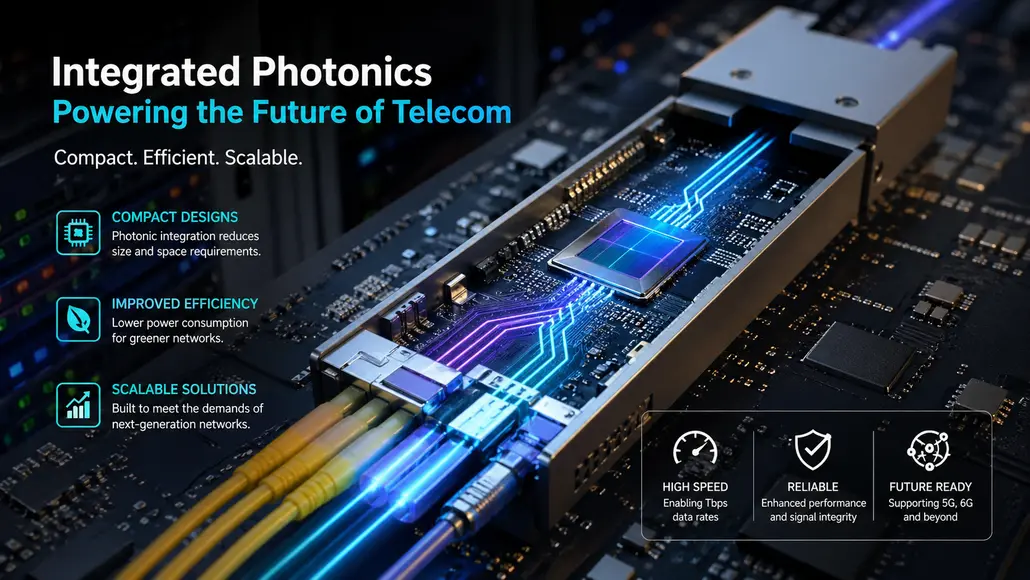
At its essence, integrated photonics is the optical equivalent of the electronic integrated circuit (IC). Instead of transistors and resistors, a Photonic Integrated Circuit (PIC) contains waveguides, lasers, and optical modulators. The ability to manufacture these components on a common substrate allows for a level of precision and density that is impossible to achieve with discrete parts. In the context of integrated photonics telecom applications, this means that a single chip can now perform the work of an entire rack of legacy equipment. This miniaturization is the primary catalyst for the current wave of telecom equipment innovation.
The benefits of optical integration are manifold. Beyond just physical size, integrated devices exhibit significantly lower signal loss and higher reliability. In a discrete system, every connection point between different components is a potential source of failure or signal degradation. By eliminating these “interconnects” and keeping the light within a single chip, PICs provide a much cleaner signal path. This is critical for high speed communication where maintaining the integrity of complex modulation formats is essential for data accuracy. As a result, compact devices powered by integrated photonics are becoming the standard for everything from data center interconnects to long-haul transport systems.
Redefining Efficiency and Scalability in Network Hardware
As data centers and central offices become increasingly power-constrained, the efficiency of networking gear has moved from a secondary concern to a top priority. Legacy telecom equipment is notoriously power-hungry, largely due to the energy required to drive high-speed electrical signals between separate optical components. Integrated photonics solves this by drastically reducing the distances data must travel in the electrical domain. By bringing the “optics to the chip,” energy consumption can be reduced by 30% to 50%. This improved efficiency is not just better for the environment; it is a prerequisite for scaling networks to meet the needs of the 6G era.
Scalability is another area where integrated photonics shines. The manufacturing process for photonic circuits leverages the same mature fabrication techniques used in the semiconductor industry. This allows for the mass production of high-performance optical modules at a fraction of the cost of manually assembled discrete systems. As a result, network operators can deploy more capacity, more quickly, and at a lower cost per bit. This economic shift is fundamental to network innovation, as it allows for the deployment of high-speed fiber in areas where it was previously cost-prohibitive, bridging the digital divide and enabling a more connected global society.
Innovations in Photonic Circuits and Packaging
One of the most exciting areas of telecom equipment innovation is the development of “Co-Packaged Optics” (CPO). In traditional designs, the optical transceiver is a pluggable module that sits at the edge of the switch. While flexible, this approach requires the electrical signal to travel several inches across a printed circuit board, leading to significant energy loss and signal noise. CPO involves mounting the integrated photonics engine directly onto the same substrate as the high-speed switching silicon. This proximity allows for a much more compact device and a dramatic reduction in power consumption.
The shift toward CPO is made possible by breakthroughs in photonic circuits and advanced packaging techniques. Technologies like “2.5D” and “3D” integration allow for the stacking of electronic and photonic chips, creating a multi-layer sandwich of high-performance components. This level of integration ensures that the next generation of telecom equipment is not only faster but also more intelligent. By embedding sensing and monitoring functions directly into the photonic circuit, operators can gain real-time insights into the health of the network, enabling proactive maintenance and more efficient resource allocation.
Global Impact on Network Innovation and Connectivity
The widespread adoption of integrated photonics is having a profound impact on the global telecommunications landscape. By lowering the barriers to entry for high-speed networking, this technology is enabling a more diverse and competitive marketplace for telecom equipment. Smaller, innovative firms can now design and manufacture high-performance optical modules that rival the offerings of traditional industry giants. This democratization of technology fosters a faster pace of innovation, leading to more resilient and efficient networks for everyone.
Furthermore, the compact designs enabled by integrated photonics are perfect for “edge” environments where space and power are at a premium. Small-cell 5G stations, rural broadband hubs, and even satellite communication terminals are all benefiting from the miniaturization of optical components. By bringing high-speed connectivity closer to the end-user, integrated photonics is empowering the next generation of digital services, from autonomous vehicles to remote healthcare, and ensuring that no community is left behind in the digital age.
Conclusion: The Photonic Future of Telecommunications
The transformation of telecom equipment through integrated photonics is a clear signal that the future of networking is light-based. By consolidating complex optical systems into compact, efficient, and scalable chips, we are overcoming the physical and economic limits of the past. This evolution is not just about making hardware smaller; it is about making it more capable, more reliable, and more accessible.
As we look toward the horizon, the continued advancement of integrated photonics telecom will be the engine that drives the 6G revolution and beyond. The synergy between photonic circuits and advanced electronics is creating a new class of “smart” hardware that can adapt to the changing needs of the global population. By investing in the development and deployment of integrated optical solutions today, we are building the foundation for a more connected, efficient, and innovative world tomorrow.