






















Key Takeaways for the 6G Optical Future
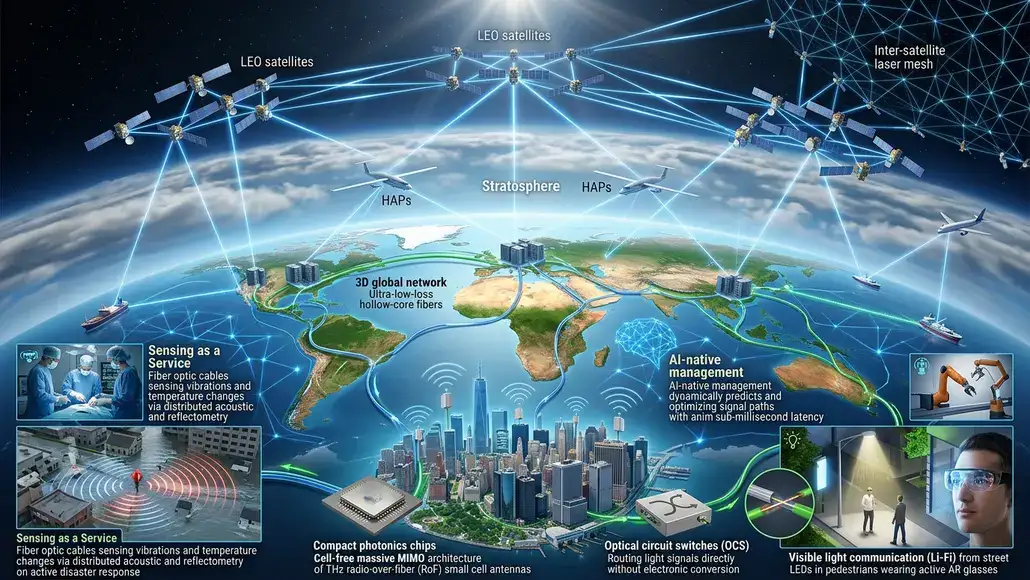
- The first essential takeaway is that 6G is an “AI-native” technology. The complexity of managing a 3D network with THz signals and sub-millisecond latency requirements is far beyond human capability. Advanced optical communication will be managed by deep-learning algorithms that can predict signal degradation caused by atmospheric conditions or network congestion and proactively adjust the optical path. This intelligent autonomy is what will make 6G networks reliable and self-sustaining, providing a seamless user experience regardless of the underlying complexity.
- The second key point is the shift toward “Sensing as a Service.” 6G optical communication systems will not just transmit data; they will also act as a vast environmental sensor. By analyzing the reflections and distortions of light in a fiber optic cable or a laser beam in free space, the network can detect vibrations, temperature changes, and even the movement of people or vehicles. This ubiquitous sensing capability will provide the real-time data needed for smart city management, disaster response, and industrial automation, turning the telecom infrastructure into a comprehensive digital nervous system for the planet.
As the deployment of 5G reaches maturity in many parts of the world, the focus of the global research community has already shifted toward the next horizon: sixth-generation (6G) wireless technology. While 5G revolutionized mobile broadband and industrial IoT, the 6G vision is far more ambitious, aiming to seamlessly blend the physical, digital, and biological worlds. This future-ready connectivity promises data rates in the terabits-per-second range and latencies measured in microseconds. However, these wireless breakthroughs are physically impossible without a concomitant revolution in the optical layer. 6G optical communication is the indispensable backbone that will carry the immense data loads of a truly hyper-connected world.
The Terahertz Gap and the Optical Solution
One of the defining characteristics of 6G is the move into the Terahertz (THz) frequency spectrum. These extremely high frequencies offer massive amounts of bandwidth but suffer from very short transmission distances and are easily blocked by physical objects. To overcome these limitations, 6G technology will rely on a “cell-free” architecture where thousands of small, distributed antennas are connected back to the core network via high-capacity fiber. In this scenario, the optical network is not just a backhaul; it is an extension of the radio system itself, a concept known as Radio-over-Fiber (RoF).
Advanced optical communication techniques, such as photonics-based THz generation, are being developed to bridge the gap between the optical and wireless domains. By using lasers to generate and modulate THz signals directly, researchers can achieve a level of precision and bandwidth that traditional electronic components cannot match. This integration of photonics and wireless innovation is the key to unlocking the ultra fast networks of the 2030s. The 6G vision depends on this “convergence of the air and the glass,” where the distinction between a wireless signal and a light pulse becomes increasingly blurred.
Building a Global 3D Network via Space-Air-Ground Integration
Unlike previous generations, 6G is not limited to the surface of the Earth. The vision for next generation connectivity includes a “3D network” that integrates terrestrial fiber, high-altitude platform stations (HAPS), and low-earth-orbit (LEO) satellite constellations. This ubiquitous coverage is designed to bring high-speed internet to the most remote corners of the planet, as well as to aircraft and maritime vessels. The critical link in this 3D architecture is free-space optical (FSO) communication the use of lasers to transmit data through the atmosphere and the vacuum of space.
6G optical communication in space offers several advantages over traditional radio frequency satellite links. Laser beams are highly directional, allowing for more secure communication and the ability to pack many more data channels into the same region of space without interference. These inter-satellite laser links form a high-speed “mesh” in the sky, capable of routing terabits of data around the globe at the speed of light. When combined with ultra-low-loss terrestrial fiber, this space-air-ground integration creates a resilient and truly global digital infrastructure that is the hallmark of the telecom future.
Enabling the Tactile Internet and Sub-Millisecond Latency
The most demanding applications of the 6G era such as multi-sensory holographic communication and remote precision manufacturing require what is known as the “Tactile Internet.” This refers to a network with latency so low that it can support real-time human-to-machine interaction with a “touch” response. To achieve sub-millisecond end-to-end latency, the optical network must undergo a radical transformation. Traditional packet-switching methods, which introduce delays through buffering and processing, must be replaced by ultra-fast optical circuit switching and bypass technologies.
In a 6G optical communication environment, data will travel through a streamlined architecture designed for speed. By utilizing advanced optical communication materials like hollow-core fibers and leveraging AI-driven predictive routing, the network can minimize the time a data packet spends “in flight.” This responsiveness is what will allow a surgeon in one continent to control a robotic arm in another with the same tactile feedback as if they were in the same room. The 6G vision is about more than just speed; it is about the “democratization of presence,” made possible by the near-instantaneous movement of light.
The Path Toward Sustainable and Future-Ready Infrastructure
As we design the 6G future, sustainability is a core requirement. The energy demands of ultra-fast networks could be catastrophic if not managed correctly. Fortunately, advanced optical communication is inherently more energy-efficient than electronic transmission. The move toward all-optical networking where the signal remains in the form of light for as long as possible is a primary strategy for reducing the carbon footprint of the 6G era. By eliminating the need for energy-intensive optical-to-electronic-to-optical (OEO) conversions, we can build a network that is both more powerful and more environmentally responsible.
Furthermore, the 6G vision includes the use of “Visible Light Communication” (VLC), or Li-Fi, for indoor environments. This technology uses the light from standard LED fixtures to transmit data, providing a high-speed, secure, and energy-efficient alternative to Wi-Fi. By integrating VLC into the broader 6G optical communication ecosystem, we can create an indoor-outdoor seamless experience that maximizes the use of existing infrastructure. This holistic approach to connectivity ensures that the 6G era is defined by intelligent, efficient, and sustainable technological growth.
Conclusion: Lighting the Way to the 2030s
The journey toward 6G is a testament to the relentless human drive for connectivity and innovation. While the wireless aspects of 6G capture much of the public’s imagination, it is the advanced optical communication layer that provides the physical reality for these dreams. From the depths of the ocean to the vacuum of space, the movement of light through glass and air will be the defining force of the next decade of digital transformation.
As we look toward the 2030s, the 6G vision represents a commitment to a world where information is ubiquitous, latency is non-existent, and connectivity is a fundamental human right. By continuing to push the boundaries of what is possible in optical communication, the telecommunications industry is laying the groundwork for a future that is more connected, more intelligent, and more inspired. The era of 6G is not just about a better smartphone; it is about building the infrastructure for the next stage of human evolution.