

















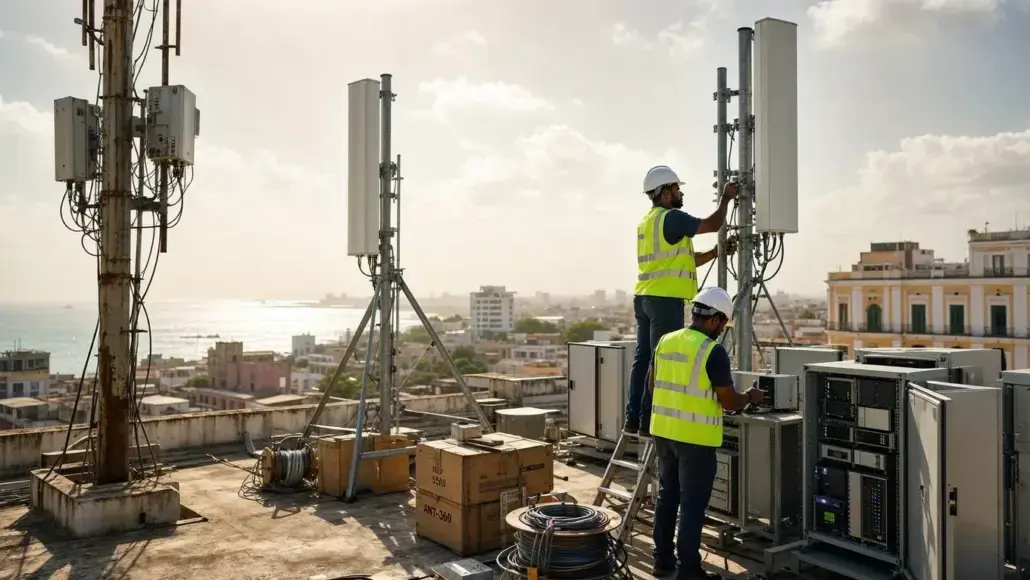

Equatorial Guinea to bolster its digital infrastructure and has gone ahead and launched a sweeping modernization program for GETESA, the state-owned telecom operator and meet the increasing need for connectivity services.
The move is part of an attempt to revitalize the traditional carrier as digitization becomes a national priority.
Charles Borome Razafimahatratra, the new CEO of GETESA, announced a rapid and short-term plan whereby network modernization is an important aspect.
The plan was recently presented to the Vice President of Equatorial Guinea, Teodoro Nguema Obiang Mangue.
A Tech Refresh
With an objective by Equatorial Guinea to bolster its digital infrastructure, the initial phase of the strategy will last 12 months. This involves optimizing the national telecommunications network, broadening mobile as well as internet coverage, and, in general, digitally transforming the business by purchasing modern equipment.
The program also looks forward to reactivating the country’s fibre optic network, which at present has been utilized only by SEGESA, the national electricity company, so as to link its power substations.
Apparently, other important efforts include the introduction of 5G services and the establishment of public Wi-Fi networks throughout the cities of Bata, Malabo, and Oyala and also in rural and urban communities throughout the country.
The strategy also includes regular improvements to the energy as well as technical infrastructure of the company. The other significant aspect is the full digitalization of operations from GETESA with a paperless management system with a view to lowering logistics expenses. The company also plans to introduce a financial platform referred to as Getesa Money, which will offer electronic payment services.
The roadmap also includes restoration of international roaming as well as launching of eSIM technology.
Connectivity problems continue
The modernization effort comes amid significant obstacles for telecommunications network of Equatorial Guinea. Cyberteq, a consulting firm, went ahead and did an audit, the inferences of which were presented in April 2026. It identified quite prominent shortcomings when it came to network speed, equipment, and capacity, as well as technical planning.
The report also cited aging infrastructure along with slow data transmission speeds in addition to dropped calls due to congestion on the network.
Cyberteq presented an itinerary to address these shortcomings by upgrading technology, boosting network capacity, and implementing an investment strategy so as to improve service quality as well as expand coverage, in accordance with the digital transformation goals of the country.
Also in April 2026, Mason, the consulting firm, recommended that Equatorial Guinea connect to the Medusa submarine cable, which would serve as the second international undersea cable of the country. The project will have a price tag of anywhere between €20 million and €60 million, which is equivalent to $23.3 million to $70 million, and aims to minimize internet downtime and improve network reliability and service quality. The infrastructure is anticipated to be fully operational between 2029 and 2030.
A Basis for Digital Transformation
Once repaired and fully operational, the GETESA network could serve as the foundation of the digital transformation strategy of Equatorial Guinea. Better facilities and service quality could speed up the digitalization of the national economy, with connectivity being an essential tool for both the private and public sectors.
When it comes to households, improved connectivity would enhance accessibility to important digital services such as communications, online learning, mobile financial services, and entertainment platforms. Better digital infrastructure would help businesses become more competitive, grow the scope for e-commerce, boost the uptake of cloud-based services, and allow more sophisticated digital management tools to be used.
By the end of 2025, Equatorial Guinea had 885,000 mobile subscribers, with a mobile penetration rate of 45.4%, as reported by DataReportal. The country also had 1.18 million Internet users, or 60.4% of the overall population.