

















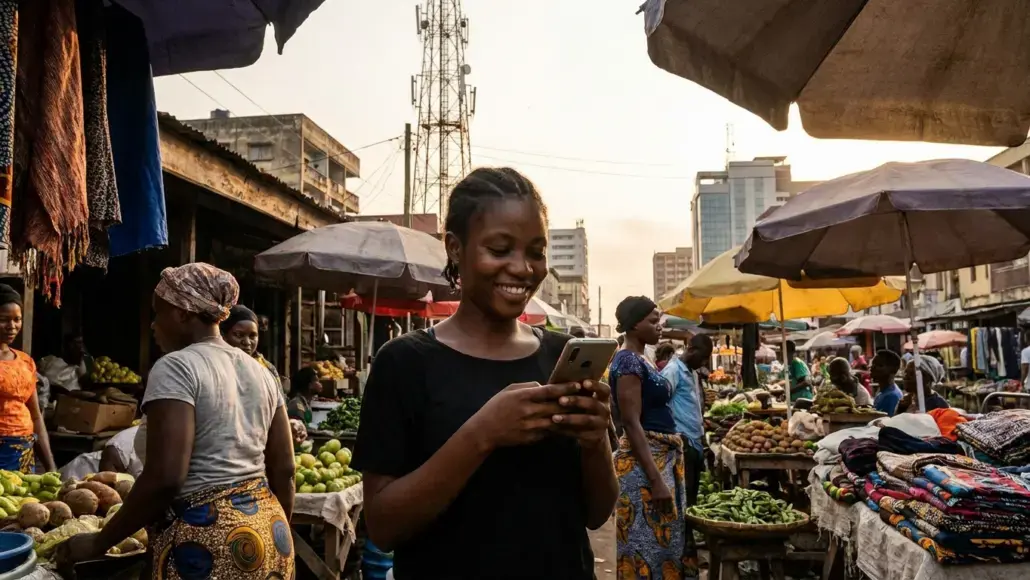

On June 22, 2026, Ericsson said it anticipates Sub-Saharan Africa to be the fastest-growing 5G subscriptions region over the next five years, increasing from almost 30 million in 2025 to approximately 370 million by 2031.
The new edition of the Ericsson Mobility Report predicts that the total number of mobile subscriptions in Sub-Saharan Africa is going to grow from 1.05 billion in 2025 to 1.31 billion in 2031, with 5G subscriptions making up almost 28% of the market by that time.
It is well to be noted that in addition to being fastest-growing 5G subscriptions region, Ericsson also anticipates legacy 2G and 3G networks to contract significantly in that period as 4G and 5G grow more dominant. Of the two, 4G will continue to dominate, with 490 million subscriptions in 2025 expanding to 610 million in 2031 and thereby representing 46% of the market.
It predicts that average monthly data usage per active smartphone in Sub-Saharan Africa will increase from 5.3 GB in 2025 to 12 GB in 2031. The overall mobile data traffic in the region is projected to increase from 2.8 EB per month in 2025 to 9.7 EB per month by 2031.
According to Alain Maupin, VP and head of Ericsson East and North Africa at Ericsson Europe, Middle East and Africa, Alain Maupin, “As digital transformation scales across the continent, the rise of AI and uplink-heavy applications, such as XR and autonomous devices, will fundamentally change traffic patterns.”
The planned roll-out of 4G and 5G is a massive opportunity for the region to accelerate its transition into the AI era, declared VP and head of Ericsson West and Southern Africa, Majda Lahlou Kassi.
He further added that “by transitioning away from legacy networks, we are building the foundation for a vibrant, inclusive digital economy. With the right collaborative investments in spectrum and policy frameworks, Africa is positioned to fully participate in, and benefit from, the AI boom.”
But the distribution as well as adoption of 5G in Sub-Saharan Africa will probably look significantly different. So far, 36 out of the 54 African countries have implemented 5G in some form, although some remain in the pre-commercial stage, and most have coverage restricted to major urban centres, high-traffic hotspots, as well as tourist areas.
The affordability of smartphones continues to be one of the primary obstacles to the adoption of both 4G as well as 5G. The GSMA Handset Affordability Coalition said that smartphones ought to be priced in the US$30-40 range so as to unlock widespread use in developing nations where cost affordability continues to be a major barrier. 3.1 billion people have mobile coverage, but they do not have access to the mobile internet, based on GSMA estimates.
Earlier, Omdia, the consulting group, said that although the smartphone shipments to Africa recorded a 14% year-on-year surge in Q4 2025, the firm anticipates those numbers to drop by 22% in 2026, with low-cost devices especially being hit due to component inflation.
Omdia also pointed out that in certain markets, import duties as well as the cost of living are also impeding the adoption of basic smartphones.