

















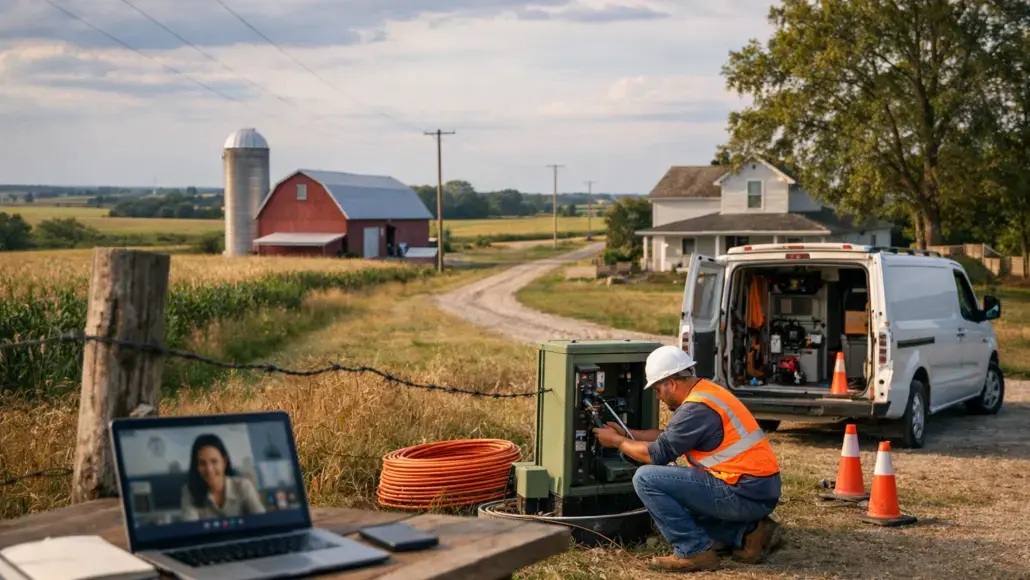

It’s frustrating when video calls buffer at critical moments or the weather knocks out your connection. Remote work, online education and everyday communication demand consistent broadband that broadband struggles to deliver. Limited infrastructure forces rural households and small businesses to accept slower service.
However, rural internet doesn’t have to be slow. As providers expand their networks, fiber internet is changing that reality.
The Rural Broadband Reality
The digital divide affects rural communities more severely than urban centers. Your frustration with limited connectivity options is real it reflects a widespread infrastructure challenge. Geographic distance between properties and smaller customer populations makes network expansion significantly more expensive per connection in rural areas.
This economic reality has left countless households and businesses without access to the high-speed internet that urban residents often take for granted. Of the 2.6 billion people who do not use the internet, 1.8 billion live in rural areas, according to a 2024 study.
The situation closer to home remains equally concerning. In the U.S., roughly 14% of rural households still lack reliable broadband, which disrupts work, school and healthcare access in meaningful ways. Residential customers and small businesses feel the impact when broadband falls short, facing inconsistent connections and limited provider choices that urban internet users rarely encounter.
Why Older Technologies Fall Short
Traditional rural internet options like satellite and DSL can’t keep pace with modern demands because the underlying technology wasn’t designed for today’s bandwidth requirements. DSL speeds also drop significantly for customers farther from the network equipment, while cable systems slow down during peak usage when multiple subscribers share capacity.
The problem runs deeper than aging technology. Rural areas often lack middle-mile infrastructure connecting local internet service providers to the global internet.
Satellite and fixed wireless technologies face their own set of challenges that can affect your connectivity experience. Weather interference disrupts signals, line-of-sight requirements restrict installations and latency creates noticeable delays.
As your household adds more connected devices and bandwidth-heavy applications, your network struggles to keep up. Supporting multiple users who stream content and access cloud applications simultaneously pushes older options past their limits.
How Fiber Optics Solves the Connectivity Crisis
Fiber internet bypasses the fundamental limitations that hold back older technologies by transmitting data as light pulses through glass cables rather than electrical signals through copper wires. This technological difference delivers measurable advantages that directly address the connectivity frustrations rural users face daily.
The key benefits of fiber internet include:
- Superior speed capabilities: Multi-gigabit performance exceeds that of older technologies.
- Consistent reliability: Underground fiber infrastructure remains protected from weather conditions that disrupt satellite signals or damage aboveground copper lines.
- Symmetrical performance: Equal upload and download speeds make fiber ideal for video conferencing and file sharing.
- Multi-device support: Ample bandwidth lets all your connected devices operate simultaneously without prioritization.
Top Fiber Internet Providers for Rural Areas
Several providers have made significant investments in bringing fiber connectivity to rural communities. Your available options depend heavily on your location, but these companies demonstrate a commitment to expanding access beyond traditional urban markets.
1. Highline
Highline is a top choice for rural fiber internet by focusing specifically on bringing reliable high-speed connectivity to communities in Michigan, Texas, Colorado, Kansas, Georgia and Nebraska. By running fiber directly to each home, the company delivers true end-to-end performance with symmetrical multi-gigabit upload and download capabilities.
Its mesh wifi technology extends coverage throughout your property while built-in security features safeguard your connection. The same infrastructure handles voice service without separate copper lines, and high-speed connectivity makes streaming as convenient as cable.
Key Features:
- True fiber-to-the-premises: Direct fiber running to your property eliminates bottlenecks from networks that stop at neighborhood nodes.
- Symmetrical multi-gigabit speeds: Equal upload and download performance supports video conferencing and file sharing without compromise.
2. Kinetic
Kinetic operates across 18 states, offering fiber connectivity to rural customers throughout a broad geographic footprint. The company’s upper-tier fiber plans can support simultaneous remote work and bandwidth-heavy business activities without slowdowns. Small businesses can also gain access to fiber and connectivity services through Kinetic Business, which delivers solutions tailored to commercial needs.
Network security protections are built into the service to guard against threats while maintaining consistent performance across all applications. This multi-state availability increases the likelihood that rural properties can find fiber service even in areas where regional providers have limited reach.
Key Features:
- Multi-state availability: Coverage spanning 18 states increases your chances of finding fiber at your address.
- Business-focused solutions: Kinetic Business delivers connectivity services tailored to small-business operations.
3. B4RN
B4RN takes a unique community-led approach to bringing gigabit fiber to hard-to-reach rural areas in the UK. Local stakeholders actively participate in building and maintaining the network, giving them a direct voice in expansion decisions that affect their communities.
This model demonstrates how local involvement can overcome the infrastructure challenges that prevent traditional providers from serving remote properties. The organization’s full-fiber architecture also creates direct connections to each property, which makes outdated copper infrastructure irrelevant while delivering connections without restrictive data allowances.
Key Features:
- Community ownership model: Local stakeholders drive network expansion and participate in infrastructure decisions affecting their areas.
- Unlimited data access: No restrictive caps mean you can use bandwidth freely, without tracking usage or incurring overage charges.
Frequently Asked Questions About Rural Connectivity
Common questions reflect practical concerns when evaluating connectivity and comparing providers.
How do you find fiber internet providers in rural areas?
Start by using provider availability tools and broadband coverage maps to identify which services reach your address. Don’t limit yourself to nationwide providers. Local and regional networks may offer options that broader searches miss.
Is fiber internet better than satellite for rural areas?
Most metrics for modern internet usage favor fiber over satellite. Speed represents the most obvious advantage, as wired connections deliver consistently faster performance. Unlike satellite, they can provide symmetrical download and upload speeds.
While extremely remote properties may still need satellite connectivity, the superior choice becomes clear when both options are available.
How much internet speed do rural homes and businesses need?
The number of users, connected devices and simultaneous activities determines appropriate speeds. Bandwidth requirements increase substantially when multiple people stream video and join calls simultaneously. Small businesses face higher demands, as video meetings and file transfers require robust upload performance.
Actual usage patterns will reveal whether entry-level speeds suffice or higher tiers make sense.
Ready to Upgrade Your Rural Internet?
Rural communities and businesses deserve the same quality internet access as their urban counterparts, and checking which networks currently reach your address represents a practical first step toward better connectivity.
As fiber internet infrastructure grows across underserved regions, more households and businesses will gain access to the dependable connectivity they need for digital work and everyday life.