














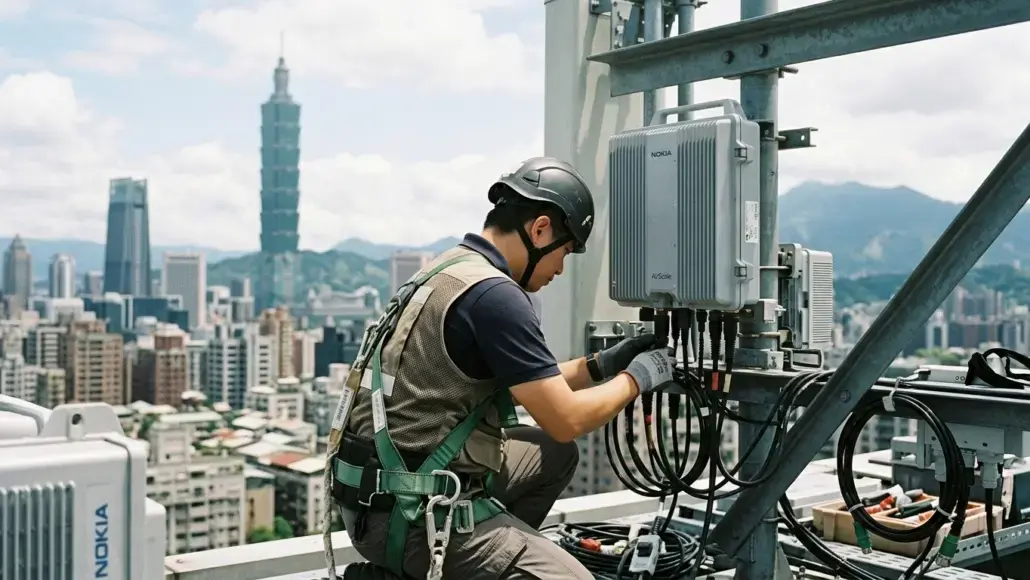

Nokia has signed a 5G expansion agreement with Taiwan Mobile to advance AI-native 5G networks throughout Taiwan. The collaboration strengthens Nokia’s position as a strategic partner while supporting Taiwan Mobile’s goals for improved network performance, automation and sustainability.
Under the agreement, Nokia will deploy its latest AirScale portfolio, including next-generation baseband, radio solutions and advanced software. The deployment is intended to strengthen Taiwan Mobile’s network infrastructure, support the introduction of new 5G services and create new revenue streams. Both companies are working to integrate artificial intelligence across mobile networks in order to build automated, resilient and energy-efficient systems capable of handling growing AI-driven traffic.
AI capabilities across the network lifecycle
The expansion introduces AI-driven capabilities covering network intelligence, infrastructure, sustainability and resilience. For AI for Network (Intelligence), Nokia will deploy AI-powered software for real-time automation and predictive analytics. These capabilities are designed to improve operational efficiency and enable closed-loop network assurance.
The agreement includes Predictive Hardware Analytics (PHWA) and the self-organizing network solution MantaRay SON. MantaRay SON uses AI algorithms to automate operations and enhance performance. This part of the deployment is expected to help Taiwan Mobile improve the management of AI-native 5G networks while reducing operational complexity.
For Network for AI (Infrastructure), Nokia’s next-generation baseband and advanced radio solutions will increase network capacity and enhance uplink performance. The infrastructure is intended to accommodate emerging AI-driven traffic profiles and deliver enhanced user experiences.
Automation, performance and advanced 5G services
The agreement will expand 5G capacity and optimise network performance through advanced radios and next-generation baseband solutions. These enhancements are expected to increase throughput, improve spectrum efficiency and provide premium user experiences.
AI-driven network management and automation will support predictive maintenance, lower total cost of ownership and reduce operational complexity. The deployment will also support advanced 5G capabilities such as network slicing and Reduced Capability (RedCap). By combining network automation with upgraded radio and baseband technology, the companies are aiming to improve how AI-native 5G networks respond to evolving traffic and service needs.
Sustainability and network resilience
For AI for Energy (Sustainability), advanced AI-powered energy management will provide traffic-aware optimisation and proactive power savings. This is intended to help Taiwan Mobile reduce energy consumption and achieve its ESG objectives.
AI for GeoStrategy (Resilience) will use AI-enabled self-healing and traffic steering to improve network resilience. These functions will allow dynamic adaptation to changing conditions and maintain service continuity in extreme scenarios.
Nokia’s energy-efficient hardware and AI-driven software will support more sustainable network operations and lower power consumption. These measures align with the building operator’s objective of establishing a low-carbon, efficiency-improving network while enhancing overall performance.