Open RAN is entering a more commercially focused phase as operators move selected deployments beyond laboratory testing and limited field trials. The technology was initially promoted around open interfaces, virtualised network functions and the ability to separate hardware and software components. As those technologies mature, the central question is shifting from whether Open RAN can work to whether it can deliver the reliability, performance and operational consistency required in live commercial networks.
The latest deployment data shows that transition is underway, although it remains gradual. Industry tracking for 2025 recorded 18 commercial launches, 26 deployments and 80 trials across the markets covered. Trials therefore remained the largest category, accounting for roughly two-thirds of the combined activity, while commercial launches represented less than one-sixth. The figures indicate that open RAN adoption is moving toward commercial operation, but the market has not yet reached a point where commercial deployment dominates industry activity.
Commercial Deployment is Becoming a More Important Test
The distinction between a trial and a commercial deployment is significant. Trials can focus on interoperability, technical performance or specific use cases under controlled conditions. Commercial networks introduce additional requirements around availability, traffic management, maintenance, security and integration with existing network systems.
That is making brownfield deployment increasingly important. Early Open RAN activity was concentrated heavily around new or greenfield networks, where operators had greater freedom to design the architecture from the beginning. The next stage involves integrating open components into established networks while maintaining existing service levels. This places greater emphasis on interoperability and lifecycle management across multiple network components.
The O-RAN ALLIANCE is continuing to develop specifications aimed at supporting commercial 4G and 5G deployments. Its Release 5, completed in 2026, added capabilities covering AI/ML workflows, massive-MIMO optimisation, network energy savings and O-Cloud management. The organisation describes its specifications as being designed for implementation in commercial networks worldwide.
The continued development of these specifications reflects an important change in the open RAN adoption cycle. Industry efforts are increasingly focused on making open architectures easier to integrate, operate and scale rather than simply demonstrating individual technical components.
Performance Remains Critical to Scaling
Commercial progress, however, does not mean that the industry’s adoption challenges have disappeared. GSMA Intelligence’s 2025 Network Transformation Survey found that 22% of operators were in the initial phases of deploying open networking technologies including Open RAN, compared with 21% in 2019. The limited change over that period highlights how much slower adoption has been than some earlier expectations suggested. GSMA Intelligence also identified network performance as a significant factor limiting wider adoption.
This makes performance validation one of the defining requirements for the next phase. Operators need to establish that open components can maintain throughput, coverage, mobility performance and service reliability under real-world network conditions.
The industry’s testing infrastructure is evolving alongside these requirements. The Spring 2026 O-RAN Global PlugFest involved 13 operators, Open Testing and Integration Centres and other institutions across nine laboratories, with 31 companies and institutions participating. Testing covered multi-vendor end-to-end integration, massive-MIMO technologies, network efficiency and open-source software.
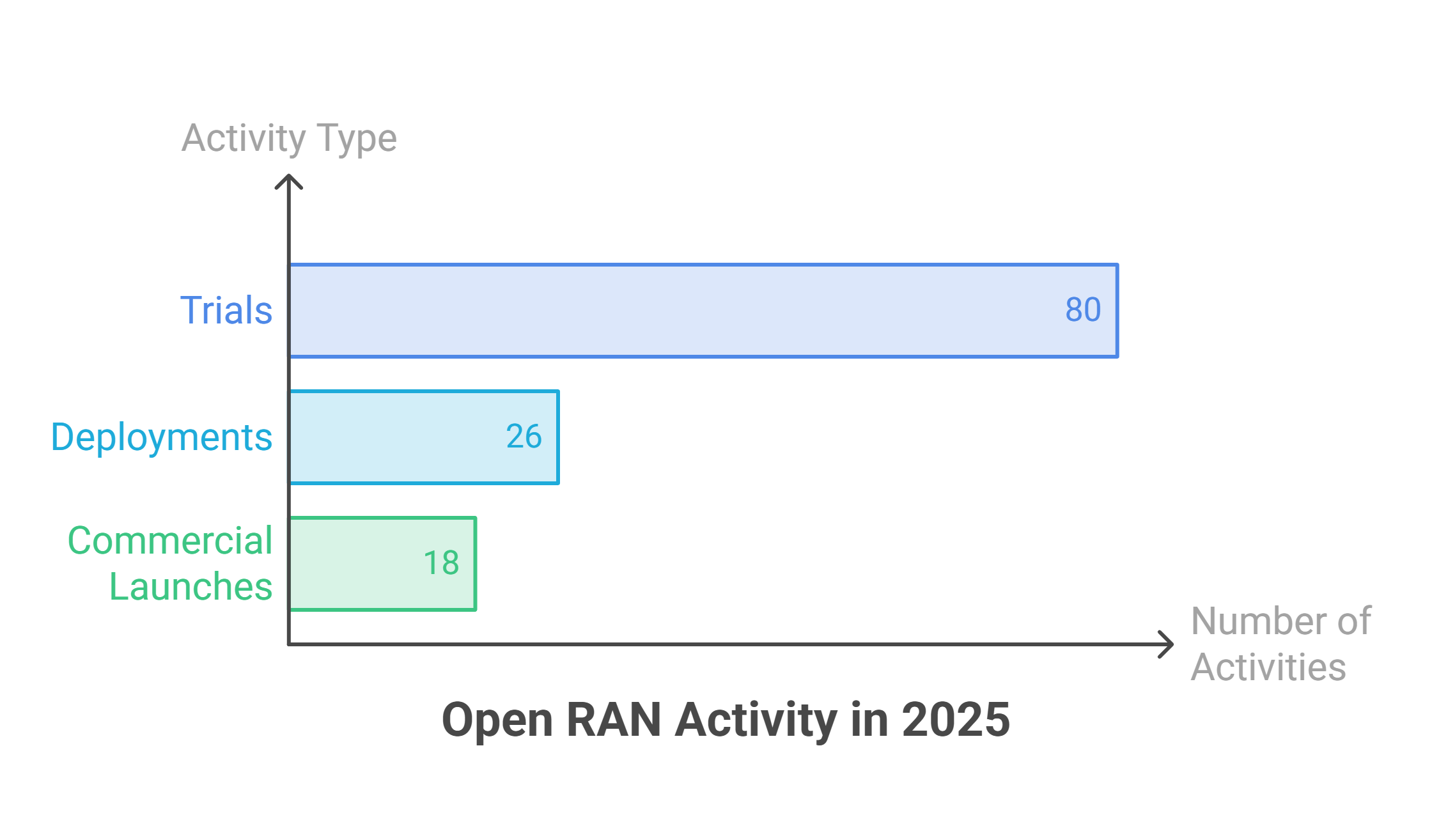
Key Takeaway: Commercial Open RAN deployments are becoming established, but trials still account for the majority of tracked activity, showing that adoption is progressing toward commercial scale rather than having fully reached it.
The direction of travel is therefore becoming clearer. Open RAN adoption has moved beyond a technology defined almost entirely by trials, but commercial scale remains selective. The next stage will depend on whether operators can demonstrate reliable performance, integrate open components into existing networks and justify the technology through operational and economic results rather than technical capability alone.
Commercial Scaling is Testing Open RAN’s Business Case
Moving from trials into commercial networks is changing the questions operators need to answer. Technical interoperability remains important, but wider deployment also depends on network performance, operating costs, integration requirements and the ability to manage increasingly complex multivendor environments. This is making open RAN adoption less about proving technical feasibility and more about demonstrating that open architectures can deliver consistent results at commercial scale.
One of the main challenges is the transition from isolated deployments to larger network footprints. Commercial operators need Open RAN components to work alongside existing radio and core infrastructure while maintaining service continuity. This creates additional requirements around orchestration, network management, software updates and fault resolution. The more vendors and software components involved, the more important interoperability becomes across the full operational lifecycle rather than only during initial integration.
The industry’s continued investment in testing reflects that challenge. The Spring 2026 O-RAN Global PlugFest brought together 13 operators, testing and integration organisations and other institutions across nine laboratories, with 31 participating companies and institutions. Testing included multi-vendor end-to-end integration, massive-MIMO systems, network efficiency and open-source software.
Performance and Economics are Shaping Commercial Decisions
Performance remains one of the biggest conditions for scale. GSMA Intelligence has identified network performance as a significant factor holding back wider Open RAN deployment, highlighting concerns around whether the technology can consistently meet the requirements of established mobile networks. Its 2025 survey also found that 22% of operators were in the initial phases of deploying open networking technologies including Open RAN, only marginally above the 21% recorded in 2019.
That relatively limited change is significant. It suggests that commercial progress has not translated into a rapid shift across the wider operator base. Instead, deployment decisions are increasingly being made on a selective basis, with operators evaluating where the architecture can deliver a measurable advantage.
The economic case is particularly important. Open RAN was initially associated with expectations of greater supplier diversity and lower costs, but industry analysis has shown that these benefits are not automatic. Integration, testing, software management and multivendor operations can introduce additional complexity, meaning the total cost of ownership has to be assessed across the entire network lifecycle rather than through equipment pricing alone.
This is making open RAN adoption increasingly dependent on operational evidence. Operators need to determine whether open architectures can provide sufficient flexibility without creating costs elsewhere in the network.
Brownfield Networks are the Next Commercial Test
The next phase is likely to be particularly influenced by brownfield deployment. Existing networks contain established hardware, software, management platforms and operational processes, making large-scale replacement difficult. Open RAN components therefore need to coexist with legacy infrastructure while gradually increasing the proportion of network functions that can be virtualised or separated.
That creates a different technical challenge from a greenfield deployment. Instead of building an open architecture from the beginning, operators need migration strategies that minimise disruption and allow different generations of infrastructure to operate together.
The commercial significance of this shift is considerable. As deployments expand, network operators will need stronger orchestration and automation capabilities to coordinate radio units, distributed units, centralised units and cloud infrastructure. Open interfaces can create greater flexibility, but that flexibility also increases the number of relationships that need to be managed.
The role of software therefore becomes more important as open RAN adoption progresses. Network functions can be updated through software, while automation and intelligence can increasingly influence how resources are allocated and how faults are handled. The O-RAN architecture’s development around the RAN Intelligent Controller is reinforcing this direction, with newer specifications expanding support for AI and machine-learning workflows.
This creates a bridge between Open RAN and the broader development of AI-RAN. Once commercial networks contain sufficiently open and programmable infrastructure, software can take a larger role in optimisation, energy management and real-time network control.
The commercial transition is therefore becoming more selective and more demanding. Open RAN adoption will depend not only on whether individual components meet technical requirements, but on whether complete network environments can deliver reliable performance, manageable operating costs and scalable software-driven operations. The market is moving beyond the question of whether Open RAN works and toward the more difficult question of where it delivers enough value to justify deployment at scale.
Open RAN is Entering a More Selective Commercial Phase
Open RAN is moving beyond an ecosystem defined primarily by trials, but commercial adoption remains gradual. The next stage will depend less on demonstrating interoperability in controlled environments and more on proving reliable performance, manageable operating costs and effective integration with existing networks.
For operators, the decision is increasingly about where open architectures can deliver measurable value rather than whether the technology can work at all. Larger commercial deployments will also place greater importance on orchestration, automation and software-driven network management.
The open RAN adoption trend is therefore entering a more selective phase. Commercial deployments are likely to expand where performance, economics and operational flexibility can be demonstrated at scale, while the wider transition will depend on how effectively the industry addresses the remaining barriers to deployment.