
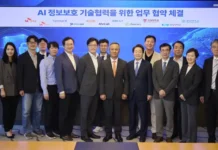














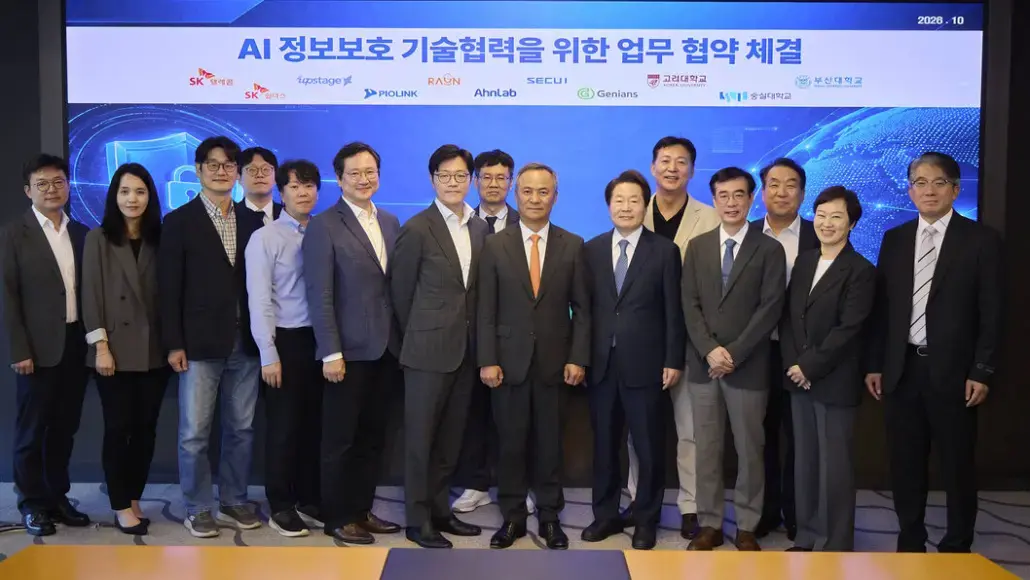

SK Telecom and Upstage have launched an independent AI cybersecurity council alongside six domestic information security companies and three universities, bringing together 11 organisations to advance AI-based cybersecurity technology in South Korea. The two companies also signed a business agreement for cooperation on AI information security technology. The signing ceremony took place at SKT Tower in Jung-gu, Seoul.
The AI cybersecurity council includes SK Telecom and Upstage, information security companies SK Shields, SecuI, AhnLab, RaonSecure, Genians and Piolink, and three academic institutions: Korea University, Soongsil University and Pusan National University.
- A total of 11 organisations participate in the AI cybersecurity council
- SK Telecom’s AX K series and Upstage’s Solar are the two AI models involved
- Participating companies contribute security operational data covering malware analysis, vulnerability analysis and security monitoring
- Training proceeds through pre-training and post-training stages
- Universities provide independent third-party evaluation of model performance and safety
Developing AI Models with Real-World Security Data
The central objective of the council is to expand AX K and Solar into the cybersecurity sector. To achieve this, the two models are being developed using security operational data contributed by participating companies. This data spans areas such as malware analysis, vulnerability analysis and security monitoring.
During pre-training, foundational security knowledge is built into the models. In the post-training stage, job-specific data from security operations is used to enhance real-world task performance. Security tasks targeted through this process include software vulnerability analysis and patching, security control centre incident response and the safe utilisation of security tools.
Participating companies are contributing threat intelligence, malware analysis data, security solution operation experience and other field expertise. SK Shields, for example, analyses 17 billion threat events per day in real time through its Secudium platform. AhnLab brings more than 2.5 PB of security data along with malware and endpoint threat detection technology.
Participating companies plan to apply AX K and Solar to security products and services, including zero-day vulnerability analysis and real-time security monitoring. Analysis and response cases identified during validation will be fed back as training data, creating a cycle of data acquisition, model training and performance verification.
Validation Through Red-Teaming and University Assessment
The AI cybersecurity council has adopted a process of mutual red-teaming, in which AX K and Solar attack and evaluate each other to identify vulnerabilities. Weaknesses discovered through this process can be used as training data to strengthen the defensive capabilities of both models.
- Korea University verifies executable file analysis capabilities and defence against attacks
- Soongsil University verifies AI security performance evaluation criteria and response to guardrail bypass attacks
- Pusan National University verifies performance and safety of next-generation and lightweight models
Yoo Kyung-sang, Head of SKT’s AI CIC, said, “The level of security AI ultimately depends on how broadly and deeply a model can reason,” adding, “We will demonstrate the effectiveness of national representative AI models in the cybersecurity domain by proving the effectiveness of models validated in our proprietary AI Foundation Model Project in real-world security settings, in collaboration with leading domestic information security companies and universities.”
The participating organisations plan to identify joint research projects and review participation in AI and information security projects through regular technical exchanges. The AI cybersecurity council remains open to future participation from additional information security companies, universities, research institutes and AI firms.