























Open RAN is changing how radio access networks are designed by separating functions that were traditionally delivered as tightly integrated systems. Radio units, distributed units and centralised units can increasingly be deployed as separate components, creating greater flexibility in how network functions are built and managed. This architectural shift is also increasing the importance of cloud infrastructure, as software-based RAN functions require computing environments capable of supporting distributed workloads.
This is where cloud native Open RAN becomes relevant. Rather than tying network functions permanently to specialised hardware, cloud-native architectures allow software to operate across commercial computing infrastructure. The approach can support more flexible deployment, software-based upgrades and the sharing of computing resources across different workloads. It also brings practices developed in the broader cloud industry, including containerisation, orchestration and automated lifecycle management, into the RAN environment.
The market opportunity is becoming more visible, although the transition is not happening at the same pace across all networks. Dell’Oro projected that Cloud RAN could account for nearly 25% of the total RAN market by 2029. At the same time, the research firm has continued to highlight performance, power consumption and cost-parity challenges as factors influencing adoption. This suggests that moving RAN functions onto cloud infrastructure is not simply a matter of replacing dedicated hardware with commercial servers. The underlying infrastructure must still meet the demanding requirements of carrier-grade networks.
Virtualisation is Changing the RAN Infrastructure
In conventional RAN environments, processing functions are closely associated with purpose-built equipment. Virtualisation separates software from that dedicated hardware, allowing network functions to operate on standardised computing platforms. Cloud-native architectures take this further by treating those functions as software workloads that can be deployed, managed and updated through common cloud-native tools.
Kubernetes is becoming an important part of this shift. The Cloud Native Computing Foundation identifies Kubernetes as a key platform for cloud-native network functions, while the O-RAN software ecosystem is increasingly using Kubernetes-based tools to deploy and manage components of the RAN architecture. This brings capabilities such as automated deployment, workload scheduling, scaling and recovery into an environment that has traditionally relied more heavily on specialised network hardware.
The change also affects infrastructure planning. Computing capacity can potentially be distributed between locations depending on the requirements of each RAN function. Some workloads may need to remain close to the network edge because of latency or processing requirements, while others can be handled in more centralised facilities. This creates greater flexibility, but it also makes infrastructure placement an important engineering decision.
Deployment Models are Becoming More Flexible
Cloud-native infrastructure allows operators to consider different ways of distributing RAN workloads across the network. Processing can be positioned closer to radio sites, within regional facilities or in larger centralised data-centre environments depending on traffic patterns, latency requirements and available computing resources.
This flexibility is particularly relevant as operators manage networks with very different levels of traffic and capacity demand. A heavily loaded area may require additional computing resources, while a lower-demand location may not need the same level of dedicated infrastructure. Software-based deployment can potentially make these resources more adaptable than fixed hardware architectures.
The O-RAN architecture is also developing around the concept of the O-Cloud, which provides the infrastructure environment for cloud-based RAN functions. O-RAN specifications include the O2 interface for cloud infrastructure management and workload orchestration, reinforcing the role of cloud infrastructure as a distinct layer within the RAN architecture.
This changes the strategic role of computing infrastructure. It is no longer simply the hardware underneath the network. It becomes part of the mechanism through which RAN functions are deployed, scaled and managed.
Cloud Native Open RAN therefore represents more than the virtualisation of existing network functions. It points toward a deployment model in which software, compute and network resources can be managed with greater flexibility. The potential benefits include faster deployment, more adaptable resource allocation and greater separation between network software and hardware. However, the ability to deliver those benefits at carrier scale will depend on whether cloud-native infrastructure can meet the performance, energy and cost requirements of modern mobile networks.
Cloud Infrastructure is Increasingly Shaping Open RAN Deployment Choices
The move toward cloud-native infrastructure is changing how operators think about the location, capacity and management of RAN workloads. Rather than treating compute as a fixed resource attached to network equipment, cloud architectures allow processing functions to be distributed across different infrastructure layers. This is making cloud native Open RAN increasingly dependent on decisions around compute placement, workload orchestration, performance and infrastructure economics.
The market outlook shows why this transition is attracting attention. Dell’Oro projected that Cloud RAN could approach 25% of the total RAN market by 2029, although its later assessment reduced the near-term outlook because of continuing challenges around performance, power consumption and cost parity with purpose-built RAN. The distinction between long-term potential and short-term adoption is important. Cloud-native infrastructure may offer greater flexibility, but operators still need to demonstrate that this flexibility can be delivered without creating unacceptable trade-offs in network performance or operating costs.
Distributed Compute is Creating New Deployment Models
One of the biggest changes is the ability to distribute workloads across different locations. RAN functions can potentially operate closer to the radio site, within regional edge facilities or in larger centralised data centres. The choice depends on factors such as latency, processing requirements, traffic levels, transport connectivity and available computing capacity.
This makes infrastructure placement a more important part of network design. Functions requiring rapid processing may need to remain closer to the network edge, while workloads with less demanding latency requirements can potentially be consolidated elsewhere. Operators can therefore evaluate infrastructure based on workload characteristics instead of applying the same deployment model across the entire network.
The O-RAN architecture supports this approach through the O-Cloud concept, which provides the infrastructure environment for cloud-based network functions. The O2 interface is designed to support infrastructure management, deployment and lifecycle operations, creating a distinct management layer between RAN applications and the underlying cloud infrastructure.
Kubernetes is Becoming Part of RAN Operations
The cloud-native approach also changes how network software is deployed and maintained. Containerisation allows individual functions to be packaged as software workloads, while Kubernetes can provide the orchestration layer needed to deploy, monitor, scale and recover those workloads.
This is particularly relevant as RAN environments become more disaggregated. A network may contain software components from different sources, running across different computing environments. Managing those components manually would increase operational complexity, making automated lifecycle management increasingly important.
The O-RAN Software Community has been incorporating Kubernetes-based capabilities into its software projects, including tools for deploying and managing RAN Intelligent Controller components. The Cloud Native Computing Foundation has similarly positioned Kubernetes as a key environment for cloud-native network functions, reflecting the broader convergence between telecom infrastructure and cloud software practices.
This convergence creates potential benefits around faster deployment and software updates, but it also introduces additional operational requirements. Telecom workloads cannot simply inherit assumptions from conventional enterprise cloud environments. Carrier-grade networks require high availability, predictable latency, synchronisation and efficient resource use.
Performance is Limiting How Quickly Cloud RAN Can Scale
This is where the commercial challenge becomes clearer. Cloud RAN can increase infrastructure flexibility, but general-purpose computing does not automatically deliver the same processing efficiency as purpose-built RAN equipment. Dell’Oro has identified performance, power and cost parity as important constraints on adoption, suggesting that the infrastructure model must mature alongside the software architecture.
Operators therefore have to consider the full infrastructure stack. CPU and GPU selection, hardware acceleration, workload placement, energy consumption and cooling requirements can all influence the economics of a cloud-native deployment.
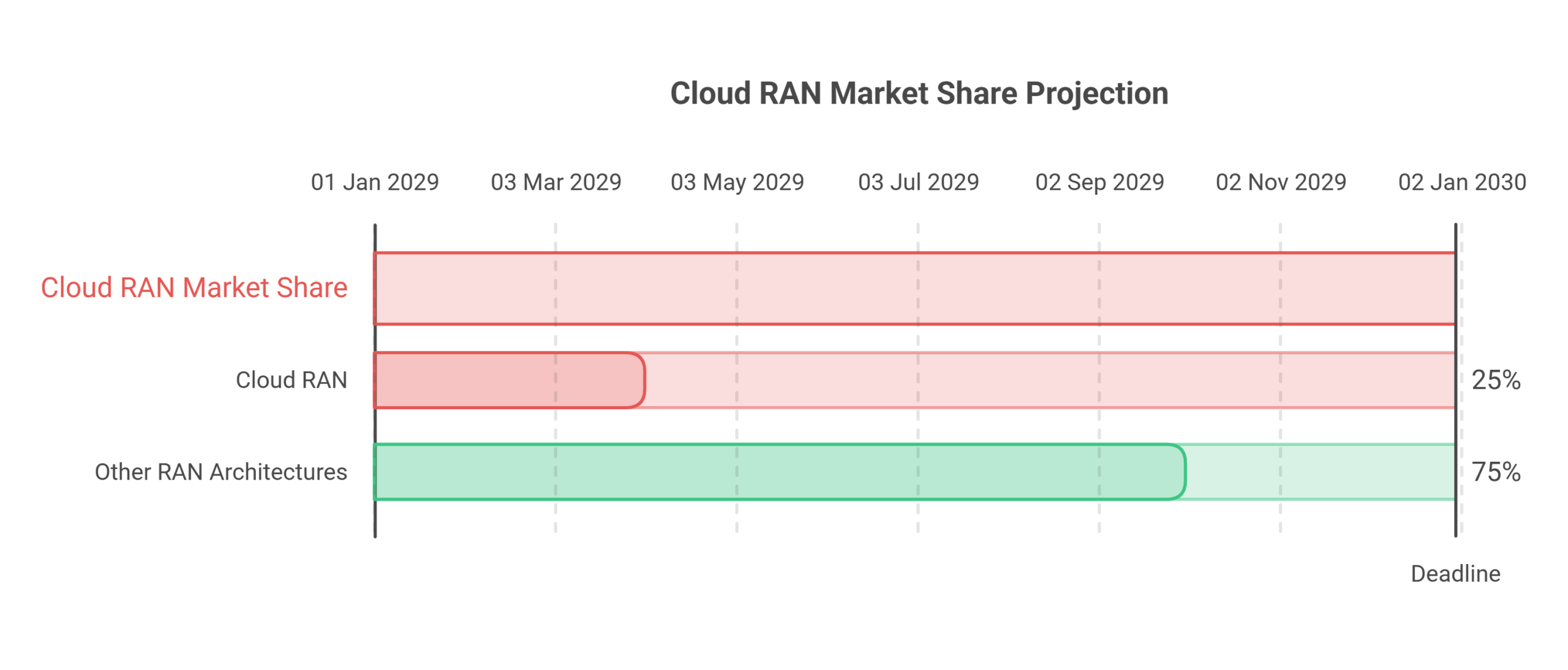
Key Takeaway: Cloud RAN could represent a meaningful share of the RAN market by 2029, but performance, power and cost considerations are likely to influence how quickly cloud-native deployment expands.
The result is a more complex deployment decision for operators. Cloud native Open RAN can create greater flexibility in how network workloads are distributed, but that flexibility has to be balanced against latency, energy efficiency, processing performance and infrastructure cost. As these trade-offs are better understood, cloud native Open RAN is likely to develop through a mix of deployment models rather than a single universal architecture.
The broader shift is therefore not simply from hardware to software. Cloud Native Open RAN is creating a new infrastructure layer in which compute resources, network functions and orchestration systems increasingly need to work together as a single operational environment.
Cloud Native Infrastructure is Reshaping Open RAN Deployment Models
The shift toward cloud-native infrastructure is changing Open RAN from a hardware-led deployment model into a more distributed software environment. Operators can increasingly separate network functions from dedicated hardware and place workloads across edge, regional and centralised computing infrastructure according to performance and capacity requirements.
However, flexibility comes with new demands around orchestration, energy efficiency, latency, hardware acceleration and operational management. The commercial value of the architecture will therefore depend on how effectively operators balance these factors rather than simply how far they can virtualise the RAN.
Cloud native Open RAN is ultimately creating a more adaptable deployment foundation for telecom networks, while also establishing the infrastructure needed for greater automation and the future integration of AI-driven network functions.