





















The development of AI RAN is changing the role software plays across radio access networks. Traditional RAN architecture has relied heavily on purpose-built hardware, with software functions closely tied to the equipment on which they run. Open and virtualised architectures have separated those layers, allowing network functions to become more programmable. The addition of artificial intelligence is taking that shift further by giving software a greater role in deciding how network resources are used and how network behaviour is adjusted.
This is creating a broader opportunity for AI RAN software across functions that were previously dependent on fixed algorithms and hardware-specific implementations. Software can increasingly manage areas such as traffic prediction, radio resource allocation, energy optimisation, anomaly detection and network performance. The change is significant because a new capability can potentially be introduced through software without requiring a complete replacement of the underlying physical network.
The market opportunity is becoming substantial. Dell’Oro forecasts approximately $35 billion in cumulative AI RAN revenue between 2026 and 2030. The research expects the early AI RAN market to be led primarily by AI used to improve existing RAN functions rather than by large-scale GPU based infrastructure dedicated to running both AI and network workloads. This suggests that the initial expansion of AI RAN is likely to happen through software capabilities integrated with existing network architectures.
Software is Becoming a More Flexible RAN Layer
The O-RAN architecture is helping establish the technical framework for this change. The Non Real Time RAN Intelligent Controller and Near Real Time RAN Intelligent Controller provide environments in which software applications can interact with RAN data and influence network behaviour. The architecture also supports rApps and xApps, creating a more modular application layer around network functions.
The O-RAN Alliance’s 2026 Release 5 expanded support for AI and machine learning workflows between the two RAN Intelligent Controller environments. The specification work also added capabilities related to massive MIMO optimisation and energy saving, demonstrating that software based intelligence is being incorporated into multiple areas of RAN operation.
This creates a different model for network evolution. Instead of relying entirely on a hardware refresh to introduce new functionality, operators can increasingly add or update software applications that work with existing infrastructure. The practical impact will depend on interoperability, computing capacity and the ability to validate software changes safely, but the underlying architecture makes more incremental upgrades possible.
The importance of AI RAN software also extends to network lifecycle management. AI models and applications can require regular updates as network conditions change, new data becomes available and model performance evolves. This means software management increasingly includes model training, validation, deployment and monitoring alongside conventional version control.
That development is making software a more strategic component of the RAN. The value of the network is no longer determined solely by the radio hardware, processing equipment or spectrum environment. Increasingly, the software running across those elements can determine how effectively available resources are used.
From Hardware Upgrades Toward Software Driven Evolution
This does not mean that hardware is becoming irrelevant. AI workloads still require computing resources, radio networks still depend on physical infrastructure and real time functions can require specialised acceleration. Instead, the balance between hardware and software is changing.
Nokia’s AI RAN architecture, for example, supports AI capabilities across different deployment models, including AI acceleration added to existing baseband infrastructure and cloud native approaches using commercial computing platforms. This reflects a broader industry effort to introduce intelligence without requiring every network to adopt an identical hardware architecture.
The resulting shift is toward a RAN where software can increasingly determine how infrastructure behaves. AI RAN software can become an upgrade mechanism, an optimisation layer and a source of network differentiation, making software capability increasingly important alongside the physical equipment that supports it.
Software is Expanding Across the RAN Value Chain
The growing role of software is becoming visible across more layers of the radio access network. RAN Intelligent Controllers, rApps, xApps, cloud platforms and machine learning systems are creating additional software interfaces between network infrastructure and the applications used to manage it. This is expanding AI RAN software beyond individual optimisation functions and toward a broader layer that can influence network configuration, resource management, energy performance and lifecycle operations.
The O-RAN architecture is central to this development. The Non Real Time RAN Intelligent Controller and Near Real Time RAN Intelligent Controller allow applications to operate at different timescales, while rApps and xApps can use network data to influence specific optimisation tasks. The O-RAN Alliance’s Release 5, completed in 2026, expanded AI and machine learning workflow services across these environments and added capabilities related to massive MIMO optimisation and energy saving.
APIs are Creating a More Programmable RAN
The growing number of software interfaces is also changing how network capabilities are developed. Rather than every function being embedded into the same software stack, applications can increasingly interact with RAN data and management systems through standardised interfaces.
The O-RAN Alliance’s 2026 specification work includes expanded AI and machine learning model training and deployment APIs, alongside continued development of interfaces connecting applications with the Service Management and Orchestration environment. These developments are intended to support a wider ecosystem of applications and make software lifecycle management more structured.
This creates the possibility of a more modular approach to network upgrades. A new software capability can potentially be tested, validated and introduced without replacing the entire physical RAN. The commercial value of that model depends on interoperability and computing resources, but it can shorten the path between developing a new feature and introducing it into an operating network.
The shift is also creating new requirements around software lifecycle management. AI models are not static software packages. They can require retraining, validation, monitoring and controlled redeployment as network conditions and data patterns change. That means operators increasingly need to track not only software versions, but also model versions, training data and performance.
Software and Hardware are Becoming More Interdependent
The expansion of software does not mean that physical infrastructure is becoming less important. Real time RAN functions still require significant processing resources, and advanced AI workloads can increase demand for accelerated computing.
Dell’Oro expects early AI RAN adoption to be dominated by AI used to enhance existing RAN functions, with non GPU architectures representing a large part of the initial opportunity. GPU RAN is expected to remain a smaller emerging segment, showing that the software transition is taking place across different compute models rather than through a single hardware architecture.
This creates a more complex relationship between software and hardware. Software determines how network resources are used, while the underlying compute platform determines what those software functions can deliver within the required performance and power limits.
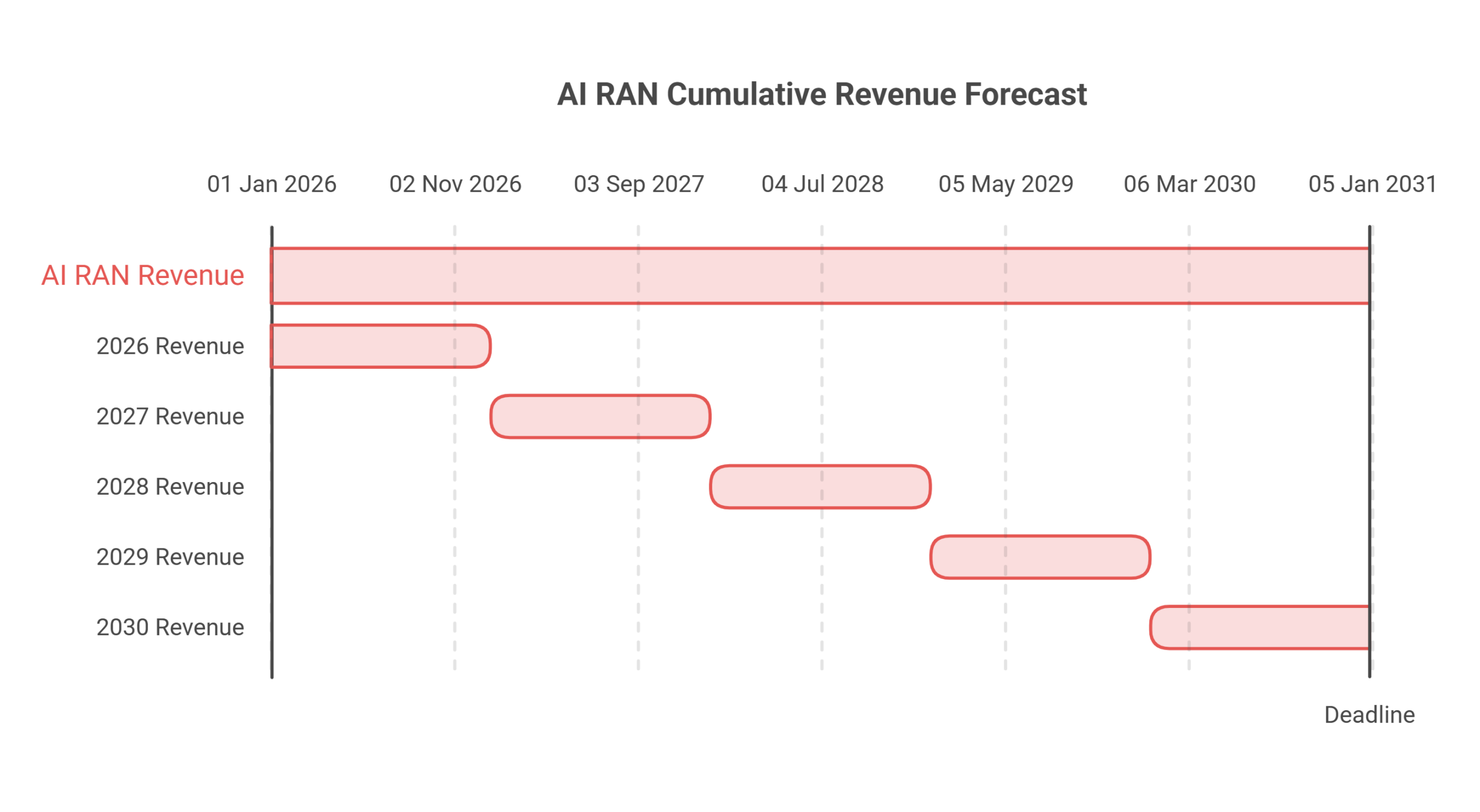
Key Takeaway: AI RAN is expected to become a significant area of RAN investment, increasing the strategic importance of software, AI capabilities and programmable network functions alongside physical infrastructure.
The commercial implications extend beyond network optimisation. Juniper Research’s RAN vendor analysis identifies software, cloud native architecture and AI platforms as increasingly important areas of competitive differentiation, suggesting that the value captured by vendors is gradually expanding beyond hardware.
This shift is making AI RAN software increasingly relevant to the economics of the RAN itself. Software can introduce new functionality, support recurring updates and allow operators to adapt network behaviour without depending entirely on hardware replacement cycles. At the same time, more software creates additional requirements around interoperability, testing, cybersecurity and lifecycle control. The opportunity therefore lies not simply in adding more software, but in building a network environment where software can be deployed, managed and updated reliably at scale.
As this model develops, AI RAN software is increasingly becoming part of the RAN’s core value proposition rather than an additional tool operating outside the network.
Software is Becoming a Strategic RAN Layer
The development of AI RAN is expanding the role of software from network support functions toward core network behaviour. Software can increasingly influence optimisation, resource allocation, energy management, monitoring and the introduction of new capabilities without requiring every change to begin with a physical hardware replacement.
This creates a different model for network evolution. Operators can potentially deploy, test and update software applications more frequently, while cloud native infrastructure provides greater flexibility for running those workloads. The approach can also support more modular development, allowing specialised applications to address specific network requirements.
The challenge is ensuring that this flexibility does not create additional complexity. Software dependencies, API compatibility, cybersecurity, model validation and lifecycle management become increasingly important as more functions move into software environments.
The strategic importance of AI RAN software therefore extends beyond artificial intelligence itself. As RAN architectures become more programmable, software is increasingly becoming a source of network differentiation, operational efficiency and ongoing capability development.