Open RAN is changing how mobile networks are built by separating functions that were traditionally delivered as tightly integrated systems. Radio units, distributed units, centralised units, cloud infrastructure and software applications can increasingly operate across a wider range of suppliers and platforms. This creates greater flexibility, but it also increases the number of components that operators need to configure, monitor, update and coordinate. As a result, Open RAN automation is becoming increasingly important to the practical scaling of disaggregated networks.
The operational challenge grows as networks become more distributed. In an integrated RAN environment, many lifecycle tasks can be managed within a relatively unified system. Open RAN introduces additional interfaces and software dependencies, requiring operators to coordinate functions across different infrastructure layers. Provisioning, configuration, software updates, fault management and performance monitoring consequently become more complex.
The O-RAN architecture addresses this through the Service Management and Orchestration layer, or SMO. The SMO is designed to coordinate disaggregated RAN functions and the cloud infrastructure supporting them, with management interfaces such as O1 and O2 providing mechanisms for lifecycle and infrastructure management. The O-RAN ALLIANCE has identified a mature, decoupled SMO and production-ready O1 and O2 interfaces as priorities for making Open RAN easier to deploy at scale.
Disaggregation is Increasing Operational Complexity
An Open RAN environment can contain separate radio units, distributed units, centralised units, cloud resources and software applications. Each component can have different configuration requirements, software versions and operational dependencies. The challenge is therefore not simply keeping individual network elements running, but ensuring that they continue to function together as one network.
This is increasing the importance of automated lifecycle management. Provisioning new network functions, validating configurations, applying software updates and responding to faults manually can become increasingly resource-intensive as deployment footprints grow. Automated workflows can standardise these processes while reducing repetitive intervention.
The need for automation also extends to cloud infrastructure. The O2 interface provides a framework for managing cloud resources and workloads within the O-RAN architecture, while the wider SMO environment connects infrastructure management with RAN operations. This creates a more structured relationship between the physical computing environment and the software functions running on it.
Efficiency is Strengthening the Business Case
The commercial motivation is also becoming clearer. Operators are under pressure to reduce operating costs while managing increasingly complex networks. GSMA Intelligence’s 2026 Network Transformation research found that 85% of operators identify OPEX efficiency as a priority business objective for deploying AI in their networks. Although this statistic concerns AI deployment rather than Open RAN specifically, it demonstrates the wider importance operators place on improving network efficiency through automation and intelligent systems.
NVIDIA’s 2026 global telecom survey provides another indicator of this direction. Among more than 1,000 telecom professionals surveyed, 65% of operators said network automation is being driven by AI, while 90% reported that AI was helping increase revenue and reduce costs. The survey is vendor-sponsored, so these figures should be treated as industry sentiment rather than independent performance measurements.
The significance for Open RAN is that automation can help operators absorb some of the additional operational complexity created by disaggregation. Automated provisioning, policy-based configuration and software lifecycle management can allow network teams to manage more components without increasing manual workloads at the same rate.
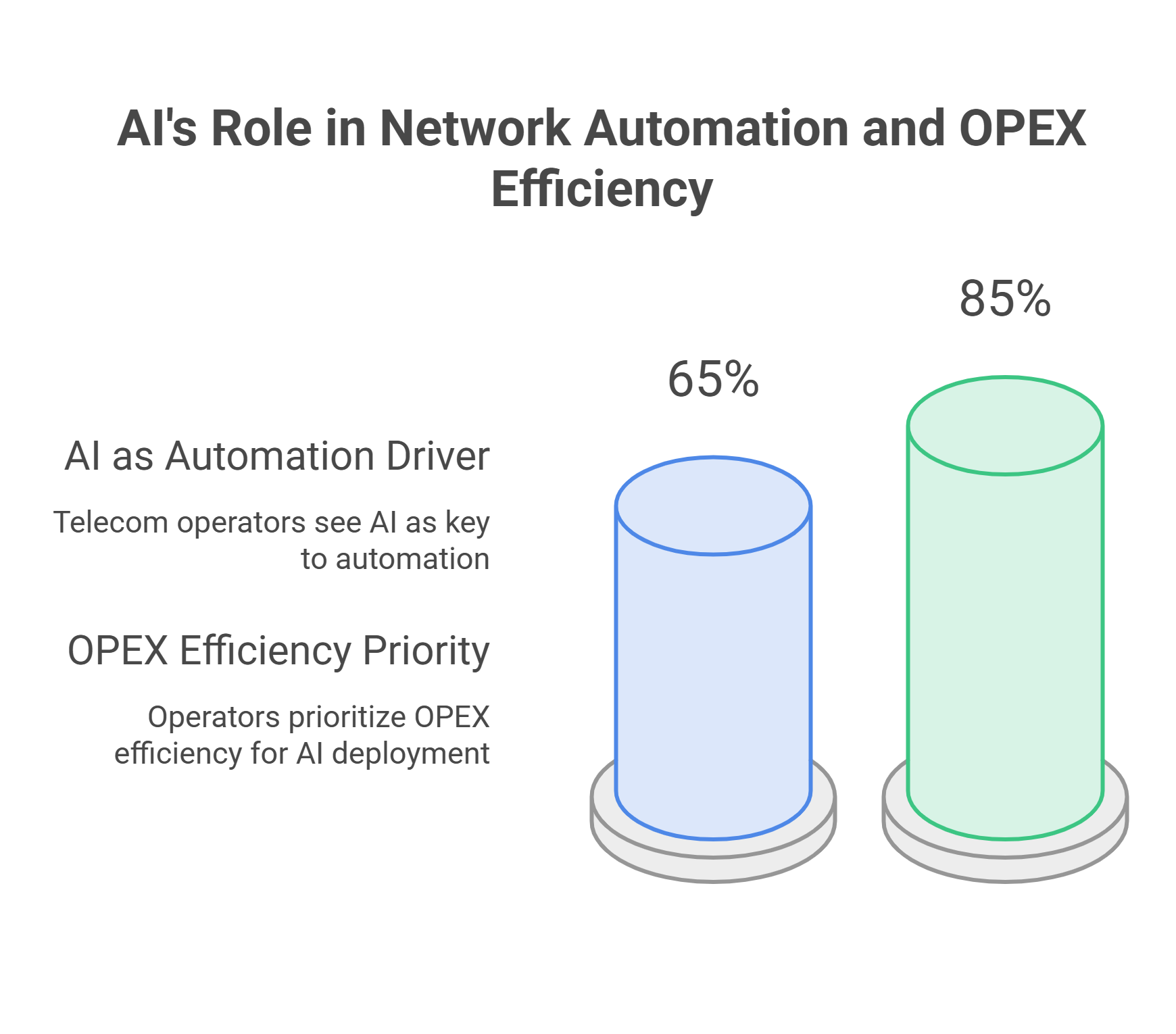
Key Takeaway: Operator interest in automation is strongly connected to efficiency and operating-cost objectives, reinforcing the need for automated management as Open RAN architectures become more complex.
The industry is also moving beyond automation of individual tasks toward coordinated network operations. At MWC Barcelona 2026, the O-RAN ALLIANCE showcased 24 open and intelligent RAN solutions, including demonstrations involving SMO, O-Cloud integration, AI and machine-learning orchestration, energy management and closed-loop automation.
This points to a broader evolution in Open RAN automation. The objective is no longer simply to automate provisioning or configuration, but to create workflows that can observe network conditions, apply policies and coordinate changes across multiple network elements.
The challenge will be ensuring that these automated systems remain reliable across a multivendor environment. As more network functions become software-based, operators must manage dependencies between infrastructure, applications and policies while maintaining service performance and security.
For Open RAN automation, the central issue is therefore scalability. Open RAN can increase architectural flexibility, but that flexibility becomes harder to manage manually as the number of components and interfaces increases. Automation and orchestration provide the operational layer needed to coordinate those elements, creating a path from disaggregated infrastructure toward more consistent and increasingly autonomous network operations.
Orchestration is Moving Toward Closed Loop Network Operations
The growing number of software functions and infrastructure components within Open RAN is increasing the importance of orchestration beyond basic provisioning. Operators need systems that can coordinate network functions, manage cloud resources, apply policies and respond to changing conditions without relying on manual intervention for every task. This is making Open RAN automation increasingly connected to closed loop operations, where network data can trigger a response and the resulting outcome can then be evaluated automatically.
The Service Management and Orchestration layer provides the main framework for this transition. Within the O-RAN architecture, the SMO coordinates the management of network functions and the underlying O-Cloud infrastructure, while interfaces such as O1, O2 and R1 connect management systems, cloud resources and applications. The architecture is intended to support lifecycle management across a disaggregated and multivendor network environment.
From Provisioning Toward Closed Loop Control
Basic automation can handle repetitive activities such as deploying a network function or applying a standard configuration. Closed loop orchestration goes further by connecting observation, analysis, decision and action.
A typical sequence can be: Network conditions are monitored, a deviation is detected, an application or policy determines an appropriate response, the change is implemented and the outcome is measured.
This approach is important in Open RAN because network components can operate on different hardware and software platforms. Manual coordination across those elements would become increasingly difficult as deployments expand. Automated workflows can instead apply common policies across network resources while maintaining greater consistency.
The O-RAN architecture provides different layers of control for this purpose. The Non-RT RIC operates over longer timescales and supports policy, analytics and optimisation through rApps, while the Near-RT RIC is designed for more immediate control through xApps. This separation allows network decisions to be made at different timescales depending on the operational requirement.
The O-RAN ALLIANCE’s 2026 specification work has continued to strengthen these interfaces. Its Release 5 introduced enhanced AI and machine-learning workflow services between the Non-RT RIC and Near-RT RIC, while ongoing work around R1 and SMO service exposure is designed to make applications and management functions easier to integrate into the broader architecture.
Zero Touch Deployment is Becoming More Important
Automation also has a practical role before a network becomes operational. Large deployments require infrastructure discovery, configuration, software installation and validation across many network elements. Repeating these activities manually can increase deployment time and introduce configuration inconsistencies.
The O-RAN ALLIANCE has specifically highlighted zero touch provisioning and automation of network deployment and configuration as important steps toward industrial-scale open and intelligent RAN. The objective is to reduce manual work while creating repeatable processes that can be applied across larger network footprints.
This also changes the economics of network expansion. The value of automation does not necessarily come from replacing a single manual task. It comes from reducing the cumulative operational workload associated with thousands of network elements, software versions and configuration changes.
Multivendor Networks are Increasing the Orchestration Challenge
One of Open RAN’s principal objectives is to allow components from different suppliers to operate through standardised interfaces. That can increase flexibility, but it also means the management environment has to coordinate software and hardware with different characteristics.
The resulting complexity extends across inventory, topology, configuration, performance monitoring, software lifecycle and fault management. In such an environment, an orchestration platform needs to understand not only individual network components but also the relationships between them.
Recent industry activity illustrates that interoperability is increasingly being considered at the management layer itself. Work on interoperability between different SMO platforms is aimed at enabling AI and automation across multivendor RAN environments, suggesting that orchestration interoperability is becoming an important part of the commercial Open RAN roadmap.
The significance is substantial. Open RAN’s commercial value depends partly on reducing dependence on tightly integrated systems, but achieving that flexibility requires management platforms that can coordinate increasingly diverse infrastructure.
Automation is Moving Closer to Network Decision Making
The next stage is therefore not simply more automated configuration. It is greater automation of network decisions.
AI and machine learning can analyse traffic patterns, energy use and performance indicators to determine whether network resources should be adjusted. The resulting action can then be applied through orchestration systems, creating a connection between intelligence and infrastructure.
This is where Open RAN automation starts to overlap with the broader development of AI RAN. Intelligent applications can generate optimisation recommendations, while orchestration systems provide the mechanism for implementing those recommendations across the network.
However, closed loop automation also introduces new risks. Incorrect data, poorly tuned policies or inaccurate AI predictions can cause an automated system to make the wrong decision repeatedly. Operators therefore need safeguards, policy controls and observability to ensure that automated actions remain within defined operational boundaries.
The broader evolution is toward a network in which deployment, configuration, monitoring and optimisation can increasingly operate as connected processes. Open RAN automation is becoming the layer that links those processes together, allowing a disaggregated network to behave more like a coordinated software system rather than a collection of independently managed components.
Automation is Becoming Essential to Scaling Open RAN
Open RAN is increasing the number of network elements, interfaces and software functions that operators need to coordinate. As deployments expand, manual provisioning, configuration and monitoring become increasingly difficult to manage efficiently.
Automation can provide the operational layer needed to coordinate these functions across multivendor environments. The progression is moving from basic task automation toward closed loop systems that can monitor network conditions, apply policies and adjust resources with limited manual intervention.
For operators, the value will depend on whether orchestration can reduce operational complexity while maintaining network performance, reliability and security. Open RAN automation is therefore becoming an increasingly important part of scaling disaggregated networks and creating the foundation for more intelligent and autonomous network operations.