






















The development of 6G is bringing artificial intelligence closer to the fundamental design of mobile networks. While earlier generations have increasingly used AI and machine learning to optimise specific functions, the emerging 6G approach is considering intelligence as something that can be embedded across the network architecture itself. This represents a shift from adding AI capabilities to networks toward designing networks that are inherently capable of supporting intelligent processes.
This is making 6G AI architecture an important area of 6G development. The International Telecommunication Union has included “artificial intelligence and communication” among the six usage scenarios of its IMT-2030 framework, while ubiquitous intelligence is identified as one of the framework’s overarching principles. These developments indicate that AI is being considered alongside core network capabilities rather than only as an external application.
AI is Moving Deeper into Network Design
The distinction between AI-assisted and AI-native networks is becoming increasingly important. An AI-assisted network can use machine learning to optimise a particular process, such as resource allocation or traffic management. An AI-native network goes further by incorporating intelligence into the architecture, allowing AI-related capabilities to influence how network functions communicate, operate and adapt.
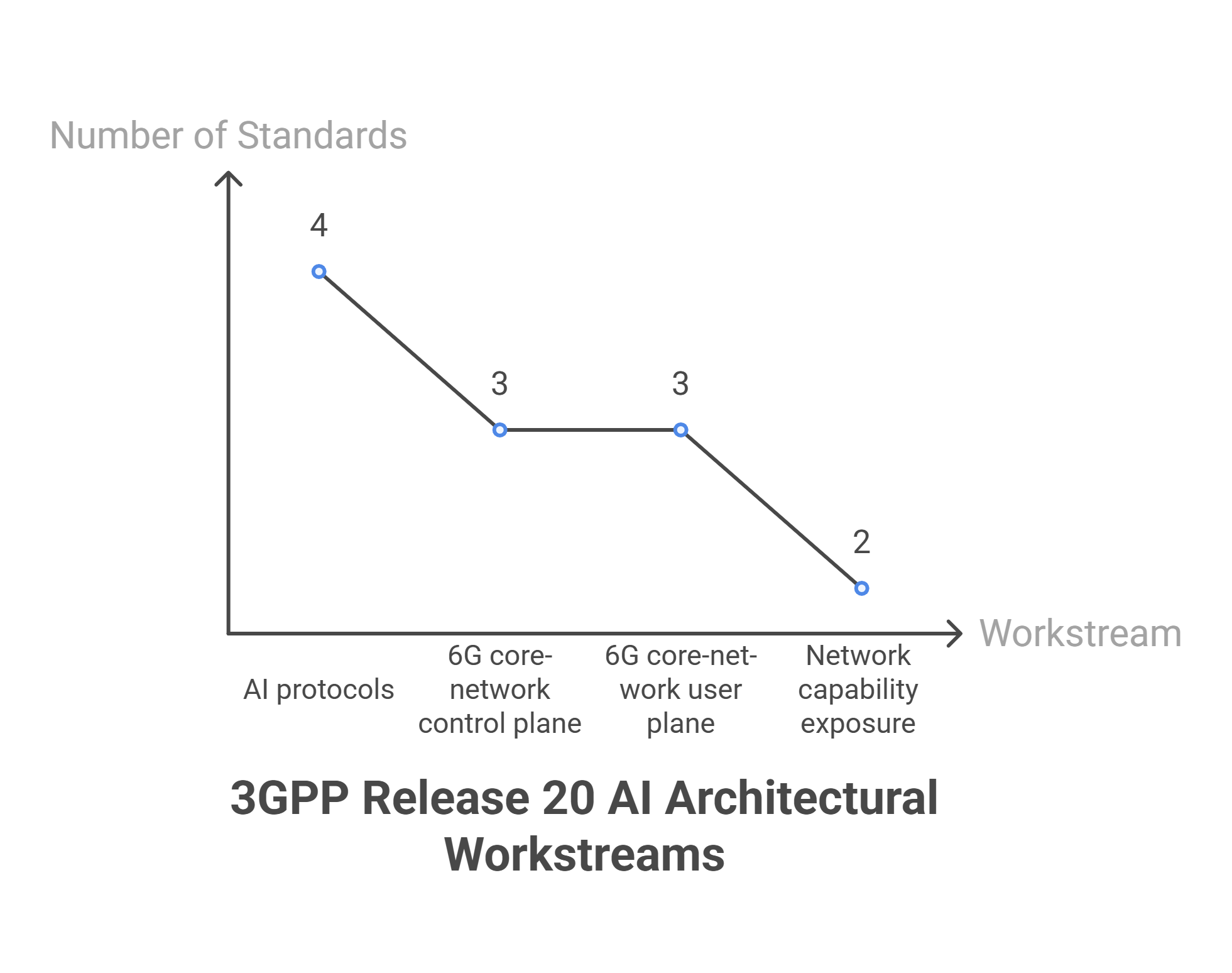
The standards process is beginning to reflect this shift. 3GPP Release 20 includes dedicated studies examining AI protocols for 6G, alongside separate work on 6G core-network control-plane and user-plane protocols. This indicates that AI is being considered at multiple architectural layers rather than being confined to radio optimisation.
For 6G AI architecture, this creates a different design challenge from simply deploying more machine-learning models. Future networks will need to determine how models interact with network functions, how data is exchanged, how inference is managed and how intelligent capabilities can be exposed to applications and services.
The Architecture is Being Developed Around Intelligence
The move toward an AI-native model also changes the relationship between data and network functions. AI systems depend on continuous access to data for training, inference and adaptation, meaning future network architectures may need to treat data availability and processing as fundamental capabilities.
ITU’s work on AI-native networks is examining this broader architectural question, including terminology, use cases and potential network architectures for embedding AI more deeply into telecommunications systems. At the same time, 3GPP’s emerging 6G studies are examining specific protocol and core-network requirements that could support more intelligent network behaviour.
This creates a progression from the AI-enabled optimisation explored in current 5G-Advanced systems toward a more deeply integrated model. 6G AI architecture is therefore not simply about adding AI to more parts of the network. It is about changing how network intelligence, data and communication functions are organised.