























Telecommunications providers are currently witnessing a significant shift in how mobile connectivity is delivered to end users, specifically those operating outside the traditional boundaries of terrestrial network coverage. The integration of satellite messaging into standard consumer smartphones marks a departure from specialized, bulky hardware toward a unified communication ecosystem. This advancement is primarily driven by the maturation of non-terrestrial network standards and the deployment of massive low Earth orbit constellations. By bridging the gap between space based infrastructure and terrestrial mobile devices, the industry is effectively addressing the long standing challenge of geographic dead zones. These regions, often characterized by rugged terrain or low population density, have historically been economically unfeasible for macro tower deployments.
The deployment of low Earth orbit satellites at altitudes ranging from 500 to 1,200 kilometers ensures that signal propagation times are kept to a minimum, enabling a level of interactivity that was previously unattainable with geostationary systems. The emergence of satellite messaging offers a viable alternative, providing a reliable safety net for users who require connectivity regardless of their physical location. This technological shift is also facilitating the development of specialized search and rescue operations, where precise location metadata can be transmitted even when the handset is moving at high speeds through dense vegetation or mountainous territories. The telecommunications ecosystem is thus evolving toward a multi-layered structure where the sky and the ground work in tandem to support a growing population of mobile subscribers who demand 100 percent geographic availability.
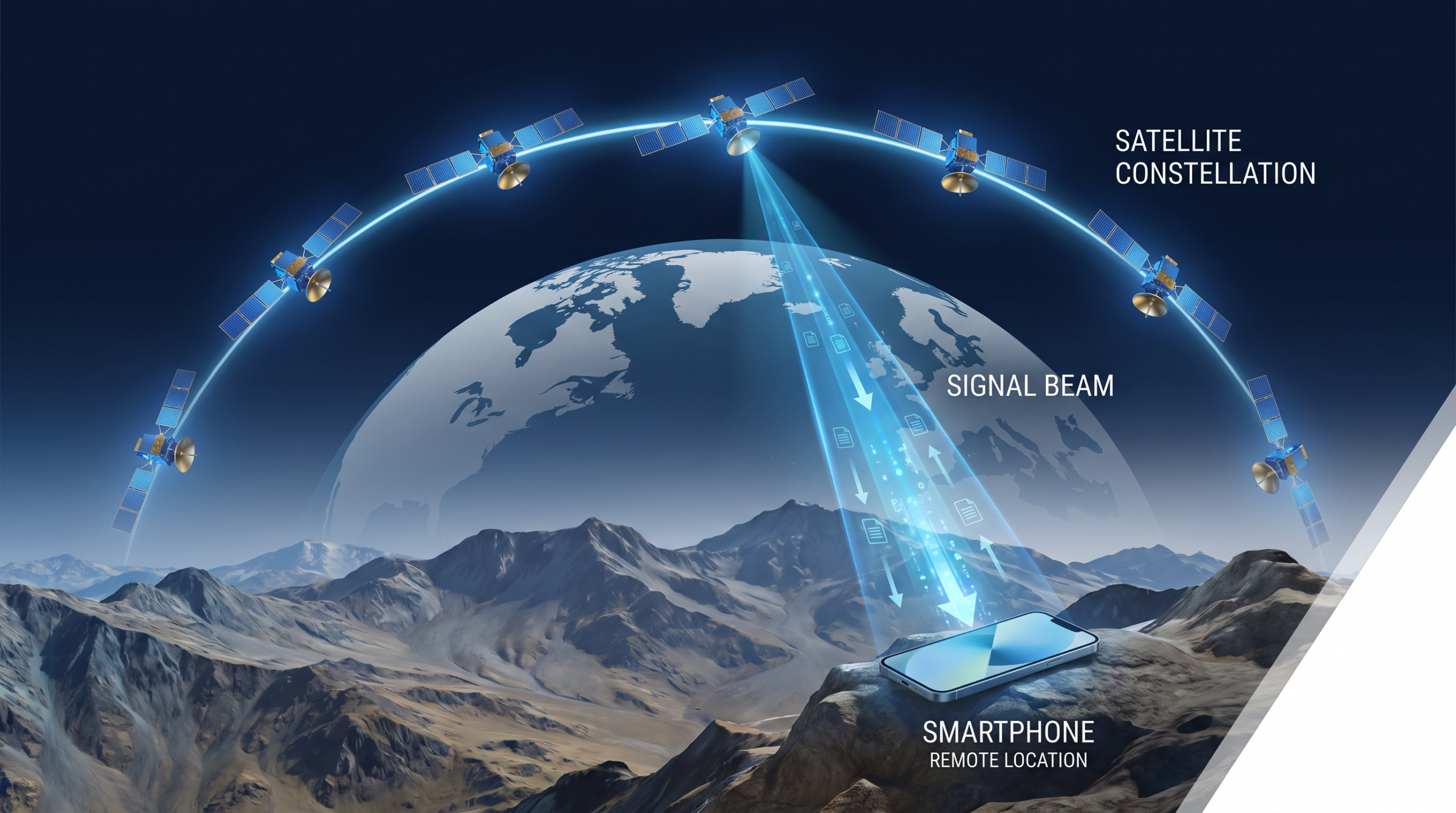
Technical Architecture of Non-Terrestrial Messaging Systems
The implementation of satellite messaging relies on a sophisticated coordination between spaceborne assets and ground based network cores. Unlike traditional satellite phones that utilize proprietary waveforms, modern systems are increasingly aligned with 3GPP Release 17 and Release 18 specifications for non-terrestrial networks. These standards define the physical layer modifications required to handle the unique challenges of space to ground communication, such as extreme propagation delays and high Doppler shifts. When a smartphone initiates a message, it must compensate for the rapid movement of satellites orbiting at approximately 7.5 kilometers per second. This process involves autonomous frequency pre-correction and timing advance adjustments, which are managed by the device baseband processor based on satellite ephemeris data. The link budget remains one of the most critical technical constraints, as standard smartphones possess limited transmit power (typically around 23 dBm) and omnidirectional antennas.
In addition to these power constraints, the system must also account for the significant free space path loss, which can exceed 160 decibels depending on the frequency band and the slant range to the satellite. To mitigate these losses, engineers are employing advanced modulation schemes such as binary phase shift keying, which offer greater resilience to noise at the expense of lower data rates. The device must also be capable of managing the handover process between rapidly moving satellites, which occur every three to seven minutes in a typical low Earth orbit constellation. This requires a high degree of synchronization between the handset and the network, as any disruption in the timing advance could lead to a loss of the communication link. The complexity of these operations is managed through a specialized software stack that runs in parallel with the traditional 5G protocol stack, ensuring that the user remains unaware of the intricate coordination occurring in the background.
To overcome these physical limitations, satellite operators are deploying spacecraft with significantly larger phased array apertures. These antennas, some measuring over 60 square meters, are capable of forming narrow spot beams that concentrate signal energy on specific terrestrial geographic areas. This high gain approach allows for a link to be established with unmodified handsets, provided there is a clear line of sight to the sky. The signal is typically received by the satellite and then relayed via a feeder link to a terrestrial gateway. From the gateway, the data is injected into the mobile network operator core, where it is treated similarly to standard terrestrial traffic. This integration is essential for maintaining service continuity, as it allows users to retain their existing mobile identities and phone numbers while communicating through space. The efficiency of this architecture is further enhanced by the development of satellite-compatible smartphone chipsets supporting multi-network connectivity, which allow for dynamic switching between cellular and orbital resources.
Regulatory Frameworks and Interference Mitigation Strategies
The expansion of satellite messaging into terrestrial frequency bands has necessitated a comprehensive overhaul of international and national regulatory policies. In the United States, the Federal Communications Commission has introduced the Supplemental Coverage from Space framework to govern the use of terrestrial mobile spectrum by satellite constellations. This regulatory approach is designed to ensure that space based transmissions do not cause harmful interference to existing terrestrial networks operated by non-partner carriers. One of the primary concerns for regulators is the management of aggregate out of band emissions, which could potentially desensitize terrestrial base stations. Satellite operators must implement rigorous beam nulling techniques and geofencing to terminate transmissions when a spacecraft passes over a region where it does not have the legal authority to operate.
International coordination is equally vital, as satellite footprints frequently cross national borders. The International Telecommunication Union plays a central role in harmonizing frequency allocations and ensuring that orbital slots are managed equitably. National sovereignty remains a key consideration, as governments require that satellite messaging traffic complies with local lawful intercept requirements and emergency call routing protocols. For example, when an emergency message is sent via satellite, the network must accurately determine the user location to route the request to the nearest public safety answering point. This requires a high degree of precision in geographic metadata, often combining GNSS data from the handset with network side verification. The complexity of these regulatory requirements has led to the adoption of standardized operational procedures, including:
- Dynamic power control to minimize the impact on adjacent terrestrial cells.
- Real time coordination between satellite operation centers and mobile network management systems.
- Automated geofencing based on high resolution digital maps to prevent unauthorized spectrum use.
- Mandatory reporting of interference incidents to national telecommunications authorities.
- Strict adherence to power flux density limits at national boundaries.
Mobile Network Operator Partnerships and Service Models
Mobile network operators are increasingly viewing satellite messaging as a strategic differentiator rather than a competitive threat. By partnering with satellite constellation providers, operators can market 100 percent geographic coverage to their subscribers, a claim that was previously impossible to fulfill. These partnerships typically follow a wholesale or revenue sharing model, where the satellite provider acts as a neutral host for the mobile operator traffic. For the operator, this approach minimizes capital expenditure since they do not need to build and maintain their own orbital infrastructure. Instead, they can focus on integrating satellite access into their existing service plans and billing systems. This integration often results in a tiered service structure, where premium subscribers receive satellite connectivity as a standard feature, while others may access it on a pay per use basis or through specific add on packages.
The business impact of these partnerships extends to customer retention and brand loyalty. In a highly competitive telecommunications market, the ability to provide a reliable connection during natural disasters or in remote wilderness areas is a powerful value proposition. During recent catastrophic weather events, such as hurricanes that disabled terrestrial towers, satellite messaging proved to be a critical lifeline for affected populations. Operators are also exploring the potential of satellite connectivity for specialized B2B segments, including logistics, agriculture, and remote utility monitoring. By offering a unified connectivity solution that spans both terrestrial and non-terrestrial domains, operators can capture new revenue streams from industries that operate in underserved regions. The long term success of these service models will depend on the continued improvement of link reliability and the reduction of latency, which currently restricts satellite messaging to low bandwidth text and small data bursts.
Future Evolution of Direct-to-Device Communication Standards
The future of satellite messaging is closely tied to the ongoing evolution of 5G and the early conceptualization of 6G standards. While current implementations are largely focused on text based communication and emergency alerts, the roadmap for non-terrestrial networks includes the support for high speed data and voice services. 3GPP Release 18 and the upcoming Release 19 are expected to introduce further optimizations for satellite communication, such as regenerative payloads. These payloads allow the satellite to perform baseband processing onboard, effectively functioning as a gNodeB in space. This shift from transparent bent pipe architectures to regenerative systems will significantly reduce latency by eliminating the need for a double hop to a ground station for signaling and control.
Additionally, the industry is moving toward greater multi-constellation interoperability. Future devices may be capable of connecting to multiple satellite networks depending on availability and signal strength, similar to how modern phones roam between different terrestrial carriers. This interoperability will be facilitated by the widespread adoption of standardized protocols across the satellite industry. As the number of active satellites in low Earth orbit continues to grow, the capacity of non-terrestrial networks will increase, eventually enabling more intensive applications like video streaming and real time collaborative tools in remote areas. The integration of artificial intelligence into network management systems will also play a role in optimizing beam steering and handovers between rapidly moving satellites. These advancements will ensure that satellite messaging remains a cornerstone of global telecommunications, providing a truly ubiquitous connectivity layer that transcends the physical limitations of terrestrial infrastructure.
The focus will remain on delivering a consistent user experience, where the transition between terrestrial and satellite networks is managed automatically by the device, ensuring that connectivity is never lost regardless of the user journey. As the industry looks toward the next decade, the convergence of satellite and terrestrial networks will be a defining feature of the global communications infrastructure. The integration of advanced antenna designs, regenerative payloads, and AI-driven network management will ensure that the limitations of today are the standard features of tomorrow. This evolution will not only improve the reliability of mobile services but also open the door to entirely new categories of applications that rely on ubiquitous, low latency connectivity to thrive in a connected world. The collaboration between space agencies, telecommunications providers, and technology companies will continue to drive this innovation, ensuring that no geographic boundary can prevent the flow of information in the digital age. Additionally, the development of standardized 6G protocols will likely incorporate non-terrestrial networks as a native component, further solidifying the role of space in the future of mobile communication.