



















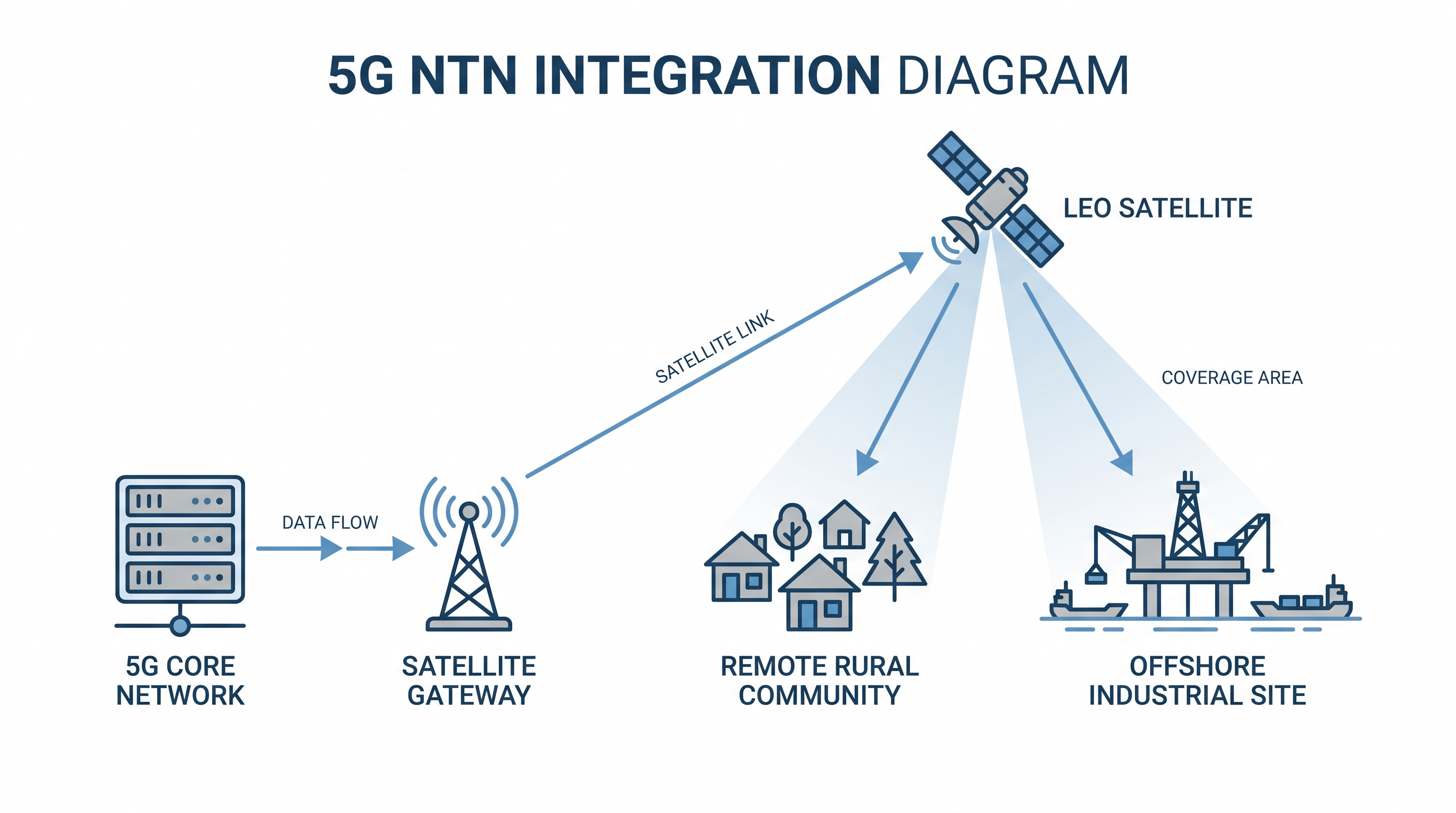
The telecommunications industry is at a pivotal moment as it seeks to extend the benefits of 5G connectivity beyond the limits of terrestrial infrastructure. For decades, remote and rural regions have struggled with limited or non-existent mobile coverage due to the prohibitive costs of deploying physical towers in low density or geographically challenging areas. However, the emergence of 5G NTN integration is offering a new way forward, allowing mobile network operators to utilize space based assets to provide high speed connectivity to every corner of the planet. By combining the capacity of terrestrial 5G networks with the broad reach of non-terrestrial constellations, the industry is effectively erasing the digital divide. This advancement is not just about extending coverage; it is about providing a consistent, high performance user experience that supports modern digital services in areas that were previously left behind. The integration of these two domains represents a major step toward achieving truly global connectivity, enabling social and economic growth in underserved communities. These efforts are particularly focused on providing a resilient communications layer that can withstand environmental disruptions and natural disasters.
By utilizing low Earth orbit satellites, the industry is able to offer lower latency and higher bandwidth than traditional geostationary systems, making 5G services practical for a wider range of applications. This technological shift is also driving down the cost of connectivity in remote areas, as operators no longer need to invest in expensive ground based infrastructure for every low density community. The convergence of space and terrestrial hardware is thus a defining feature of the modern telecommunications strategy, ensuring that the benefits of high speed internet are accessible to all. As the ecosystem continues to evolve, we expect to see even greater levels of innovation, with new service models emerging to meet the needs of a diverse global population. The focus remains on delivering a seamless and high quality experience that transcends the physical limitations of the earth, providing a truly unified network for the next generation of mobile users. This transition is being supported by a coordinated effort between satellite operators, mobile carriers, and government agencies to ensure that the infrastructure is in place to support the growing demand for connectivity. In the long term, the role of non-terrestrial networks will be essential for maintaining a resilient and inclusive digital economy. Additionally, the development of specialized 6G protocols will likely incorporate non-terrestrial networks as a native component, further solidifying the role of space in the future of mobile communication.
Technical Foundations of 5G Non-Terrestrial Networks
The successful implementation of non-terrestrial connectivity relies on a suite of technical adaptations designed to handle the unique physics of space to ground communication. Unlike traditional satellite systems that were isolated from cellular standards, 5G non-terrestrial networks are built on the 3GPP Release 17 and Release 18 frameworks. These standards define the physical layer and protocol modifications needed to accommodate massive propagation delays and rapid Doppler shifts associated with low Earth orbit satellites. A central component of this architecture is the modification of the timing advance mechanisms, which ensure that signals from a device arrive at the satellite at the correct time to be processed. This is particularly challenging when the satellite is moving at several kilometers per second relative to the ground.
Additionally, the integration process involves the deployment of specialized baseband processors and radio frequency front ends in consumer devices. These components must be capable of switching between terrestrial and orbital frequencies while maintaining a stable connection. The use of advanced waveforms and error correction techniques is also essential for overcoming the significant signal attenuation caused by the long distance between the device and the orbital constellation. By adhering to standardized 3GPP protocols, the industry ensures that 5G NTN integration can be implemented across a wide range of devices and networks, fostering a competitive and interoperable ecosystem. The goal is to make the transition between space and ground networks invisible to the user, providing a seamless experience whether they are in a dense urban center or a remote wilderness area.
Spectrum Allocation and Interference Management in Remote Areas
Managing the radio frequency spectrum is one of the most complex aspects of extending connectivity into remote regions. Non-terrestrial networks typically utilize a combination of dedicated mobile satellite service bands and flexible use terrestrial frequencies. The allocation of these bands is governed by national regulators and international bodies like the International Telecommunication Union. In remote areas, where terrestrial spectrum is often underutilized, satellites can utilize these frequencies to provide supplemental coverage. However, this requires rigorous interference management to ensure that space based transmissions do not disrupt existing services in adjacent regions. To manage these challenges, operators and regulators employ a variety of strategies, including:
- Strict out of band emission limits to prevent signal leakage into neighboring terrestrial bands.
- Dynamic beamforming and nulling to concentrate signal energy on targeted remote areas.
- Real time coordination between satellite operators and terrestrial carriers to manage frequency use.
- Geofencing to prevent satellites from transmitting over unauthorized geographic regions.
- Mandatory use of high precision location data to route traffic and manage spectrum rights.
Additionally, the adoption of unified network management improving satellite-terrestrial operations is critical for maintaining spectrum efficiency. By providing a holistic view of frequency utilization across both domains, operators can optimize the use of available bandwidth and minimize the risk of conflict. This integrated approach allows for more flexible spectrum sharing models, where satellites can fill gaps in terrestrial coverage during periods of high demand or in areas with poor signal quality. As the number of active satellites and terrestrial 5G sites continues to grow, the importance of coordinated spectrum management will only increase. The objective is to maximize the utility of this finite resource, ensuring that it can support the widest possible range of services and users.
Socio-Economic Impact of Ubiquitous Rural Connectivity
The extension of 5G connectivity into remote regions has profound implications for social and economic development. In many parts of the world, a lack of reliable communication is a major barrier to education, healthcare, and business growth. By providing high speed access through non-terrestrial networks, the industry is enabling a new era of digital inclusion. In agriculture, for instance, connected sensors and automated equipment can significantly improve crop yields and resource management, even in the most isolated areas. In education, remote students can access high quality digital resources and participate in real time virtual classrooms, regardless of their location. The impact on healthcare is equally significant, with telemedicine services providing a lifeline for communities that are far from traditional medical facilities.
The economic benefits of rural connectivity also extend to the growth of local businesses and the integration of remote regions into the global economy. By providing a reliable connection, the industry enables entrepreneurs in underserved areas to access international markets and compete on a level playing field. This digital empowerment can lead to increased investment, job creation, and improved living standards in rural communities. Additionally, the availability of 5G connectivity supports the deployment of critical infrastructure, such as remote energy grids and water management systems, which are essential for sustainable development. The socio-economic value of 5G NTN integration is thus not just about providing internet access; it is about providing the foundational infrastructure that enables communities to thrive in the 21st century.
Infrastructure Evolution and the Path to Regenerative Payloads
The future of 5G non-terrestrial networks will be defined by the evolution of orbital infrastructure from simple relay systems to advanced processing platforms. Most current satellite systems utilize a transparent bent pipe architecture, where the satellite acts as a mirror that reflects signals between the ground station and the user device. While effective, this approach introduces significant latency due to the double hop required for signal processing. The next stage of evolution involves the deployment of regenerative payloads, which integrate baseband processing capabilities directly onto the satellite. This allows the spacecraft to function as a fully operational gNodeB in space, significantly reducing latency and improving the overall efficiency of the network.
Regenerative payloads will also enable more advanced features such as on orbit routing and inter-satellite links. These capabilities allow satellites to communicate directly with each other, bypassing ground stations and further reducing propagation delays. This is particularly important for supporting time sensitive applications such as real time gaming, autonomous transportation, and industrial automation in remote areas. The transition toward these advanced systems will require significant investment in satellite design and manufacturing, as well as the development of new software frameworks to manage the complex orbital environment. As the industry moves toward 6G, we expect to see even greater integration of space and ground infrastructure, creating a truly ubiquitous and resilient communication layer. The focus will remain on delivering a consistent and high performance experience for all users, ensuring that the benefits of the digital age are shared by everyone, regardless of where they live or work.