























The effectiveness of business intelligence within the telecommunications sector is often limited by the time and effort required to prepare data for analysis. Communications service providers generate massive amounts of information from a wide variety of sources, including network telemetry, billing systems, and customer interaction logs. This data is frequently stored in inconsistent formats and across multiple siloed systems, requiring extensive cleaning, transformation, and integration before it can be used for decision-making. In a traditional data engineering environment, these tasks are performed manually by specialized teams, creating a significant bottleneck that can delay the delivery of critical insights by weeks or even months.
Manual data preparation is not only slow but also prone to human error, which can undermine the reliability of the resulting analytics. With thousands of tables and millions of records to manage, it is nearly impossible for human engineers to identify and correct every inconsistency or anomaly in the dataset. This is particularly problematic in a telecom context, where accurate data is essential for managing network performance and optimizing customer experience. When business leaders are forced to make decisions based on incomplete or inaccurate information, it increases the risk of costly mistakes and missed opportunities. The complexity of modern 5G networks and the rapid pace of digital transformation are making these legacy approaches increasingly unsustainable.
To address these challenges, telecom operators are increasingly looking toward automation to streamline their data engineering workflows. By reducing the reliance on manual processes, organizations can significantly accelerate the time-to-insight and allow their data teams to focus on more strategic activities. The goal is to create a more agile and responsive business intelligence environment that can keep pace with the needs of a fast-moving industry. This transformation involves the adoption of modern data management platforms that can automate the ingestion, profiling, and cleaning of large-scale telecom datasets. This shift is a critical step for any operator looking to become truly data-driven and to capitalize on the opportunities of the digital economy.
Automating Data Cleansing and Transformation with AI
AI-augmented data preparation offers a powerful solution to the bottlenecks of traditional data engineering by using machine learning to automate the most time-consuming aspects of the data lifecycle. Instead of manually writing complex ETL scripts, data engineers can utilize AI-powered tools to automatically discover data sources, infer schemas, and suggest transformations. These systems can learn from historical data and user feedback to continuously improve their accuracy and efficiency, significantly reducing the manual effort required to prepare data for analysis. For telecom operators, this means a much faster and more reliable path from raw data to actionable business insights.
One of the primary applications of AI in data preparation is the automated identification and correction of data quality issues. Machine learning models can be trained to recognize common errors in telecom datasets, such as duplicate subscriber records, inconsistent address formats, and missing network telemetry values. Once an issue is identified, the system can automatically apply the appropriate cleansing rules or flag the record for human review. This proactive approach to data quality ensures that the information being used for business intelligence is always accurate and reliable, which is critical for maintaining high levels of network performance and customer satisfaction.
AI-augmented data preparation also simplifies the process of integrating data from disparate sources. By identifying semantic relationships between different datasets, AI tools can automatically suggest how to join tables and reconcile conflicting information. This is particularly useful for telecom operators that need to combine data from legacy BSS and OSS systems with modern cloud-based applications. By automating these complex integration tasks, AI allows organizations to build a more holistic view of their business without the need for extensive manual coding. The result is a more flexible and scalable data environment that can easily adapt to changing business needs and new data sources.
Enhancing Data Discovery and Metadata Management
Finding the right data for a specific analytical task is often one of the most difficult parts of the business intelligence process. In a large telecom organization, data is spread across thousands of systems and databases, making it nearly impossible for users to know what information is available and how it should be used. AI-augmented data preparation tools address this challenge by using natural language processing and machine learning to improve data discovery and metadata management. These tools can automatically scan the entire data ecosystem to identify new datasets, extract metadata, and categorize information based on its business context.
By building a searchable and intelligent data catalog, AI makes it much easier for business analysts and data scientists to find the information they need. Instead of searching through technical schemas, users can query the catalog using plain language to find relevant data products. The system can also provide recommendations based on the user’s past behavior and the popularity of specific datasets within the organization. This self-service capability is essential for fostering a data-driven culture and for enabling faster innovation. When teams can easily find and access high-quality data, they are much more likely to develop new insights and to launch successful digital initiatives.
Additionally, AI can help to improve the quality and consistency of metadata across the organization. By automatically tagging data with relevant keywords and business terms, AI tools ensure that the metadata is always up-to-date and accurate. This is critical for managing data governance and compliance, as it provides a clear view of where sensitive information is stored and who has access to it. For telecom operators, the use of AI to enhance data discovery and metadata management is a major driver of operational efficiency and business value. It allows the organization to fully utilize its data assets and to make more informed decisions across the entire business.
Supporting Real-Time BI and Predictive Analytics
The move toward real-time business intelligence and predictive analytics is a major trend in the telecommunications industry, driven by the need for faster decision-making and more proactive network management. AI-augmented data preparation is a key enabler for these advanced analytical capabilities, as it provides the high-speed data integration and processing needed to support real-time workflows. By automating the preparation of streaming data from the network edge, AI allows operators to gain immediate insights into network congestion, signal quality, and potential hardware failures. This responsiveness is essential for maintaining high levels of service availability in the 5G era.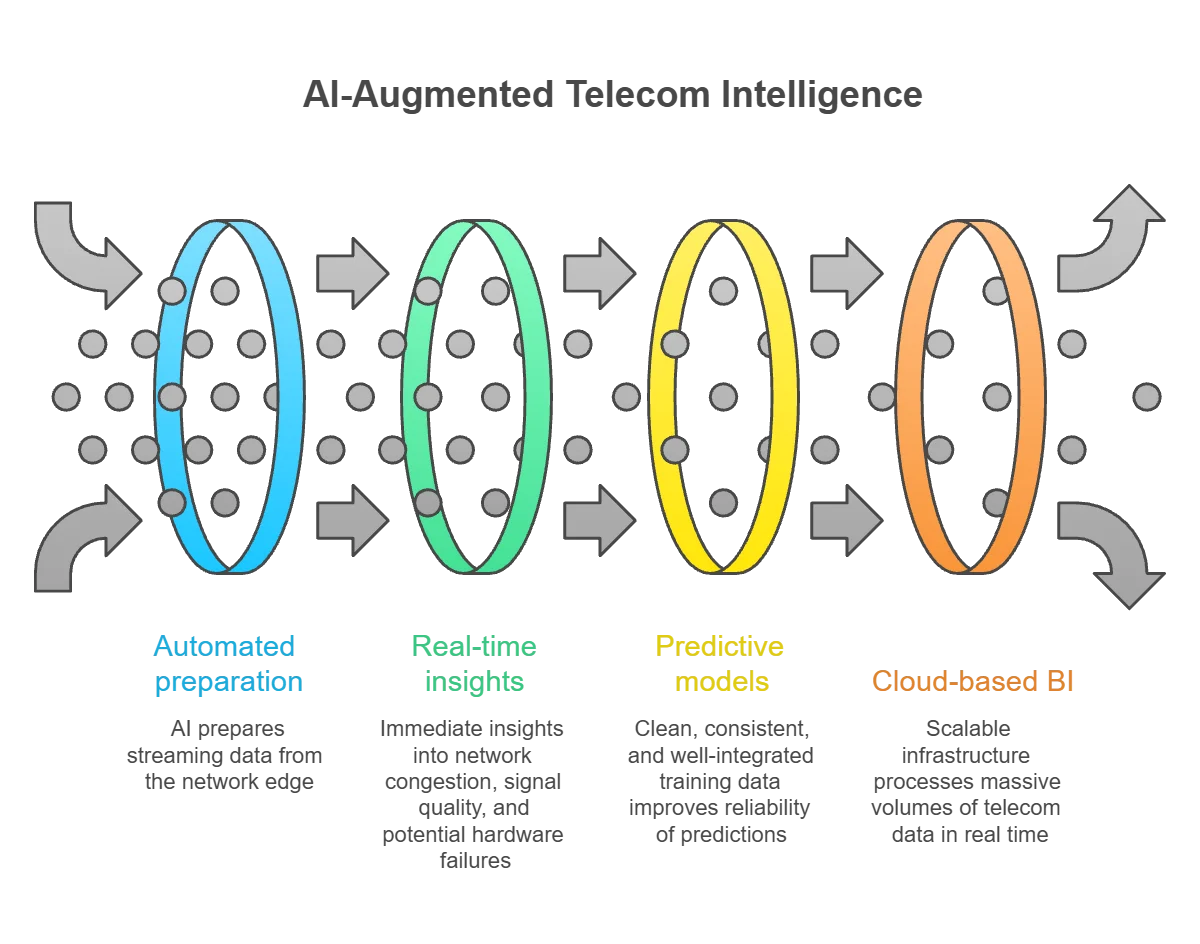
In addition to real-time insights, AI-augmented data preparation also provides a foundation for more accurate predictive models. By ensuring that the data used for training these models is clean, consistent, and well-integrated, AI helps to improve the reliability of predictions for everything from customer churn to network capacity needs. Machine learning models are only as good as the data they are built on, and the use of AI to prepare that data is a critical factor in the success of any predictive analytics initiative. For telecom operators, the ability to accurately forecast future trends is a key competitive advantage that allows for more effective strategic planning and resource allocation.
The integration of AI-powered data preparation with modern cloud-based BI platforms further enhances the agility and performance of the organization. These platforms provide the scalable infrastructure needed to process massive volumes of telecom data in real time, while the AI layer ensures that the data is always ready for analysis. By combining these technologies, communications service providers can create a highly automated and responsive business intelligence environment that can adapt to the changing needs of the business. This transformation is not just about improving IT efficiency, but about empowering the entire organization with the insights needed to thrive in the digital age.
Organizational Impact and Skill Evolution for Data Teams
The adoption of AI-augmented data preparation has a significant impact on the roles and responsibilities of data teams within the telecommunications industry. As the most repetitive and time-consuming tasks are automated, the focus of data engineers and analysts shifts from manual data preparation to more strategic activities. This includes designing more sophisticated data architectures, developing advanced analytical models, and working more closely with business units to identify new opportunities for data-driven innovation. This evolution of skills is essential for building a more modern and effective data organization that can deliver higher levels of value to the business.
While automation reduces the need for manual coding, it increases the importance of data governance, quality monitoring, and model management. Data teams must develop the expertise needed to oversee and tune the AI systems that are preparing the data, ensuring that they are operating correctly and producing accurate results. This requires a deeper understanding of machine learning principles and the ability to work with a new generation of AI-powered tools. The transition to an AI-augmented environment is therefore as much an organizational and cultural challenge as it is a technical one, requiring a commitment to continuous learning and professional development.
Ultimately, the goal of AI-augmented data preparation is to empower humans with better tools and better data, not to replace them. By removing the drudgery of manual data engineering, AI allows data professionals to spend more time on the creative and analytical tasks that drive business value. This leads to a more engaged and productive workforce, which is essential for the long-term success of any telecommunications operator. By embracing the power of AI to transform their data preparation processes, communications service providers can build a more agile, secure, and data-driven organization that is prepared for the challenges and opportunities of the 5G era and beyond.