





















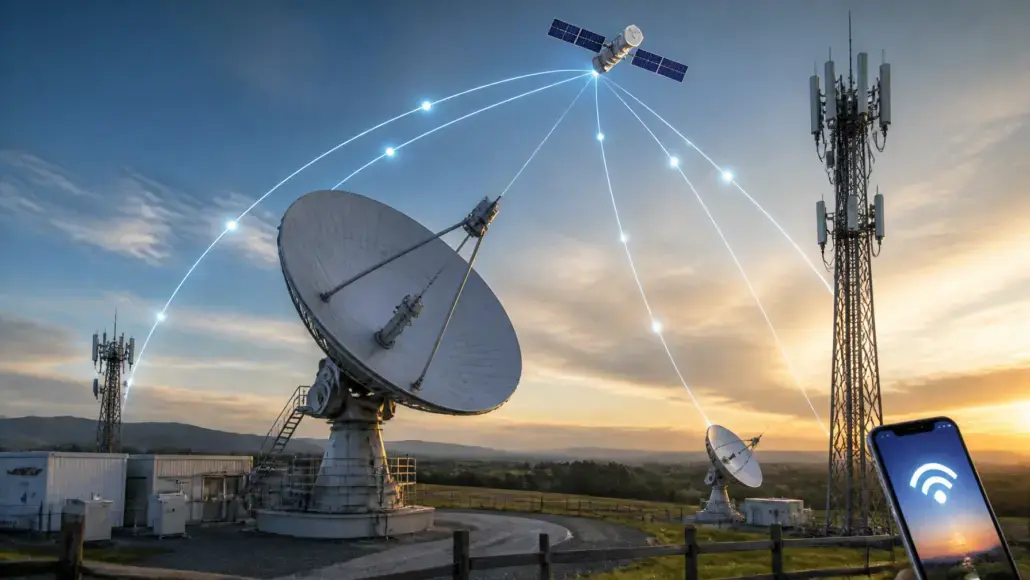

New Zealand mobile operator 2degrees has taken a significant step in its rollout of direct to device satellite connectivity, officially opening its Marton satellite ground station and completing successful testing of voice calls, video calls and mobile data through the satellite network using standard smartphones.
The facility, officially opened by the Hon Paul Goldsmith, Minister for Media and Communications and Minister for Space, is one of the first commercial AST SpaceMobile ground stations to become operational anywhere in the world. The satellite ground station will support the rollout of satellite-enabled mobile connectivity across New Zealand, targeting areas that fall beyond the reach of traditional mobile coverage.
Throughout August, engineering teams from 2degrees and AST SpaceMobile conducted trials at the site, successfully completing voice calls, video calls and mobile data sessions through the network. These tests were carried out using everyday mobile phones rather than specialised satellite devices, demonstrating the practical viability of direct to device satellite connectivity for mainstream users.
Extending Mobile Coverage Through Satellite Infrastructure
Once commercially available, the service is designed to deliver voice, data and messaging to customers carrying standard 4G and 5G smartphones, without requiring a satellite phone or additional hardware. This approach positions the satellite ground station as an extension of the existing mobile network rather than a standalone system.
2degrees CEO Mark Callander has highlighted the importance of building and operating a local ground station that allows calls, data and messaging to originate and terminate on the 2degrees core network without transiting any other country or jurisdiction. The operator has invested millions in the Marton facility to enable satellite connectivity for New Zealanders in areas outside traditional coverage zones.
AST SpaceMobile maintains partnerships with more than 50 mobile network operators globally, representing a combined subscriber base of nearly three billion mobile subscribers. Chris Ivory, Chief Commercial Officer at AST SpaceMobile, noted that New Zealand’s early adoption of the technology and deployment of commercial ground infrastructure position the country at the forefront of space-based cellular broadband. He added that the integration of networks is advancing to deliver voice, broadband data and SMS directly to everyday smartphones without specialised devices.
Satellite Networks as Part of Future Mobile Infrastructure
The opening of the Marton satellite ground station, combined with successful service testing, marks a milestone on the path toward commercial launch. Callander confirmed that 2degrees will continue testing and announce timings for customer trials and a commercial launch in due course. AST SpaceMobile has outlined a launch roadmap under which service availability increases with each additional satellite deployed, and 2degrees has indicated it will offer the service commercially when availability reaches a level deemed viable.
The deployment underscores a broader industry trend in which satellite infrastructure is increasingly becoming part of mobile network architecture. For operators like 2degrees, direct to device satellite connectivity offers a pathway to extend mobile coverage into remote and underserved regions using the same smartphones customers already carry, bridging gaps that conventional terrestrial networks have been unable to fill.