





















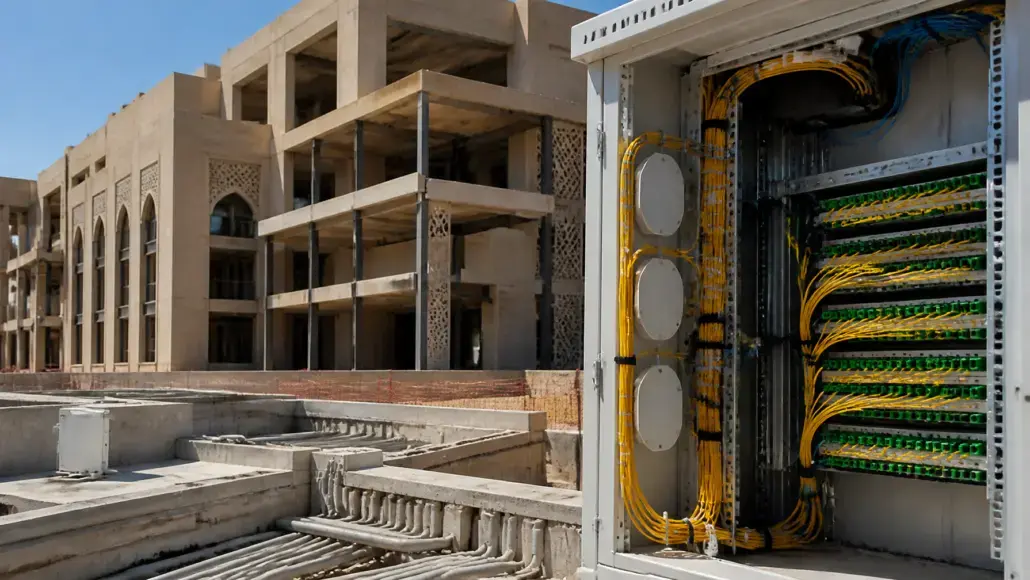

Oman’s Telecommunications Regulatory Authority (TRA) has introduced new rules governing Passive Telecom Infrastructure in buildings and real estate developments, setting technical requirements for new construction and major renovation projects.
The regulation applies to commercial, industrial and residential buildings, as well as real estate complexes. Developers and property owners will be required to provide infrastructure such as ducts, cable routes and other facilities needed to support telecommunications networks.
The new framework is designed to prevent buildings from being structured around a single telecom operator. It requires internal network infrastructure to support access by different licensed operators on fair and non-discriminatory terms.
The rules also establish responsibilities for building owners and telecom licensees. Owners are responsible for creating and maintaining internal passive connections unless they appoint a licensed operator to handle the work.
In-building coverage systems must be designed and built by a contracted licensee for larger developments meeting specified thresholds. These include complexes with more than 48 property units, six or more above-ground floors, two or more underground floors, or a single floor exceeding 3,000 square metres.
New Compliance Rules Cover Building Approvals
The regulation makes Passive Telecom Infrastructure part of the building approval process. Before a municipality issues a building completion certificate, an authorised or licensed entity must inspect the internal telecommunications connections and confirm that they meet TRA requirements.
For larger developments where an operator is contracted to build and operate the infrastructure, other licensed operators may be invited to share construction and operating costs. The framework also provides for shared maintenance responsibilities where such arrangements are accepted.
The rules cover fibre and copper cabling, ducts, equipment and protection rooms, power supplies, backup batteries and other passive network elements. Fibre-optic cabling will be required in schools, hospitals and other facilities designated by the TRA.
Most of the new requirements will take effect six months after publication. Buildings with construction permits issued before the regulation takes effect are exempt, while certain residential requirements have a longer implementation period.
The TRA has also established penalties for non-compliance. Fines include OMR 500 for non-compliant internal connections, OMR 300 for arrangements that give one operator exclusive service in a building, and OMR 800 per 1,000 square metres of affected area for certain larger buildings.
The regulation is intended to ensure Passive Telecom Infrastructure is planned alongside building development rather than added later. By setting common technical and access requirements, the TRA is creating a framework that allows telecom operators to use shared internal infrastructure while giving developers clearer compliance obligations.