
















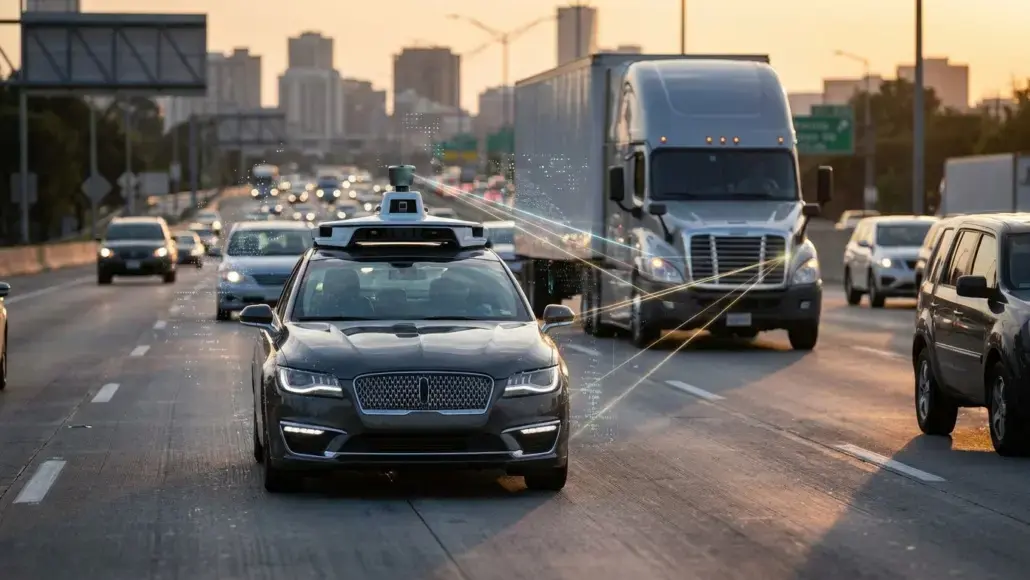

A self-driving car can generate up to 19 terabytes of data per hour, placing potential pressure on 5G networks that must manage real-time information from multiple vehicles. With 5G latency ranging from 20 to 50 milliseconds, delays in stop commands may become critical and could lead to accidents.
The move toward 6G is intended to address these demands through extremely fast speeds, very short delays and built-in AI capabilities that improve sensing and communication. For 6G connected vehicles, Integrated Sensing and Communication (ISAC) will function like radar, providing millimeter-level precision to detect objects or accidents, potentially before current camera systems can do so. The technology could improve autonomous vehicle safety and efficiency while also supporting applications such as digital twins that depend on real-time data integration.
Standalone networks and unified standards
The network model for 6G will differ from the approach used for 5G. While 5G’s non-standalone (NSA) architecture relied on 4G core infrastructure, 6G networks will be built as standalone (SA) systems from the start. Ericsson states that standalone 6G networks will simplify system complexity, improve scalability, and reduce integration costs by aligning both radio access and core networks.
For 6G connected vehicles, this AI-native and edge-integrated design will require infrastructure capable of meeting high bandwidth and low latency requirements. The fragmented architecture of existing 5G networks is a bottleneck, and legacy networking components may struggle with 6G deployment demands.
The 3rd Generation Partnership Project (3GPP), a collaboration of seven telecom standards organizations, is developing unified standards for 6G. Those standards are expected to ensure interoperability and enable advanced capabilities such as network slicing. 6G networks promise transfer speeds 50 to 100 times faster than 5G, with peak speeds reaching up to 1 terabit per second and microsecond latency.
Cybersecurity and infrastructure pressures
Security remains a major challenge for 6G connected vehicles and wider network deployments. Industry experts warn that 6G will improve security through design but will also introduce new risks associated with AI. Stephen Douglas from Keysight Technologies noted that AI-native architectures may widen the attack surface for hybrid networks by exposing more APIs and models. Gartner predicts that by 2026, AI and GenAI applications will account for over 30% of API demand.
Ericsson has identified over 20 potential threat types related to 6G, including challenges with the misuse of spatial mapping data and adversarial attacks. Existing routers, firewalls and edge devices are often inadequately equipped for 6G’s higher bandwidth and lower latency requirements. Douglas suggests these devices will need enhancements to support next-generation networks.
Enterprise preparation and rollout timeline
Most enterprise networks are only partially prepared for a transition to 6G, according to Douglas. Supporting 6G connected vehicles and other AI-driven operations will require modern LAN and WAN architectures that can accommodate the expected bandwidth and latency. Investments in fiber networks, edge computing and zero-trust architecture are critical for future readiness.
Ericsson anticipates finalizing 6G specifications by 2028, with commercial rollouts expected around 2029-2030. Initial rollouts will depend on existing 5G SA infrastructure before more advanced AI-native capabilities are introduced. Experts recommend a phased migration strategy, with enterprises beginning now by improving security policies and investing in technologies that facilitate the transition.