















Verizon has significantly broadened the scope of its collaborative push toward next-generation wireless technology by welcoming nine major companies into the 6G Innovation Forum. The newly added members are Amazon Web Services, Cisco, Intel, Keysight Technologies, MediaTek, NVIDIA, Palo Alto Networks, Rohde & Schwarz and VIAVI Solutions. Together with founding participants Ericsson, Samsung, Nokia, Meta and Qualcomm Technologies, the expanded 6G Innovation Forum now represents a wide cross-section of the global technology landscape spanning cloud infrastructure, silicon design, cybersecurity, automated testing and accelerated computing.
The forum was originally established to build an open and resilient 6G ecosystem focused on developing foundational technologies, trialing emerging use cases, exploring new spectrum bands and ensuring alignment with global standards bodies such as 3GPP. With the addition of these nine organizations, the group gains deeper multi-disciplinary expertise that is expected to strengthen work across AI integration, cloud services, network security and independent test emulation, all of which are critical to shaping an AI-native network architecture from the ground up.
Yago Tenorio, Chief Technology Officer and Senior Vice President of Technology Development at Verizon, said, “By expanding our Innovation Forum and refining live edge-AI trials today, we are ensuring the AI-native 6G network is built from day one to scale 5G Advanced capabilities and translate these next-generation technologies into meaningful, real-world experiences for our customers.”
Successful ISAC Trials Demonstrate Practical 6G Capabilities
To move beyond theoretical research, Verizon highlighted recent field trials with founding members Samsung and Qualcomm centered on Integrated Sensing and Communication, commonly known as ISAC. This technology enables cellular networks to function as distributed, radar-like sensors without requiring physical cameras, integrating communication and sensing within the same infrastructure.
In a trial conducted with Samsung during a major international soccer celebration in Dallas, Texas, the companies demonstrated AI-powered crowd-density detection using a virtualized Radio Access Network, a single 5G base station and CBRS spectrum. Samsung’s AI RAN and edge AI platform analyzed ambient wireless signal variations from smartphones to produce real-time crowd-density heatmaps, showcasing how network-native sensing could support large-scale event management. This marked the first such ISAC trials demonstration on a virtualized RAN for crowd detection.
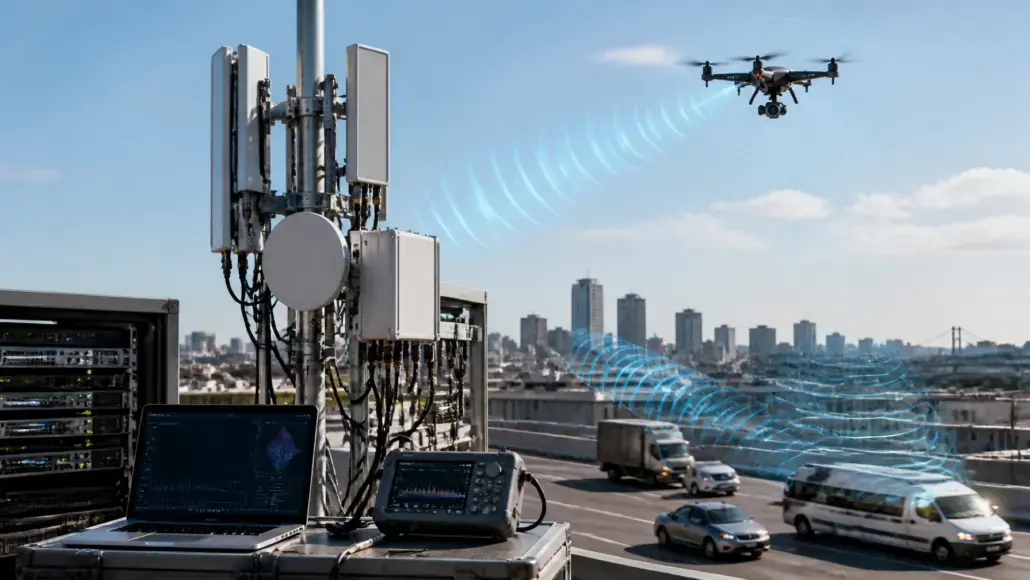
A separate trial with Qualcomm at its San Diego campus focused on drone and vehicle tracking. Using millimeter-wave spectrum and four synchronized transmission and reception points, the system mapped the position and velocity of an airborne target and ground vehicles while simultaneously maintaining high-speed 5G Standalone communications with a phone user on the ground. The results underscored how next-generation wireless networks could provide foundational tracking infrastructure for autonomous drone safety and similar applications. These ISAC trials represent tangible progress toward capabilities that are expected to mature further with 6G.
Expanded 6G Ecosystem Sets the Stage for Future Deployment
Looking ahead, the members of the 6G Innovation Forum plan to continue sharing findings from demonstrations inx`volving digital twins, robotics, AI and advanced wearables. Verizon has identified the 2028 Summer Olympics in Los Angeles as an interim proving ground on the path toward commercial 6G deployment, with a dedicated 6G Lab already established in the host city to stress-test capacity demands and early use cases of the AI-native network era. The expanded 6G ecosystem positions the broader industry to collaboratively address the technical and operational challenges that lie ahead.