














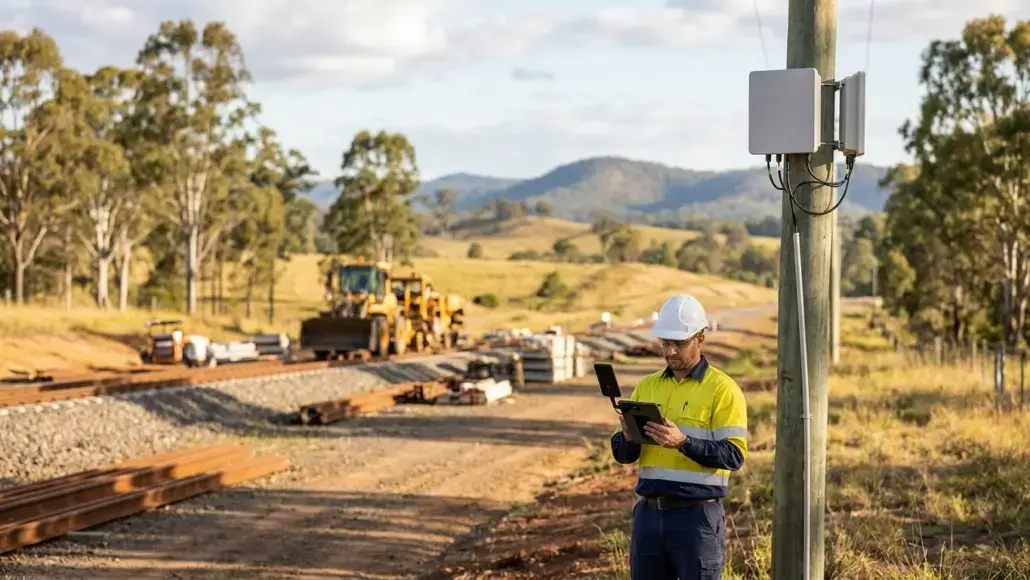

Ericsson has secured a contract to deliver a private 5G platform for the initial phase of Queensland’s next-generation rail infrastructure. Partnering with rail engineering firm UGL Transport and communications specialist Frequentis, Ericsson will deploy a Queensland private 5G network that supports a 5G-enabled Digital Radio System (DRS). This deployment is part of Stage 1 of The Wave, the Queensland Government’s public transport and rail program connecting Brisbane and the Sunshine Coast. The system is scheduled to be fully operational to support passenger services ahead of the Brisbane 2032 Olympic and Paralympic Games.
Enhancing Regional Transport Infrastructure
The DRS contract is one of four work packages within the broader procurement activity for Stage 1 of The Wave, managed by the Department of Transport and Main Roads. The private 5G platform serves as the core foundation for introducing ETCS Level 2, a highly precise digital signaling technology.
Digital Train Control Implementation
Delivered by Alstom, ETCS Level 2 replaces traditional trackside signaling with continuous communication between trains and control systems. This digital train control requires a reliable, high-availability network, which the new connectivity layer provided by Ericsson is purposefully designed to deliver. The first operational segment of this Digital Radio System will be launched on the Sunshine Coast line, a primary corridor in the state’s broader track upgrade plans.
Network Architecture and Technical Integration
The technology partner’s role encompasses the design, supply, integration, testing, and commissioning of a mission-critical Queensland private 5G network for Sector 1 North of the South-East Queensland rail system. The architecture features a private 5G Radio Access Network (RAN) combined with a geographically redundant 5G Core network, supported by advanced cloud infrastructure. This geographically redundant setup is specifically engineered to ensure uninterrupted, high availability for mission-critical rail communications.
Spectrum Use and Interoperability
Operating on Band n101 using 1900 MHz spectrum, the network provides a pathway toward Future Railway Mobile Communication System (FRMCS) capabilities. FRMCS is the global rail industry’s planned successor to the current GSM-R standard. Furthermore, the platform enables Mission Critical Services (MCX) and satisfies vital interoperability requirements where the metropolitan rail lines interface with the National Network for Interoperability.
Future Capabilities and Project Timeline
Beyond immediate signaling needs, the private 5G platform is built to accommodate future voice, video, and data applications as the system naturally evolves. This structural foundation includes advanced operational functions that extend far beyond the primary ETCS Level 2 use cases.
Ludvig Landgren, Head of Ericsson Australia and New Zealand, stated that the mission-critical platform will directly underpin the region’s next-generation rail communications, supporting safer operations and enabling the implementation of digital train control. He noted that the implementation team is proud to deliver this critical infrastructure for the region ahead of the upcoming Brisbane 2032 Olympic and Paralympic Games.
The Brisbane 2032 Olympic Games will run from July 23 to August 8, followed by the Paralympic Games from August 24 to September 5. The new infrastructure is explicitly scheduled to be operational ahead of these dates. This project represents a practical adoption of mission-critical 5G for essential transport infrastructure in Australia, providing a reference case for integrating this technology into other operational environments.