





















NTT Docomo and Mitsubishi Estate are developing 5G Smart City Infrastructure across Tokyo’s Otemachi, Marunouchi and Yurakucho districts, targeting the high data traffic and growing connectivity needs of one of Japan’s leading business areas.
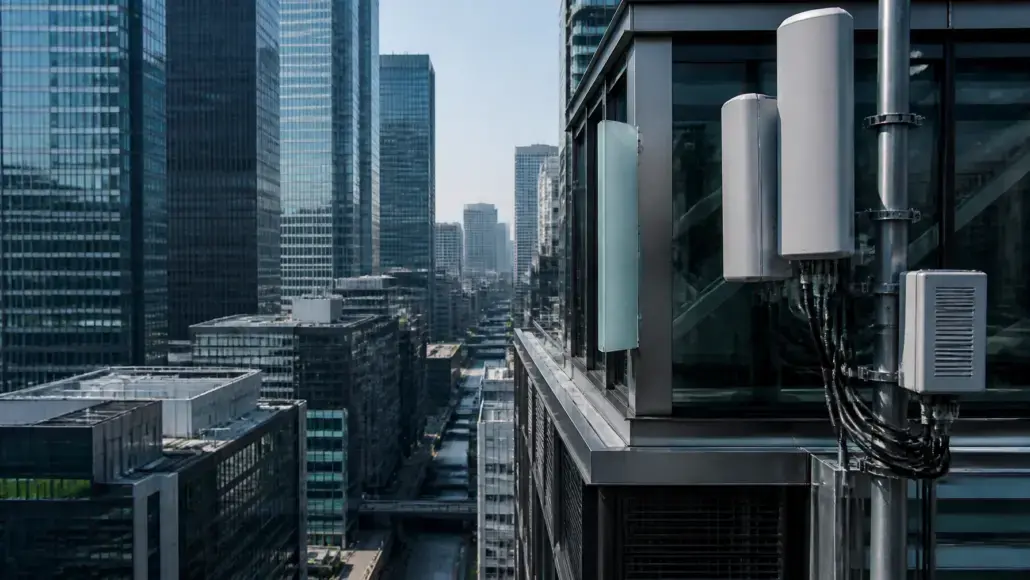
The project will introduce advanced 5G Smart City Infrastructure across the Marunouchi area, including 26GHz millimetre-wave spectrum with 800MHz of combined bandwidth, Tri-Band Massive MIMO and glass antenna technology. The development is designed to strengthen network capacity while supporting the expansion of emerging digital services.
Marunouchi is a major office and commercial district that handles large volumes of daily data traffic. NTT Docomo has already installed new base stations using technologies including glass antennas to improve communication quality. The operator said further infrastructure is needed as demand for digital services increases.
Addressing millimetre-wave deployment challenges
A key challenge for 5G Smart City Infrastructure in the district is the deployment of additional antennas without disrupting the area’s established architectural landscape.
Millimetre-wave signals have strong straight-line propagation but are more vulnerable to physical obstructions. As a result, antennas need to be installed in locations with suitable visibility, making dense deployment more difficult in a historic urban environment.
NTT Docomo and Mitsubishi Estate are therefore exploring urban antenna solutions that can be positioned effectively while limiting their visual impact. The approach is intended to allow 5G Smart City Infrastructure to expand within the district while maintaining the character of the surrounding architecture.
Connecting 5G, fibre and data centres
The companies are also considering the use of Mitsubishi Estate’s infrastructure assets, including data centres and fibre optic networks, to accelerate the development of communications infrastructure required for the smart city clusters.
The combination of wireless and fixed infrastructure could support a more integrated connectivity environment for the area. It also gives the project a broader role beyond individual 5G base stations, linking network infrastructure with existing digital and physical assets.
The initiative is intended to provide a blueprint for deploying 5G Smart City Infrastructure in other major urban areas across Japan. Future smart city projects are also expected to include wired communication environments using All Photonics Network technology.
The development shows how 5G Smart City Infrastructure is evolving in dense urban environments, where network expansion requires advanced radio technologies as well as infrastructure solutions that can work alongside existing buildings, fibre networks and data centres. For NTT Docomo and Mitsubishi Estate, the Marunouchi project provides a model for combining connectivity expansion with the practical demands of modern city development.