






















For decades, telecommunications operators have relied on traditional, monolithic data warehouses to manage their business intelligence and reporting needs. These legacy systems were designed for an era of predictable data growth and structured records, but they are increasingly ill-equipped to handle the massive volumes of unstructured information generated by 5G networks and IoT devices. The centralized nature of these warehouses often leads to severe performance degradation as the data load increases, resulting in long processing times that hinder real-time decision-making. Additionally, the high cost of maintaining and scaling on-premises hardware creates a significant financial burden for operators looking to modernize their infrastructure.
One of the primary difficulties with legacy warehouses is their lack of flexibility in accommodating new types of data. Telecom operators today need to integrate information from a wide variety of sources, including network telemetry, social media feeds, and customer interaction logs. Traditional systems typically require complex and time-consuming ETL processes to transform this data into a format that can be stored and analyzed. This rigidity prevents teams from quickly gaining insights into emerging trends or network issues, which is a major disadvantage in a fast-moving industry. The resulting data silos often mean that different parts of the organization are working with inconsistent or outdated information, leading to operational inefficiencies and missed opportunities.
Beyond these points, legacy systems often lack the built-in security and governance features needed to comply with modern privacy regulations. As data volumes grow, it becomes increasingly difficult to track and control access to sensitive information across a complex and aging infrastructure. This increases the risk of data breaches and non-compliance, which can have devastating consequences for an operator’s reputation and bottom line. Given these challenges, it is clear that the transition to cloud-native data fabrics is not just a technological upgrade, but a necessary step for operators looking to remain competitive and secure in the digital economy.
Architectural Components of Cloud-Native Data Fabrics
The shift toward a more modern data architecture involves the adoption of cloud-native data fabrics, which provide a unified layer for managing information across disparate systems and environments. Unlike traditional warehouses, a data fabric is not a single repository but a set of integrated services that use metadata and machine learning to automate the discovery, integration, and delivery of data. This architectural approach allows for a much higher degree of flexibility and scalability, as it can connect to data regardless of its physical location or format. By providing a consistent view of the entire data ecosystem, the fabric enables more effective collaboration and faster time-to-insight.
At the core of a data fabric are several key components that work together to simplify data management. These include a global metadata catalog that provides a single source of truth for all data assets, and a set of automated integration tools that can connect to a wide range of sources using standardized APIs. The fabric also includes advanced security and governance features that allow for the implementation of consistent policies across the entire environment. By automating many of the manual tasks associated with data management, these components allow IT teams to focus on more strategic initiatives, such as developing new analytical models or optimizing network performance.
Another important feature of cloud-native data fabrics is their ability to support hybrid and multi-cloud environments. This is particularly relevant for telecom operators that may have a mix of on-premises legacy systems and modern cloud-based applications. The fabric acts as a bridge between these different environments, ensuring that data can flow freely and securely between them. This level of integration is essential for supporting complex business processes that span multiple systems and for providing a holistic view of the customer and the network. This approach is highly complementary to a data mesh architecture, which emphasizes decentralized ownership and data as a product.
Integration Strategies for Hybrid Cloud Environments
Successfully migrating from legacy warehouses to a modern data fabric requires a well-defined strategy for integrating disparate systems across hybrid cloud environments. This process often begins with a thorough assessment of the existing data infrastructure to identify the most critical datasets and the systems that produce them. From there, operators can begin to implement the necessary connectivity tools to link their legacy systems to the new data fabric. This might involve the use of specialized connectors or the deployment of lightweight data agents that can ingest information from on-premises databases and stream it to the cloud.
One common approach is to use a phased migration strategy, where certain workloads or datasets are moved to the cloud-native environment while others remain on-premises for a period of time. This allows the operator to gain experience with the new architecture and to demonstrate its value before committing to a full-scale migration. During this transition period, the data fabric plays a critical role in maintaining consistency and visibility across the hybrid environment. By providing a unified access layer, the fabric ensures that users can continue to query and analyze data regardless of whether it is stored in a legacy warehouse or a modern cloud database.
Automating Data Integration and Discovery Processes
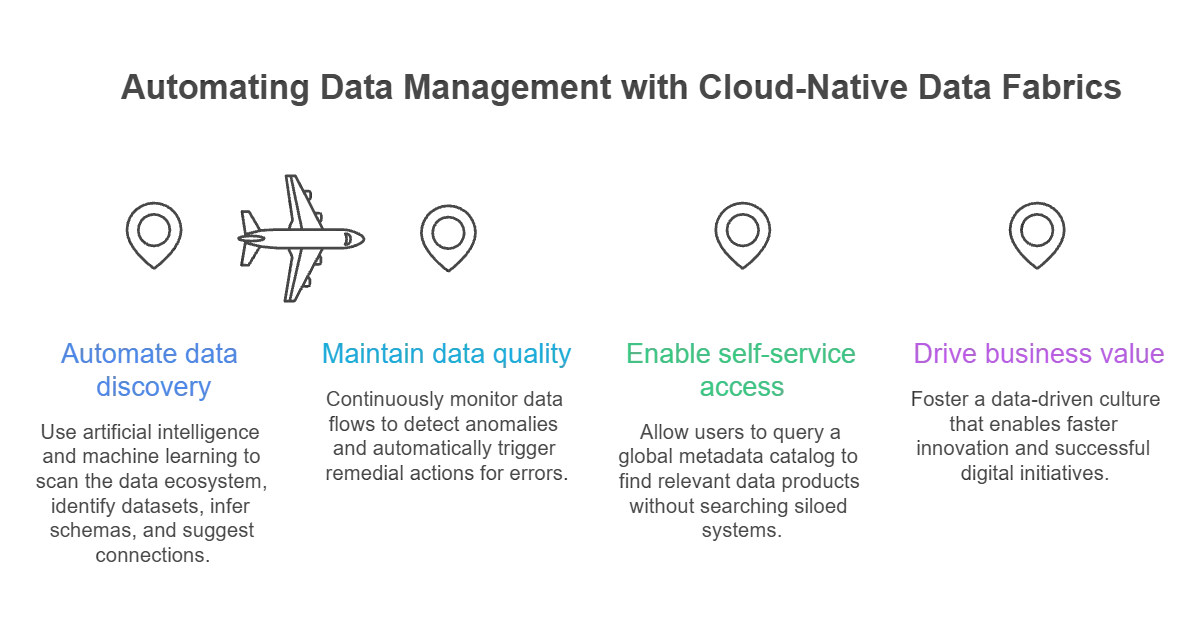
Integration also involves the modernization of existing data pipelines and processing workflows. Instead of traditional batch-oriented ETL, operators are increasingly moving toward real-time streaming and micro-services-based architectures. This allows for more immediate data processing and enables the creation of responsive applications that can react to network events or customer actions as they happen. The use of cloud-native data fabrics facilitates this shift by providing the necessary infrastructure for high-scale, low-latency data integration. By adopting these modern integration strategies, telecom operators can significantly improve the agility and performance of their IT systems.
Long-Term Scalability Benefits for Service Providers
The transition to cloud-native data fabrics provides telecommunications service providers with a foundation for long-term scalability that is simply not possible with legacy systems. Because the fabric is built on top of cloud infrastructure, it can easily scale up or down to accommodate changes in data volume or processing requirements. This elasticity is essential for managing the massive growth in data expected from 5G and future network technologies. It also allows operators to more effectively manage their IT costs, as they only pay for the resources they actually use.
In addition to technical scalability, the data fabric also supports the organizational scalability needed to manage increasingly complex ecosystems. By providing a unified and automated framework for data management, the fabric makes it easier to onboard new partners, integrate acquisitions, and launch services in new markets. This flexibility is a key competitive advantage in an industry that is characterized by rapid change and intense competition. The ability to quickly and easily integrate new data sources and systems allows operators to stay ahead of the curve and to capitalize on new opportunities as they arise.
Ultimately, the long-term benefits of migrating to cloud-native data fabrics extend far beyond simple IT efficiency. By creating a more agile, secure, and data-driven organization, operators can improve every aspect of their business, from network operations to customer service. The insights gained from a modern data architecture can lead to more effective network planning, more personalized marketing campaigns, and more proactive maintenance strategies. For these reasons, the migration away from legacy warehouses is a strategic priority that will shape the future of the telecommunications industry for years to come.