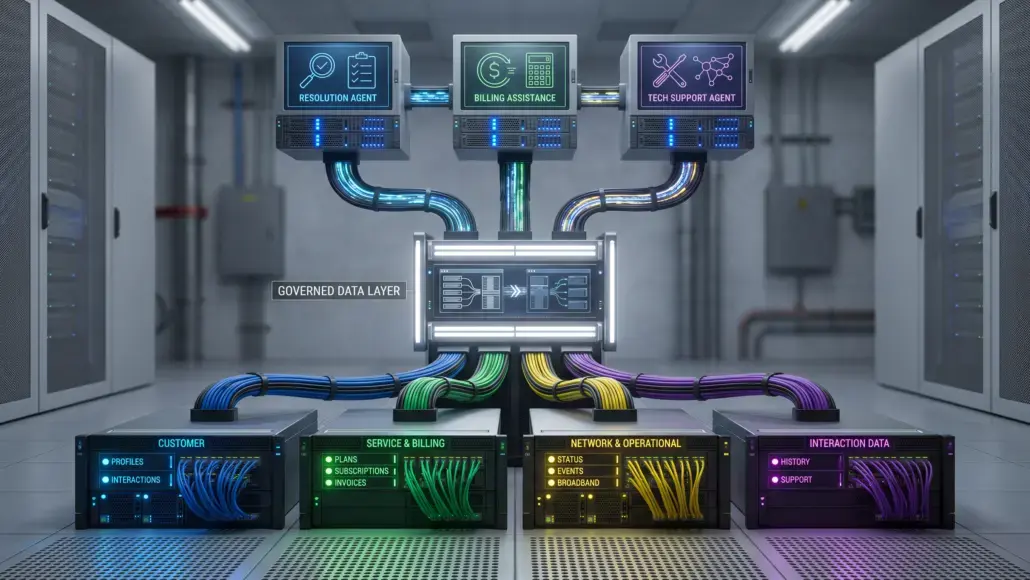
The expansion of AI agents in telecom is exposing a fundamental requirement: agents need reliable access to the data that allows them to understand a customer request, make a decision and take an appropriate action. Telecom operators hold this information across customer relationship management, billing, network, service and operational platforms, often with different data structures and access mechanisms.
This makes telecom AI data architecture increasingly important to the development of agentic customer service. An AI agent may need to combine account information with interaction history, service status and operational data before it can determine what a customer needs. Without a consistent way to discover, access and govern those sources, adding more AI agents can simply create more isolated applications rather than a connected customer-service environment.
AI Agents Need More Than a Model
A large language model can interpret a customer’s request, but it does not automatically know the current state of an account, whether a service is active or whether a network incident is affecting the customer. Those answers have to come from connected enterprise systems.
This creates a distinction between the AI model and the data architecture supporting it. A customer asking why a bill has changed could require access to billing records, plan information, previous interactions and relevant service data. A technical-support interaction could additionally require network or device information.
Telecom AI data architecture therefore needs to make different information sources accessible to AI systems while preserving the controls associated with each source. TM Forum’s AI-Native Blueprint identifies Data Architecture as one of four core workstreams alongside Agentic AI, Security & Governance and AIOps, reflecting the need to develop these capabilities together rather than treating data as a separate infrastructure problem.
Breaking Down the Data Silos
Fragmented data is a particular challenge in telecom because operators commonly run multi-vendor environments with information distributed across legacy and modern systems. TM Forum notes that siloed data and fragmented architectures remain structural barriers to scaling AI, while its AI-Native ODA roadmap argues that isolated AI deployments cannot coordinate decisions across customer, service and network domains without a common architectural foundation.
For customer service, this means an agent should not need to operate within a single application or rely on manually transferred information. A connected architecture can allow customer, service and operational data to be accessed according to the requirements of a particular workflow.
This also changes the role of data architecture. The objective is not simply to store more information, but to make relevant data discoverable, accessible and usable by AI systems while maintaining data quality, permissions and governance.
Data Quality is Becoming an Agent Capability
An agent can only be as reliable as the information it retrieves. An outdated account record, inconsistent service status or incomplete interaction history can lead to an incorrect recommendation or an inappropriate action. This makes data freshness, consistency and lineage important considerations for agentic customer service.
TM Forum’s Modern Data Architecture work specifically highlights the need for telecom data environments to support collaboration and reuse while ensuring that data consumers only access information they are authorised to process. It also identifies the increasing complexity of data applications as a reason for combining easier data access with governance and policy enforcement.
For AI agents, this means the data layer becomes part of the operational control system. Telecom AI data architecture has to determine not only where information resides, but how an agent can discover it, whether it is current enough to use and what actions the agent is permitted to take based on it.
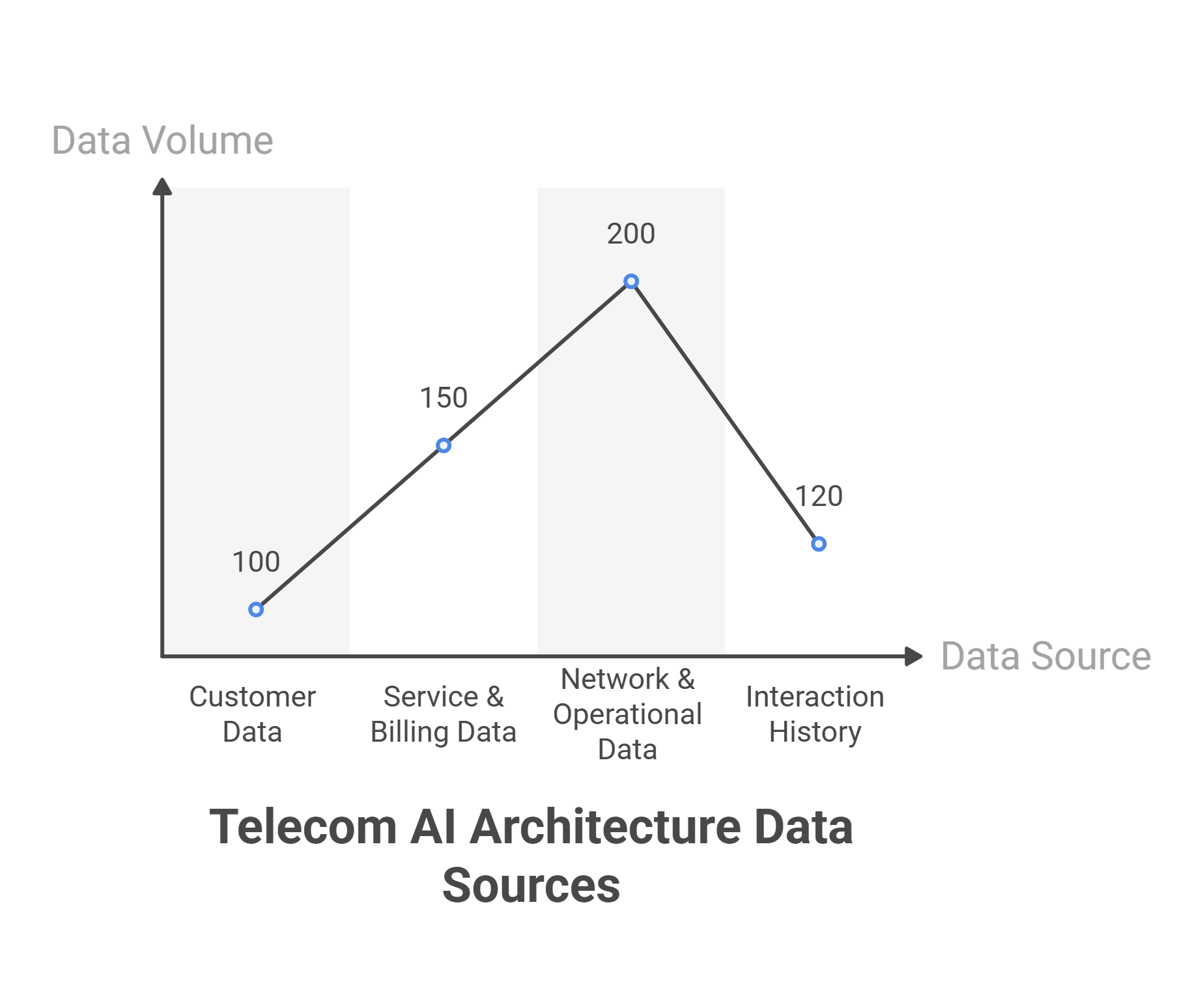
Key Takeaway: AI agents require a governed data foundation that can connect customer, service and network information without removing the controls around access and use.
The development of agentic customer service is therefore becoming as much an architectural challenge as an AI challenge. As operators move beyond isolated pilots, telecom AI data architecture will increasingly determine whether agents can work across multiple telecom domains with the information and controls required for reliable customer interactions.
Telecom Data Architecture is Connecting AI Agents to Operational Systems
The usefulness of an AI agent depends on whether it can access the information and systems required to act on a customer request. In telecom, those resources are distributed across multiple operational environments, including CRM, billing, order management, service assurance and network platforms. An architecture that connects these sources can give agents access to a broader operational view without requiring every application to be rebuilt around AI.
This is making telecom AI data architecture an important layer between telecom systems and agentic applications. Rather than giving an agent unrestricted access to every data source, operators can create controlled pathways through which the agent retrieves the information required for a specific task.
Data Access is Becoming more Structured
A connected data architecture can allow agents to discover relevant information without depending on a single database or application. An account-related request might require billing and subscription data, while a connectivity problem could require service and network information. The architecture therefore needs to support different combinations of data depending on the workflow.
APIs, data services and common information models can help create these connections. They allow an AI agent to request specific information from an underlying system while keeping the operational system itself separate from the conversational interface.
This is particularly relevant as operators deploy multiple agents for different functions. An agent handling billing enquiries should not need the same access as one supporting technical troubleshooting, while both may need some shared customer information. Telecom AI data architecture can provide the common foundation while allowing access to be determined by the role and purpose of each agent.
Real-Time Data is Becoming more Important
Agentic customer service also increases the importance of data freshness. A response based on an outdated service status can be misleading, while an old account record can result in an incorrect recommendation. Data architectures therefore need to distinguish between information that can be retrieved from relatively stable records and information that needs to be obtained in real time.
Network information provides a clear example. If a customer reports poor connectivity, the agent may need the current service state rather than a historical network record. Similarly, an order-related enquiry may depend on the latest fulfilment status rather than information from an earlier system update.
This makes telecom AI data architecture more than a storage or integration layer. It becomes part of the mechanism that determines which information is available to an agent, when that information was last updated and whether it is appropriate to use for a particular decision.
Governance is Becoming Part of the Architecture
Greater access to data also introduces stronger governance requirements. Telecom customer information can include account, billing, usage and service records, meaning that agents cannot simply be given broad visibility across all enterprise systems.
Access policies can restrict an agent to the information required for its task, while authentication and authorisation controls can determine which actions are available after information has been retrieved. Logging and audit mechanisms can also provide visibility into what data an agent accessed and which workflows it initiated.
This becomes increasingly important as agents move from answering questions toward taking action. Retrieving an invoice and changing a customer’s service are fundamentally different operations and should not carry the same level of authority.
The resulting architecture needs to balance accessibility with control. Telecom AI data architecture can support more capable agents by bringing fragmented information together, while governance determines how that information can be accessed and used.
As telecom operators move toward larger agent ecosystems, the data layer will increasingly need to support reuse, real-time access and controlled interaction across multiple domains. That foundation will determine how effectively AI agents can move between customer, service and network contexts without creating new silos.
Data Architecture is Becoming a Foundation for Agentic Telecom Services
The expansion of AI agents in telecom is increasingly dependent on how customer, service and network information is organised and made accessible. Connecting these sources can allow agents to understand requests using current operational context rather than relying on isolated application data.
This makes telecom AI data architecture a foundational element of agentic customer service. Its role is not only to connect systems, but also to manage data quality, access permissions, freshness and governance so that agents can use information reliably.
As operators move from individual AI deployments toward broader agent ecosystems, telecom AI data architecture will determine how effectively agents can work across customer, service and network domains. A stronger data foundation can help prevent new AI silos while giving agents the controlled access they need to support increasingly complex telecom workflows.