

















Close
SATEXPO 2026
Sunday, February 22, 2026
CABSAT 2026

SK Telecom, Deutsche Telekom and Ericsson Join Hands for Transcontinental 5G Trial Deployment at GSMA Mobile World Congress Shanghai 2016

Note* - All images used are for editorial and illustrative purposes only and may not originate from the original news provider or associated company.

Subscribe

- Never miss a story with notifications

- Gain full access to our premium content

- Browse free from any location or device.

Media Packs

Expand Your Reach With Our Customized Solutions Empowering Your Campaigns To Maximize Your Reach & Drive Real Results!

– Access the Media Pack Now

– Book a Conference Call

Leave Message for Us to Get Back

Related stories

AI Driven Automation Redefining Industry Operations

The shift toward intelligent autonomous systems is fundamentally altering the mechanical and logistical foundations of global manufacturing. By integrating advanced cognitive computing into physical production lines, businesses are moving away from rigid, pre-programmed automation toward a flexible, learning-based model that optimizes efficiency, predicts failures, and adapts to market shifts in real-time.

5G Advanced Networks Accelerating Enterprise IoT

The evolution of 5G into its "Advanced" phase represents a critical milestone for industrial connectivity, offering the reliability and precision required for mission-critical operations. By combining dedicated private networks with edge computing and high-density sensor arrays, enterprises can create a seamless digital nervous system that drives the next wave of smart factory innovation and autonomous logistics.

6G Innovation Shaping Future Telecom Networks

The transition from the current 5G landscape to the nascent world of 6G represents a monumental shift in the fabric of global connectivity. By integrating artificial intelligence directly into the network architecture and exploring the untapped potential of the Terahertz spectrum, the next generation of wireless technology will bridge the gap between physical reality and digital simulation, enabling a truly hyperconnected world.

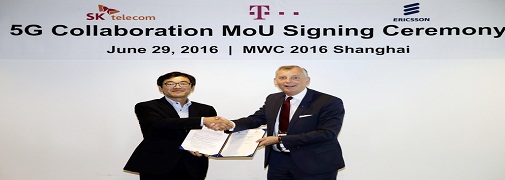
SK Telecom signs an MOU with Deutsche Telekom and Ericsson to jointly develop 5G core network at GSMA Mobile World Congress Shanghai 2016.At MWC Shanghai 2016, SK Telecom and Ericsson also showcased 26.9 Gbps transmission speed over the air and Software-Defined Telecommunications Infrastructure

SK Telecom’s CTO Alex Jinsung Choi participated in the panel discussion to share the company’s 5G vision and ambition.

SK Telecom (NYSE: SKM) announced today that it signed a memorandum of understanding (MOU) with Deutsche Telekom and Ericsson to cooperate in the development of the 5G core network*. The signing ceremony took place at Kerry Hotel Pudong, where the GSMA Mobile World Congress Shanghai is being held.

The core network can be described as the control tower of telecommunication network, performing important features to provide services including user authentication, mobility and session managements, voice calls, and Internet connectivity. As end user traffic must go through not only radio access network but also core network before reaching the Internet, radical renovations on the core network architecture is one of the keys to the successful implementation and commercialization of 5G.

Through the partnership, the three parties will deploy trial network in Korea and Germany based on key 5G technologies, including NFV(Network Functions Virtualization), SDTI(Software-Defined Telecommunications Infrastructure), distributed cloud, and network slicing technologies. The aim of this world’s first transcontinental trial is to provide optimized end-user experiences by providing consistent quality of services and roaming experiences for advanced 5G use cases with enhanced global reach.

As SK Telecom in Korea and Deutsche Telekom in Germany collaborate with ecosystem, the alliance will jointly develop 5G use cases, conduct global marketing promotions, and work for potential standardization.

Moreover, at the GSMA booth located within the GSMA Innovation City, SK Telecom and Ericsson has demonstrated 26.9Gbps transmission speed over the air, which the fastest 5G transmission speed demonstrated so far. The two companies have successfully demonstrated the 26.9Gbps in May 2016 in Korea. Moreover, they are also displaying ‘Software-Defined Telecommunications Infrastructure (SDTI)*, an infrastructure platform that will be applied to the 5G pilot system by the end of 2016.

SDTI refers to an infrastructure platform where all mobile network infrastructure components, such as CPU, memory and storage, are disaggregated as customizable modules that can be flexibly and dynamically recomposed together to provide the optimal level of infrastructure scale for various 5G services based on their requirements.

Meanwhile, Alex Jinsung Choi, CTO of SK Telecom, has participated in the panel discussion (“5G – Beyond speed into a new paradigm”) of the GSMA Network 2020 Summit. CTO Choi shared SK Telecom’s 5G vision, stressing that the 5G system will make people’s lives safer, more efficient and more pleasant/interesting by offering personalized and customized services based on open platforms unlike the former generations of the mobile networks.

Latest stories

Related stories

AI Driven Automation Redefining Industry Operations

The shift toward intelligent autonomous systems is fundamentally altering the mechanical and logistical foundations of global manufacturing. By integrating advanced cognitive computing into physical production lines, businesses are moving away from rigid, pre-programmed automation toward a flexible, learning-based model that optimizes efficiency, predicts failures, and adapts to market shifts in real-time.

5G Advanced Networks Accelerating Enterprise IoT

The evolution of 5G into its "Advanced" phase represents a critical milestone for industrial connectivity, offering the reliability and precision required for mission-critical operations. By combining dedicated private networks with edge computing and high-density sensor arrays, enterprises can create a seamless digital nervous system that drives the next wave of smart factory innovation and autonomous logistics.

6G Innovation Shaping Future Telecom Networks

The transition from the current 5G landscape to the nascent world of 6G represents a monumental shift in the fabric of global connectivity. By integrating artificial intelligence directly into the network architecture and exploring the untapped potential of the Terahertz spectrum, the next generation of wireless technology will bridge the gap between physical reality and digital simulation, enabling a truly hyperconnected world.

AI Powered Digital Transformation in Enterprise IT

The integration of artificial intelligence into the core of enterprise technology is no longer an optional luxury but a fundamental necessity for survival in the modern digital economy. By moving beyond simple task automation toward a state of autonomous, data-driven decision-making, organizations can unlock unprecedented levels of efficiency, predictive security, and cloud-based scalability that redefine the boundaries of what a modern business can achieve.

Subscribe

- Never miss a story with notifications

- Gain full access to our premium content

- Browse free from any location or device.

Media Packs

Expand Your Reach With Our Customized Solutions Empowering Your Campaigns To Maximize Your Reach & Drive Real Results!

– Access the Media Pack Now

– Book a Conference Call

Leave Message for Us to Get Back

Translate »