











AI Agents Need a New Interface to the Network
The value of network APIs becomes clearer as AI agents move from generating information to carrying out tasks. An agent may need more than access to an application database. In a telecom environment, it may need current information about a connected device, the quality of the network serving it, its location or the availability of a nearby edge resource. Standardised APIs give that intelligence a defined way into the network.
This is where CAMARA and GSMA Open Gateway become important. CAMARA is developing operator-agnostic APIs so developers do not have to create a different integration for every telecom provider. GSMA Open Gateway is using those standardised interfaces to create a broader cross-operator environment. By March 2026, 86 operator groups representing more than 300 networks and 80% of global mobile connections were aligned with the Open Gateway framework. More than 60 channel partners were commercialising network APIs.
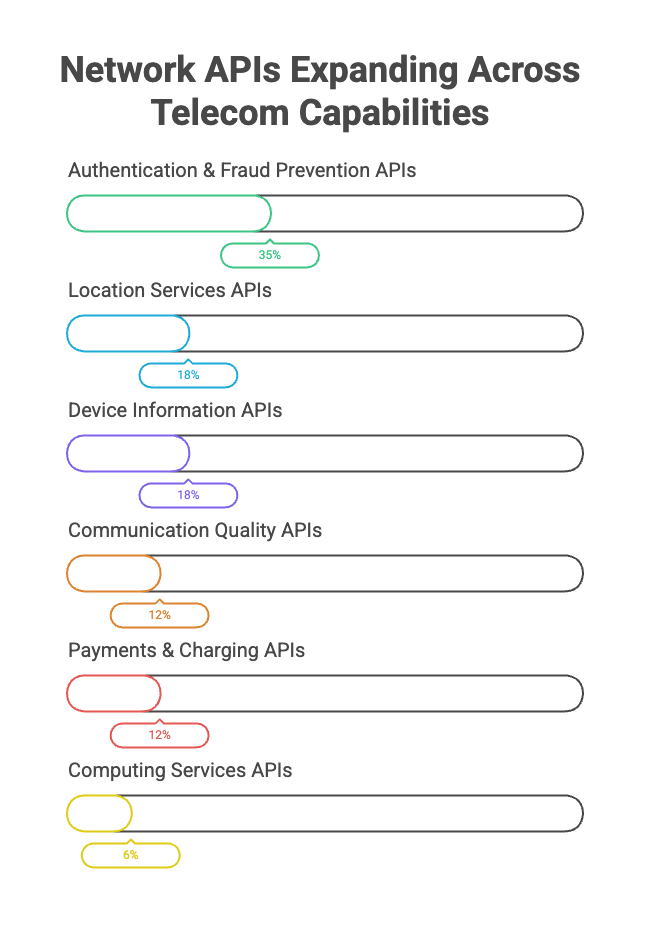
The breadth of the API layer is also expanding. The current Open Gateway catalogue lists 17 APIs across authentication and fraud prevention, location services, device information, communication quality, payments and charging, and computing services. That includes capabilities such as device location, device reachability, Quality on Demand and Simple Edge Discovery.
For an AI application, this means the network can become a source of live operational context rather than an invisible transport layer. A system could, for example, verify a device’s location, determine whether it is reachable or identify an appropriate edge location before deciding how an application should proceed.
Model Context Protocol Is Connecting AI to Network Capabilities
The next development is making these network capabilities easier for AI systems to discover and use.
In January 2026, CAMARA published a white paper describing how Model Context Protocol (MCP) can work with CAMARA APIs. The proposed architecture uses an MCP server to translate a CAMARA network API into an AI-readable tool, allowing AI applications and agents to discover and call network capabilities while retaining policy, consent and security requirements.
The significance is architectural. A traditional software integration usually depends on developers knowing which endpoint to call and how to handle its response. An AI agent needs a more discoverable tool layer because it may determine during its reasoning process that network information or a network capability is relevant to the task.
That approach is already moving into implementation. In July 2026, Orange contributed the first provider implementation to CAMARA’s MCP Enablement initiative, exposing network capabilities including device location, SIM-swap detection, identity verification and quality of service as tools that compatible AI assistants and agents can invoke.
The infrastructure challenge now extends beyond making APIs available. Telecom operators need to make those interfaces reliable, secure and predictable enough for machine-driven consumption. CAMARA’s work is therefore also addressing API design, security, consent requirements and AI-readable definitions, while its technical proposals call for authoritative MCP tool definitions to remain aligned with corresponding CAMARA API versions.
That matters because AI agents could generate a very different usage pattern from conventional applications. An agent may make API requests dynamically and potentially at high frequency as it works through a task. GSMA has highlighted this shift toward more high-frequency and non-deterministic API behaviour, making governance, security, capacity and policy controls increasingly important parts of the network API architecture.