













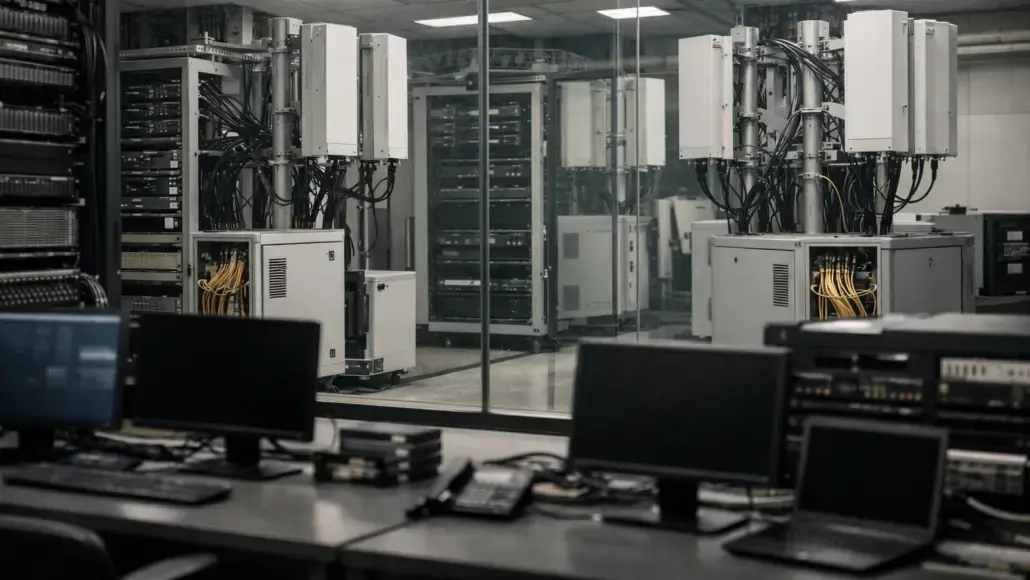
As telecom networks become more software-driven and increasingly autonomous, operators face a basic problem: artificial intelligence needs to make decisions about infrastructure that is too important to use as a testing ground. Changing network parameters, routing, capacity or service configurations directly on a live network can affect performance for large numbers of users. Digital twins are emerging as a way to give AI a realistic environment in which to model those changes, assess their likely effects and refine decisions before they reach production infrastructure.
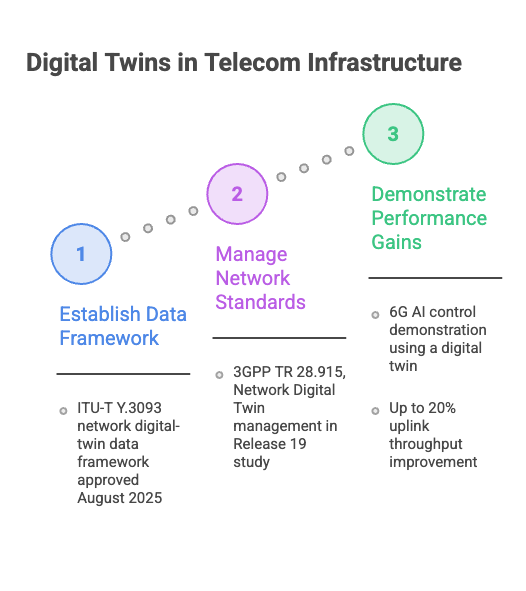
A network digital twin is more than a visual copy of a network. It is a virtual representation that can reflect the physical and operational state of the real network using data such as equipment configuration, device status, events, topology, performance and service information. The ITU’s Y.3093 recommendation, approved in August 2025, establishes requirements for the data domain supporting network digital twins and specifically highlights real-time interaction between physical and virtual networks.
That real-time relationship is what makes digital twins relevant to autonomous telecom infrastructure. A static model can show what a network looks like, but an operational twin can help represent what the network is doing now and how it may respond to a proposed change. AI can then use that environment to test configurations, evaluate possible outcomes and identify a preferred action without immediately applying every experiment to the live network.
The Network Needs a Virtual Environment for AI
The need becomes more important as networks move toward higher levels of autonomy. An autonomous system has to do more than detect a fault. It needs to understand the network state, evaluate possible responses and determine whether a change could create a new problem somewhere else.
A digital twin can support that process by bringing different network data sources into one environment. ITU’s framework includes historical and operational data, device status, network topology, performance information, events and service data, while also requiring compatibility with existing databases, data lakes and physical network equipment.
This creates a foundation for AI-driven simulation and optimisation. Instead of making a network change first and observing the result afterwards, operators can increasingly test potential decisions against a virtual representation of the infrastructure.
The concept is already moving into next-generation network research. Work on network digital twins is now part of formal 3GPP standardisation, with the Release 19 study TR 28.915 focused specifically on the management aspects of Network digital twins.
Research demonstrations are also beginning to show measurable performance benefits. A 2026 6G RAN study using digital-twin-based AI control reported up to 20% improvement in uplink throughput in its demonstrated scenario. The digital twin was used to evaluate and validate the AI-driven network-control approach before applying it to the real-world environment.
The significance is not the 20% figure alone, which comes from a specific demonstration rather than an industry benchmark. It is that a virtual representation of the network can become part of the process through which AI decisions are evaluated.