




















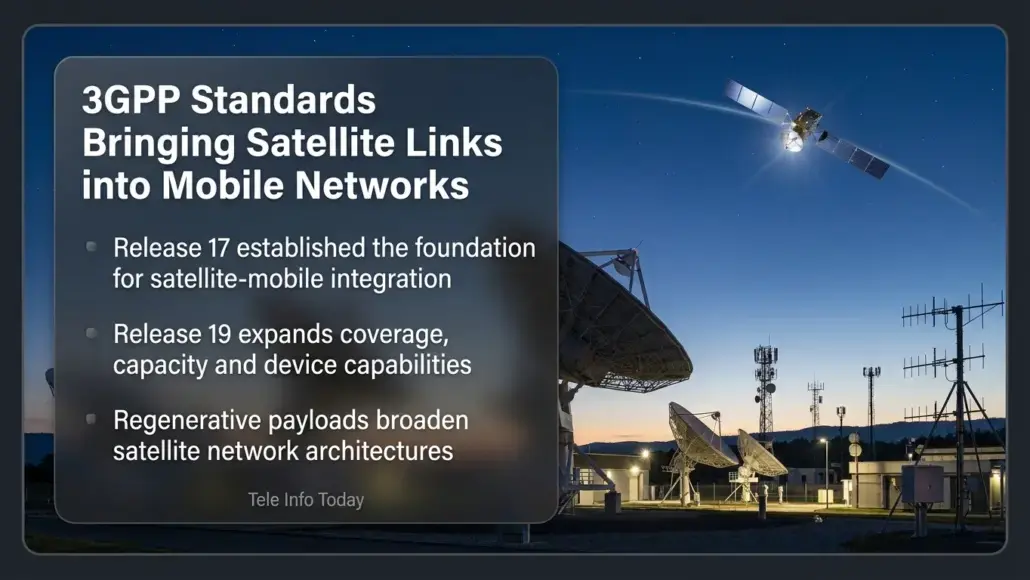

3GPP standards are turning satellite connectivity into a more structured extension of the mobile ecosystem. Developed by the Third Generation Partnership Project (3GPP), they provide a common technical framework for linking non-terrestrial networks with cellular systems. This is important as satellite-to-device services need to work across radios, devices, network functions and satellite architectures rather than operate as isolated connectivity products.
- Release 17 established the foundation for New Radio Non-Terrestrial Networks (NR-NTN) and IoT-NTN.
- The release supports satellite-based 5G New Radio and low-power IoT technologies.
- Transparent satellite payloads are supported across geostationary and non-geostationary configurations.
- The framework created a baseline for integrating satellite links with the wider 5G architecture.
Releases Extending Satellite-Mobile Network Capabilities
The role of 3GPP standards extends beyond the radio interface, covering areas such as network architecture, radio requirements, device capability signalling and conformance. Release 18 continued the NTN work with additional enhancements, while Release 19 is broadening the technology toward improved downlink coverage and uplink capacity, broadcast services and support for half-duplex devices, including reduced-capability equipment. Release 19 also advances regenerative payload architectures, where elements of the radio access network can be placed onboard the satellite.
- Release 19 addresses downlink coverage and uplink capacity improvements.
- Broadcast capabilities expand the potential uses of satellite links beyond direct device connections.
- Half-duplex, RedCap and eRedCap devices broaden the range of equipment that can support NTN.
- Regenerative payload support creates additional architectural options for satellite-mobile networks.
The progression of 3GPP standards reflects a shift from demonstrating that satellite links can connect devices toward defining how those links can operate as part of mainstream mobile infrastructure. Common specifications can support greater reuse of device and network technologies, although commercial interoperability will still depend on spectrum access, licensing, satellite capacity, network agreements and device capabilities.
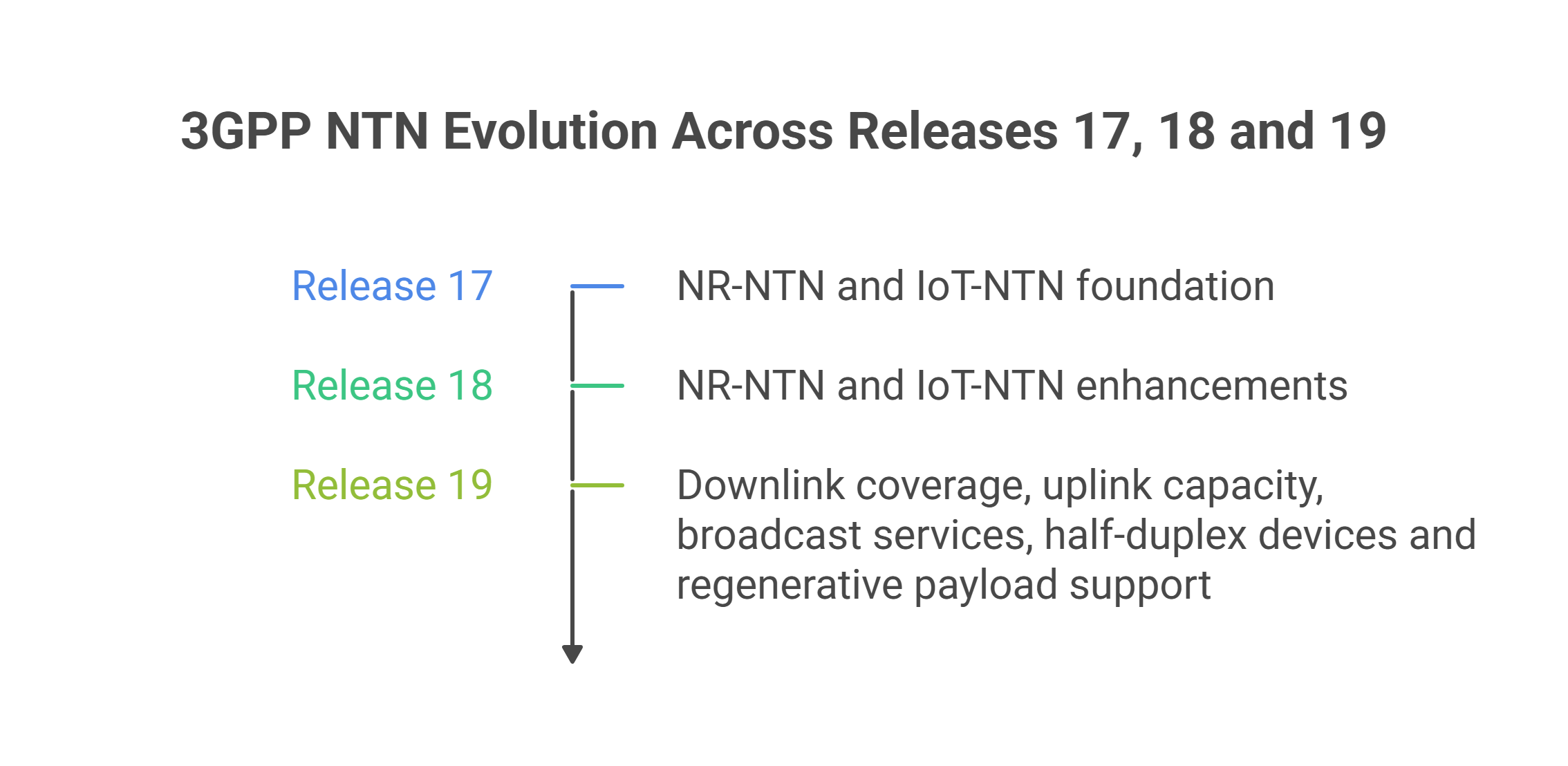
The timeline shows how successive releases are expanding the technical foundation for integrating satellite links into mobile networks.
Release 19 Expanding the Capabilities of Satellite-Mobile Networks
The development of 3GPP standards is moving beyond the initial NTN foundation established in Release 17. Release 18 introduced further enhancements, while Release 19 is broadening the range of satellite-mobile capabilities being addressed through the standards process. The work includes improvements to downlink coverage and uplink capacity, along with support for broadcast services and half-duplex user equipment, including RedCap and eRedCap devices.
These developments are important because satellite networks face different propagation conditions, coverage patterns and capacity constraints from terrestrial cellular systems. Improving how mobile devices and networks handle those conditions can make satellite access more practical across a wider range of applications and device categories.
Release 19 Extending NTN Performance and Device Support
Current Release 19 work is addressing several areas that could strengthen the integration of satellite links into mainstream mobile architectures:
- Downlink coverage improvements can help extend usable service areas and improve the consistency of satellite-based mobile connectivity.
- Uplink capacity enhancements address the ability of devices to transmit information efficiently over satellite links, an important consideration as services move beyond basic messaging.
- Broadcast support opens additional possibilities for distributing information over wide satellite footprints rather than relying exclusively on one-to-one connections.
- Half-duplex and reduced-capability devices extend NTN support toward equipment with different power, cost and hardware requirements.
The scope of 3GPP standards is therefore expanding from basic connectivity support toward a broader set of operating requirements for different satellite and terrestrial network configurations.
Regenerative Architectures Bringing Network Functions Closer to Orbit
Another significant area in Release 19 is support for regenerative payload architectures. Unlike transparent payloads, regenerative satellites can incorporate network functions onboard the spacecraft, including elements associated with the radio access network.
This approach can change how traffic is processed between the satellite and terrestrial infrastructure. It may reduce dependence on some ground-based functions and create additional architectural options for satellite-mobile networks, although the practical benefits will depend on constellation design, spectrum, gateway infrastructure and network deployment models.
- Regenerative architectures can provide greater flexibility in how satellite traffic is processed and routed.
- Standards-based support can give equipment and satellite developers a clearer framework for building interoperable implementations.
Qualcomm’s X105 5G Modem-RF platform provides an example of how 3GPP standards are moving into commercial silicon, with support for Release 19-ready 5G NR-NTN capabilities. Such implementations indicate that standards development is increasingly being translated into device and network technologies rather than remaining confined to specifications.
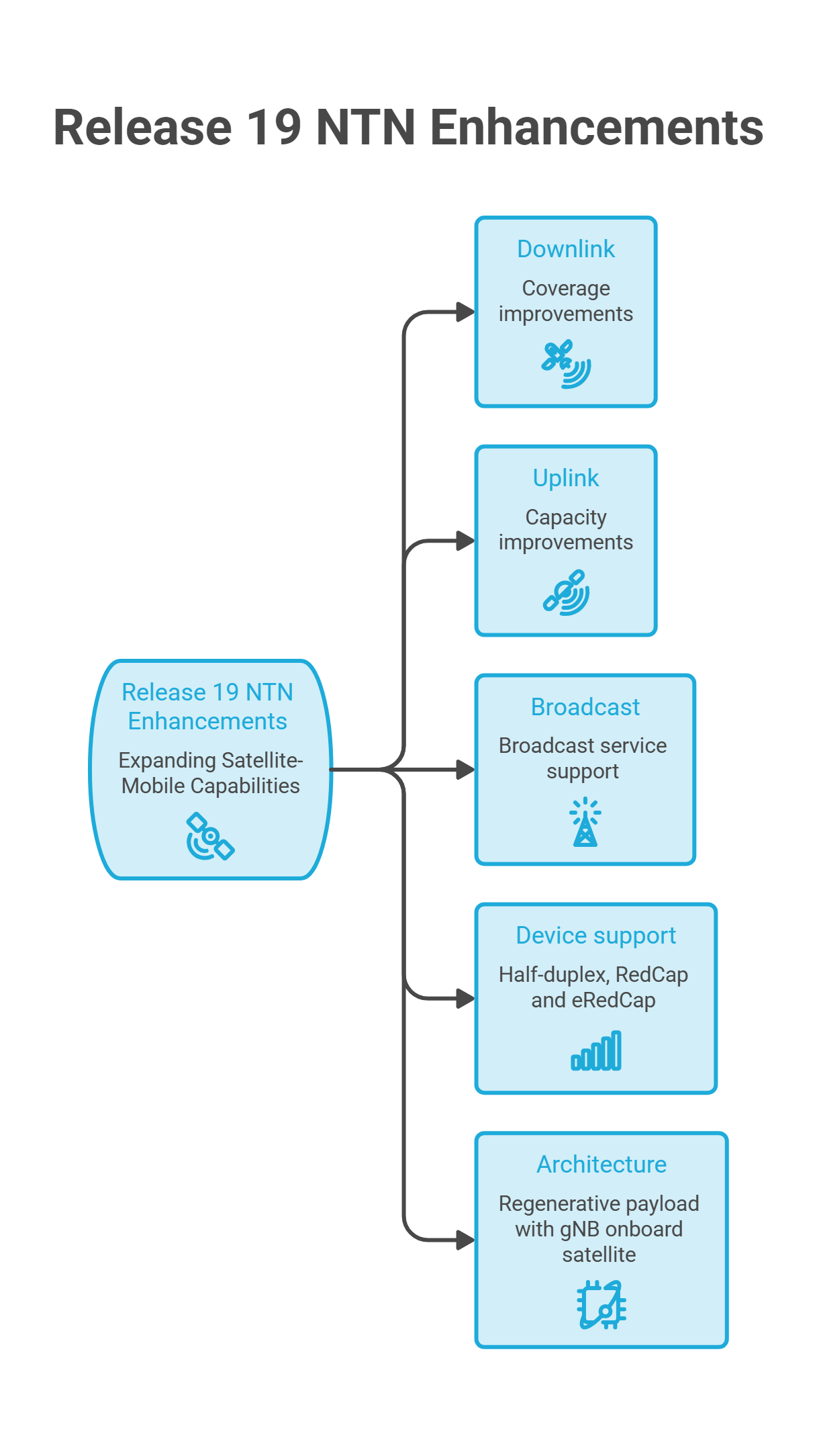
The matrix highlights how Release 19 is expanding NTN from foundational satellite connectivity toward broader network, device and architectural capabilities.
Standards Moving Satellite Connectivity Toward Mobile Networks
The expansion of 3GPP standards is giving satellite connectivity a more defined path into mainstream mobile architectures, from radio interfaces and device capabilities to evolving network designs. Release 19 broadens this foundation with improvements spanning coverage, capacity, broadcast services and regenerative payloads, while commercial modem development is beginning to reflect those specifications.
Standards alone, however, will not determine how quickly satellite-mobile services scale. Spectrum policy, licensing, satellite capacity, device hardware, gateway infrastructure and agreements between operators and satellite providers will continue to shape deployment. The next stage will increasingly depend on how these technical standards are translated into operator services and customer offerings.
The transition from technical specifications to commercial network services is examined through 3GPP standards for satellite-mobile integration.
References
- 3GPP – NR NTN Specifications and Work Items – 2026
- 3GPP – NR NTN Phase 3 Release 19 Change Requests – 2026
- Qualcomm – Qualcomm Announces 5G Advanced Leap with Qualcomm X105 5G Modem RF – 2026