






















The development of 6G is increasingly being shaped by technologies and capabilities that are already advancing through 5G-Advanced. Rather than representing a complete break from existing mobile networks, the next generation is being developed through a sequence of standards, research programmes and technical improvements that build on the foundations established by 5G.
This makes 5G advanced 6G an important part of the industry’s technology transition. 3GPP identifies Release 18 as the first 5G-Advanced release, with work spanning areas such as enhanced radio capabilities, artificial intelligence and machine learning, network energy efficiency and broader network performance. Subsequent releases are continuing this development while dedicated 6G studies are beginning to define the requirements for the next generation.
5G-Advanced is Creating a Bridge to the Next Generation
The relationship between the two generations is also visible in the standards timetable. 3GPP’s Release 20 programme includes dedicated 6G studies, while Release 21 is expected to carry the first normative 6G specifications. At the same time, development of the 5G-Advanced architecture continues, creating a period in which the two technology cycles overlap.
This overlap is important because many capabilities associated with future networks are already being explored within 5G-Advanced. AI and machine learning are being introduced into network operations, energy-saving mechanisms are being developed and new approaches to connectivity and sensing are being studied. These developments provide technical experience that can help inform the requirements and architecture of later systems.
The International Telecommunication Union is following a similar evolutionary approach through its IMT-2030 framework. The framework describes 6G as building on the existing IMT-2020 foundation while introducing additional capabilities and new usage scenarios. This positions 5G advanced 6G development as a progression in which established network technologies are extended while new capabilities are introduced.
Standards are Moving from Concepts Toward Measurable Requirements
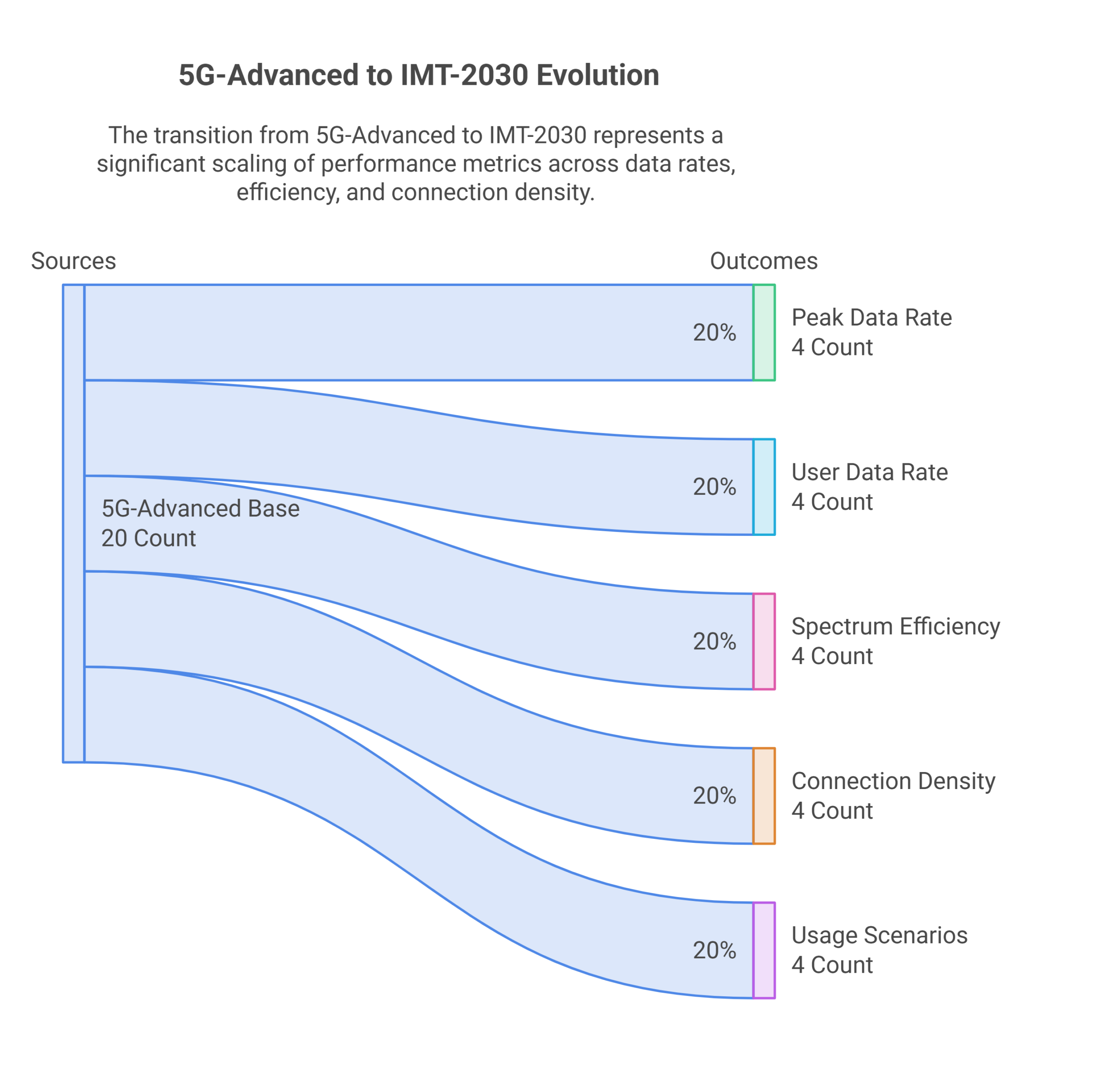
The transition is becoming more concrete as international standards bodies define measurable performance requirements for 6G. In 2026, the ITU completed draft technical performance requirements for IMT-2030 covering 20 minimum technical performance requirements, including several that are specific to 6G.
The framework also introduces new usage scenarios alongside enhanced versions of established mobile connectivity applications. These include immersive communication, ubiquitous connectivity, artificial intelligence and communication, and integrated sensing and communication.
The significance of this process is that 6G is increasingly being evaluated through defined technical parameters rather than broad predictions about future connectivity. At the same time, 5G-Advanced continues to develop capabilities that address many of the same underlying challenges, including higher performance, greater intelligence and more efficient network operation.
The result is a technology transition that is being built progressively. 5G advanced 6G development is therefore less about replacing one generation with another overnight and more about extending current capabilities while establishing the technical conditions for the next stage of mobile networks.
5G-Advanced Capabilities are Aligning with 6G Requirements
The transition from 5G-Advanced to 6G is becoming more tangible as international standards bodies move from broad technology visions toward measurable requirements. The relationship is not based on simply carrying existing technologies into a new generation. Instead, capabilities being developed through 5G-Advanced are addressing several of the same technical challenges that the IMT-2030 framework is now defining in greater detail.
This makes 5G advanced 6G development increasingly relevant across multiple areas of network design. Artificial intelligence, higher performance, expanded connectivity, sustainability and integrated sensing are all appearing within the development paths of both generations, although their eventual implementation in 6G may differ significantly.
5G-Advanced Capabilities are Aligning with Emerging 6G Targets
The scale of the transition can be seen in the ITU’s latest IMT-2030 requirements. The framework defines 20 minimum technical performance requirements, including targets for peak data rates of 50–200 Gbit/s, user-experienced data rates of 300–500 Mbit/s or higher, and spectrum efficiency improvements of 1.5–3 times compared with IMT-2020. Connection density targets range from 1 million to 100 million devices per square kilometre, depending on the requirement.
These are not commercial network guarantees. They are minimum performance levels used to evaluate candidate IMT-2030 radio interface technologies. The distinction matters because the figures describe the direction of technical development rather than a forecast of what every future network will deliver.
Several of the underlying challenges are already being addressed through 5G-Advanced. Improvements in radio performance, AI-assisted optimisation, energy efficiency and expanded coverage are establishing technical experience that can inform later systems.
New 6G Capabilities are Building on an Existing Foundation
The connection becomes even clearer in areas where the ITU has introduced capabilities beyond the established 5G framework. IMT-2030 includes six usage scenarios, with three familiar communication-oriented scenarios and three newer directions, including artificial intelligence and communication, ubiquitous connectivity, and integrated sensing and communication.
The framework also identifies new capabilities including AI integration, advanced sensing, improved positioning and sustainability. At the same time, 5G-Advanced is already developing technologies that address related requirements, creating an overlap between current network evolution and future 6G research.
This overlap is particularly important for the standards process. In June 2026, ITU-R completed draft evaluation guidelines for IMT-2030 candidate technologies, defining 3 evaluation methods and 7 test environments, including new environments specifically designed around industrial use cases and integrated sensing.
The numbers show how the transition is becoming more structured. 5G advanced 6G development is increasingly moving from technology concepts toward defined performance requirements, test environments and evaluation procedures.
Key Takeaway: 6G is being defined through measurable performance and evaluation criteria while building on technical areas already advancing through 5G-Advanced.
The broader direction is therefore one of progressive expansion rather than technological replacement. As 5G-Advanced continues to mature, its work is helping address some of the performance, intelligence, efficiency and connectivity challenges that 6G is expected to take further. 5G advanced 6G development is consequently becoming a continuous standards and technology pathway, with current improvements increasingly feeding into the requirements of the next generation.
5G-Advanced is Creating a Gradual Path Toward 6G
The transition from 5G-Advanced to 6G is increasingly taking shape through overlapping standards and technology development rather than a single generational shift. Capabilities being refined today, from advanced radio performance and AI-enabled operations to greater efficiency and expanded connectivity, are contributing to the technical foundation for future networks.
The move toward IMT-2030 is also becoming more structured as international bodies establish measurable performance requirements, evaluation methods and new usage scenarios. This provides a clearer framework for determining which technologies can meet the demands of the next generation.
5G advanced 6G development will therefore remain an evolutionary process, with current 5G-Advanced improvements providing technical experience while 6G introduces new architectural capabilities. The result is a gradual transition in which standards, network technologies and performance requirements increasingly converge toward the next generation of mobile connectivity.