





















Artificial intelligence and machine learning are becoming increasingly embedded in the operation of mobile networks as 5G-Advanced develops. The focus is moving beyond using AI to analyse network information toward applying machine learning directly to functions that influence network performance, resource allocation and operational efficiency. This is giving 5G advanced AI a broader role within the network itself.
3GPP has been developing the technical foundations for this shift through its 5G-Advanced standardisation work. Rel-18 introduced AI/ML support for the 5G radio access network, including procedures for data collection, model training and inference. This creates a framework in which network measurements can be processed by models and the resulting outputs used to support specific network functions.
AI/ML is Moving Deeper into Network Operations
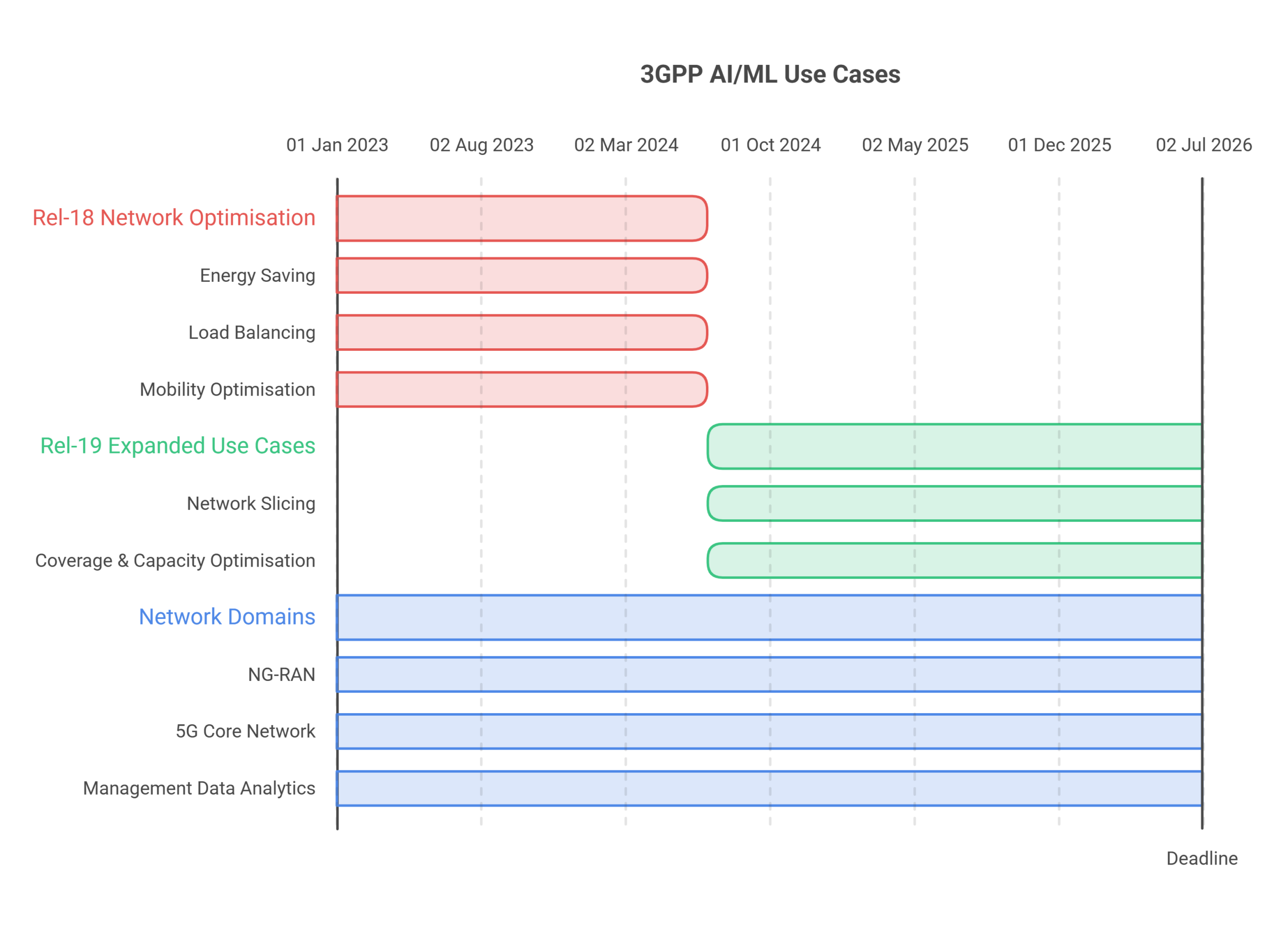
The initial use cases provide a clear indication of where this development is heading. 3GPP Rel-18 identified AI/ML applications for network energy saving, load balancing and mobility optimisation. These are operational functions that directly affect how networks use resources and respond to changing traffic and mobility conditions.
Energy-saving applications can use network conditions to help determine when resources can be reduced or reconfigured. Load balancing can analyse traffic and network conditions to support more effective resource allocation, while mobility optimisation can use collected measurements to improve decisions around movement between cells.
These applications show that 5G advanced AI is becoming associated with network decisions rather than being limited to a separate analytics layer. The effectiveness of these functions depends on the availability of relevant operational data, suitable models and mechanisms for applying model outputs within the network.
Standardisation is Expanding the Scope of Network Intelligence
The development is continuing through later 5G-Advanced releases. Rel-19 work has expanded AI/ML applications into areas including network slicing and coverage and capacity optimisation. At the same time, AI/ML management work is addressing functions across the 5G radio access network, 5G Core Network and management data analytics.
This broader scope increases the number of network functions that can potentially use machine learning. It also introduces more requirements around how data is collected, how models are trained and deployed, and how inference is managed after deployment. Data quality therefore becomes an important part of the overall architecture, alongside model performance.
5G-Advanced AI is Expanding Beyond Individual Network Functions
The development of AI and machine learning in 5G-Advanced is moving from individual optimisation tasks toward a broader network management capability. As standards work expands the number of functions that can use AI/ML, networks are increasingly being designed to collect information, train or apply models and use their outputs as part of ongoing operational processes.
The shift is particularly visible in network slicing and coverage and capacity optimisation. These use cases require the network to process changing conditions and produce information that can support decisions over time, moving the role of 5G advanced AI beyond static analysis toward more continuous optimisation.
Network Intelligence is Expanding Beyond RAN Optimisation
Network slicing provides one example of this broader role. Rel-19 work includes AI/ML-assisted mechanisms that can use predicted slice-level information and user-equipment performance feedback. Rather than assessing network conditions only after they occur, the approach is intended to support the use of predictive information within network management.
Coverage and capacity optimisation follows a similar direction. AI/ML can be used to identify potential future coverage or capacity issues and provide predicted information that can support optimisation decisions. This is important because network demand changes continuously across locations, users and time periods. A model capable of anticipating those changes could help operators adjust network resources before performance deteriorates.
The development also increases the importance of model lifecycle management. AI/ML functions require more than a trained algorithm. Networks need mechanisms for model training, testing, deployment, transfer, inference and ongoing management. 3GPP’s work on AI/ML management is therefore expanding alongside the use cases themselves.
From Network Data to Continuous Optimisation
The wider architecture also brings AI/ML closer to multiple layers of the network. 3GPP management work covers AI/ML capabilities across the 5G radio access network, 5G Core Network and management data analytics. This creates a broader environment in which information generated by different network functions can contribute to optimisation and decision-making.
The result is a more continuous relationship between data and network behaviour. Operational information can be collected from network elements and user equipment, processed through models and used to influence subsequent network decisions. 5G advanced AI is therefore becoming less about a single automated function and more about creating feedback mechanisms that allow networks to adjust to changing conditions.
This also creates practical requirements around data governance. Models depend on the relevance, volume and quality of the information used to train and operate them. As AI/ML expands across network functions, operators will need to manage data collection, model performance and lifecycle processes alongside conventional network operations.
The direction of standardisation suggests that 5G advanced AI will increasingly support networks that can anticipate conditions, optimise resources and adapt operations with less manual intervention. That progression provides an important bridge between current 5G-Advanced capabilities and the more deeply intelligent architectures being explored for 6G.