

















The Internet of Things (IoT) has already begun to reshape the way we live and work, from smart homes that adjust their temperature to factories that predict when a machine is about to fail. However, for most of its history, the IoT has been constrained by the limits of terrestrial connectivity. In a world where only 15% of the earth’s surface is covered by cellular networks, billions of potential “things” have remained offline, unable to share their data. This is now changing as space based IoT advancing enterprise telecom solutions provides a global connectivity layer that can reach into the deepest oceans, the highest mountains, and the most remote deserts, unlocking a new era of industrial intelligence and efficiency.
The Massive Scale of the Space IoT Opportunity
The sheer scale of the opportunity for space-based IoT is staggering. According to industry analysts, there are millions of high-value assets from shipping containers and oil pipelines to endangered wildlife and agricultural sensors that are currently operating in “blind spots” where no terrestrial network exists. Space based IoT advancing enterprise telecom solutions allows for the tracking and monitoring of these assets on a truly global scale. By using small, low-power satellites that can communicate with inexpensive ground-based sensors, enterprises can now gain a real-time view of their entire global operation, regardless of where their assets are located.
This massive scale is being enabled by the deployment of “nanosatellites” or “CubeSats” small, cost-effective satellites about the size of a shoebox. Because they are so small and light, dozens of them can be launched on a single rocket, dramatically lowering the cost of building a global constellation. For a telecom provider, this means that space based IoT advancing enterprise telecom solutions is no longer a multi-billion-dollar gamble, but a scalable business model that can start small and grow alongside customer demand. This “democratization of space” is the engine that is driving the rapid expansion of the IoT into every corner of the planet.
Narrow-Band (NB-IoT) via Satellite
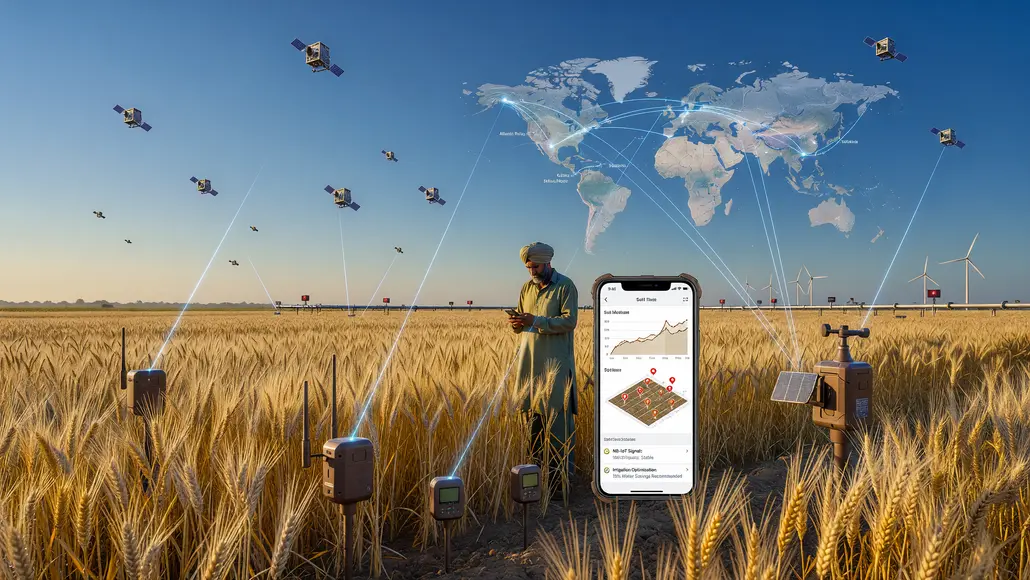
A key technological driver of this revolution is the adaptation of Narrow-Band IoT (NB-IoT) standards for satellite communications. NB-IoT is a low-power, wide-area network (LPWAN) radio technology that was originally designed for terrestrial cellular networks. By adapting this standard for use with satellites, space based IoT advancing enterprise telecom solutions allows for the use of small, battery-powered sensors that can last for years without a charge. These sensors can transmit small bursts of data such as a GPS coordinate, a temperature reading, or a pressure alert up to a passing satellite, which then relays the information to a central cloud platform for analysis.
The 3GPP standards body has been instrumental in this adaptation, ensuring that the same silicon chips and software used for terrestrial IoT can also be used for space-based connections. This is a massive win for the industry, as it allows for the mass production of inexpensive sensors and a unified management system for global device connectivity. For an enterprise, this means they can manage their entire fleet of “things” whether they are in a city center or a remote desert using a single platform and a single set of tools. This seamless integration is the hallmark of space based IoT advancing enterprise telecom solutions, making global monitoring as simple as checking a smartphone app.
Global Device Connectivity for Logistics and Supply Chain
One of the most immediate applications of space based IoT advancing enterprise telecom solutions is in the world of global logistics and supply chain management. A shipping container traveling from a factory in China to a warehouse in Europe will spend weeks at sea, well out of range of any cellular tower. With a space-based IoT sensor, the owner of that container can monitor its location, the temperature of its contents, and even whether its doors have been opened in real-time. This level of visibility is essential for the transport of high-value or perishable goods, reducing loss and ensuring that the supply chain remains resilient and efficient.
In the trucking industry, space-based IoT allows for the tracking of trailers across vast continental routes where cellular coverage is often spotty. By monitoring the “health” of the trailer such as tire pressure and brake wear operators can perform predictive maintenance, reducing the risk of a breakdown in a remote area and improving the overall safety of the fleet. These data-driven insights are a direct result of space based IoT advancing enterprise telecom solutions, turning a simple transport operation into a high-tech, information-rich business that can respond dynamically to the challenges of the road.
Data Analytics and the Industrial Transformation
The true value of space based IoT advancing enterprise telecom solutions is not just in the connectivity itself, but in the data that it provides. When millions of sensors are connected via satellite, they generate a massive stream of real-time information that can be fed into advanced data analytics platforms. This allows for the use of digital twins virtual models of a physical asset or system that are updated in real-time with satellite data. For an enterprise in the mining or oil and gas industry, this means they can monitor the health of their remote equipment and perform predictive maintenance, identifying a potential failure before it happens and avoiding costly downtime.
These analytics also enable more efficient resource management. In a large-scale mining operation, for example, satellite data can be used to optimize the routes of autonomous haul trucks, reducing fuel consumption and minimizing the site’s environmental impact. In the energy sector, space-based IoT allows for the remote monitoring of solar and wind farms in isolated locations, ensuring that they are operating at peak efficiency and identifying any issues that need to be addressed. This industrial transformation is being powered by space based IoT advancing enterprise telecom solutions, making the world’s most remote industries as efficient and data-driven as any modern factory.
Precision Agriculture and Environmental Monitoring
Agriculture is another sector where space based IoT advancing enterprise telecom solutions is having a profound impact. Farmers in remote regions can now use satellite-connected sensors to monitor soil moisture, crop health, and local weather patterns. This information allows for “precision agriculture,” where water and fertilizer are applied only when and where they are needed, increasing yields while reducing environmental impact. In a world with a growing population and a changing climate, these efficiencies are not just a luxury; they are a necessity for global food security.
Similarly, environmental organizations are using space-based IoT to monitor the health of the world’s forests and oceans. Sensors can track the movement of endangered species, monitor the quality of air and water in remote areas, and even detect the early signs of a wildfire. By providing a ubiquitous monitoring layer, space based IoT advancing enterprise telecom solutions is giving us the tools we need to protect our planet more effectively. The data collected by these sensors is a vital resource for scientists and policymakers, allowing them to make informed decisions about conservation and sustainability on a global scale.
Remote Monitoring for Infrastructure and Safety
Ensuring the safety and integrity of critical infrastructure is a major challenge for many nations. Thousands of miles of pipelines, power lines, and railways run through uninhabited areas where manual inspection is difficult and expensive. Space based IoT advancing enterprise telecom solutions provides a way to monitor these assets continuously. Sensors can detect a leak in a pipeline, a fault in a power line, or a shift in a bridge’s structure and immediately send an alert via satellite. This real-time monitoring is a vital part of disaster prevention and ensures that critical services remain operational and safe for the public.
In the event of a natural disaster, space-based IoT can also be used to track the movement of floodwaters or the extent of damage to a power grid, providing emergency responders with the information they need to save lives and restore services as quickly as possible. This resilience is a key benefit of space based IoT advancing enterprise telecom solutions, making our modern society more robust and better prepared to face the challenges of an unpredictable world. By extending the reach of our “eyes and ears” into space, we are creating a safer and more secure environment for everyone.
The Shift Toward a Service-Based Business Model
For the telecommunications industry, space based IoT advancing enterprise telecom solutions is also driving a shift in business models. Instead of simply selling bandwidth, satellite and telecom operators are increasingly offering “solutions as a service.” This means providing the sensors, the satellite connectivity, the cloud platform, and the data analytics as a single integrated package. This makes it far easier for an enterprise to adopt IoT technology, as they don’t need to worry about managing the complex underlying infrastructure. This “one-stop-shop” approach is a major driver of the rapid adoption of space-based IoT across all industrial sectors.
This model also encourages a deeper level of partnership between telecom operators and their industrial customers. By working together to design and deploy a space-based IoT solution, the operator can gain a better understanding of the customer’s needs and provide more value-added services over time. This leads to longer-term contracts and a more stable revenue stream for the operator. For the customer, it means they have a single partner they can rely on for all their global connectivity and monitoring needs. Space based IoT advancing enterprise telecom solutions is thus creating a more collaborative and efficient business ecosystem that benefits everyone involved.
Enhancing Global Security and Compliance
In addition to driving efficiency, space based IoT advancing enterprise telecom solutions is also improving global security and regulatory compliance. In the maritime industry, for example, international regulations require ships to be tracked to prevent collisions and illegal activities. Space-based IoT provides a reliable way to meet these requirements, ensuring that every vessel can be identified and monitored, even in the middle of the ocean. This not only improves safety but also helps to combat piracy, illegal fishing, and smuggling, making our oceans more secure for global trade.
Similarly, in the financial sector, IoT-based tracking of high-value cargo provides a new level of security for international trade. By monitoring the location and condition of a shipment in real-time, banks and insurance companies can more accurately assess risk and provide more favorable terms for their customers. This reduces the cost of global trade and makes it more accessible to businesses of all sizes. The security and transparency provided by space based IoT advancing enterprise telecom solutions are thus a powerful catalyst for global economic growth, building trust and confidence in the digital systems that power our world.
Conclusion: The Future of a Connected Planet
As we look toward the future, the role of space-based IoT will only continue to grow. We are moving toward a world where every asset, every vehicle, and every environment is connected to a global network of intelligence. Space based IoT advancing enterprise telecom solutions is the critical link that makes this vision possible, providing the reach and resilience that terrestrial networks cannot match. From the depths of the ocean to the edge of the atmosphere, the influence of the IoT will be felt in every part of our lives, making our world more efficient, more sustainable, and more secure.
The ongoing convergence of satellite technology, 5G, and artificial intelligence will only accelerate this transformation. In the 2030s, we can expect to see “smart cities” that extend their intelligence into the surrounding rural areas, “autonomous supply chains” that manage themselves without human intervention, and a global environmental monitoring system that tracks the health of our planet in real-time. This is the future that space based IoT advancing enterprise telecom solutions is building today a future where the digital and physical worlds are seamlessly integrated into a single, global ecosystem of intelligence and innovation.