





















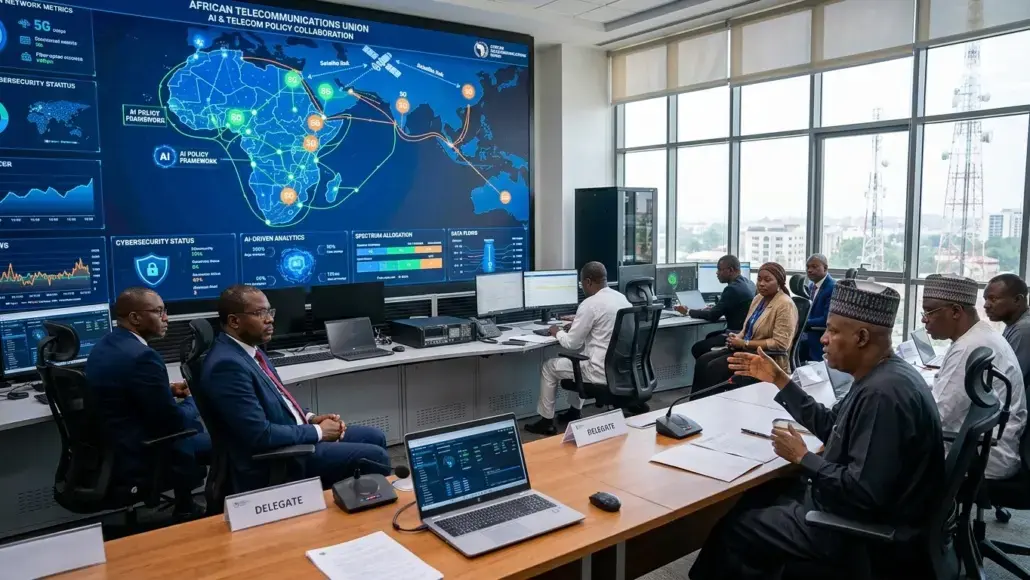

Vice President Kashim Shettima has called on African countries to strengthen collaboration in shaping AI telecom policies, urging governments across the continent to adopt a unified approach to artificial intelligence, telecommunications, and digital governance. Speaking at the seventh Ordinary Session of the Conference of Plenipotentiaries of the African Telecommunications Union (ATU) in Abuja, Shettima said closer regional cooperation is essential to advancing Africa’s digital ambitions and increasing the continent’s influence on global technology policies.
Represented by the Deputy Chief of Staff to the President, Ibrahim Hadejia, Shettima noted that no African nation, regardless of its size or resources, could independently achieve its digital transformation goals. He said the conference provides a timely opportunity for member states to align their priorities ahead of the 2026 International Telecommunication Union (ITU) Plenipotentiary Conference while supporting African candidates seeking leadership positions within the global telecommunications body.
Shettima Calls for Unified AI Telecom Policies
Highlighting the importance of coordinated AI telecom policies, Shettima urged African countries to work together on expanding affordable internet connectivity, strengthening cybersecurity, improving spectrum management, harmonizing technical standards, promoting responsible artificial intelligence governance, and accelerating digital trade across the continent.
He emphasized that collaboration would enable Africa to play a greater role in shaping international regulations governing emerging technologies rather than simply adopting policies developed elsewhere.
“No single nation, regardless of its size or resources, can fully realise Africa’s digital ambitions in isolation. Our future depends on collaboration,” Shettima said.
He further stressed that broadband networks, artificial intelligence, cloud computing, satellite communications, and secure digital infrastructure have become as vital to economic development as traditional infrastructure such as roads, railways, power systems, and ports. According to him, stronger AI telecom policies will help create a more connected and competitive digital economy while supporting innovation across industries.
Digital Transformation Remains a Continental Priority
Shettima reaffirmed Nigeria’s commitment to broadband expansion, artificial intelligence, digital public infrastructure, cybersecurity, innovation, and the development of a skilled technology workforce under President Bola Tinubu’s administration. He also linked Africa’s digital agenda to the African Union’s Agenda 2063 and the Digital Transformation Strategy for Africa, stating that technology investments should generate employment, improve healthcare and education, expand financial inclusion, and create greater opportunities for women and young people.
“The next chapter of Africa’s integration will not be written by roads and rail alone. It will also be written by fibre, satellites, data, artificial intelligence and the partnerships that connect our people and our economies,” he added.
Ministers Reinforce Regional Cooperation
Minister of Communications, Innovation and Digital Economy Bosun Tijani echoed Shettima’s call for stronger regional collaboration, saying Africa must arrive at the 2026 ITU Plenipotentiary Conference prepared, united, and credible. He said the continent’s rapidly growing technology ecosystem, expanding entrepreneurial base, and youthful population present an opportunity to influence the future of the global digital economy.
Tijani also announced that Nigeria’s N-ATLAS artificial intelligence initiative will be expanded into a continental programme known as the ATLAS Network, reflecting broader efforts to strengthen regional cooperation on AI telecom policies and digital innovation across Africa.