























Telecom networks are becoming too complex to manage through increasingly large layers of manual processes and fixed automation alone. As operators add 5G, cloud infrastructure, edge computing and more demanding enterprise services, the number of network events and decisions that need to be handled is also growing. Agentic AI is emerging as the next step, giving network systems the ability to interpret situations, plan actions and execute tasks within defined operational boundaries.
That is different from conventional automation. A traditional automated system generally follows a predefined rule when a known condition occurs. An agentic system can combine information from different sources, determine what is happening, decide what action is appropriate and then execute that action through connected network systems. GSMA describes this broader shift as a move from “AI for Networks” toward AI-native infrastructure, with AI agents being developed for network operations, service creation and optimisation.
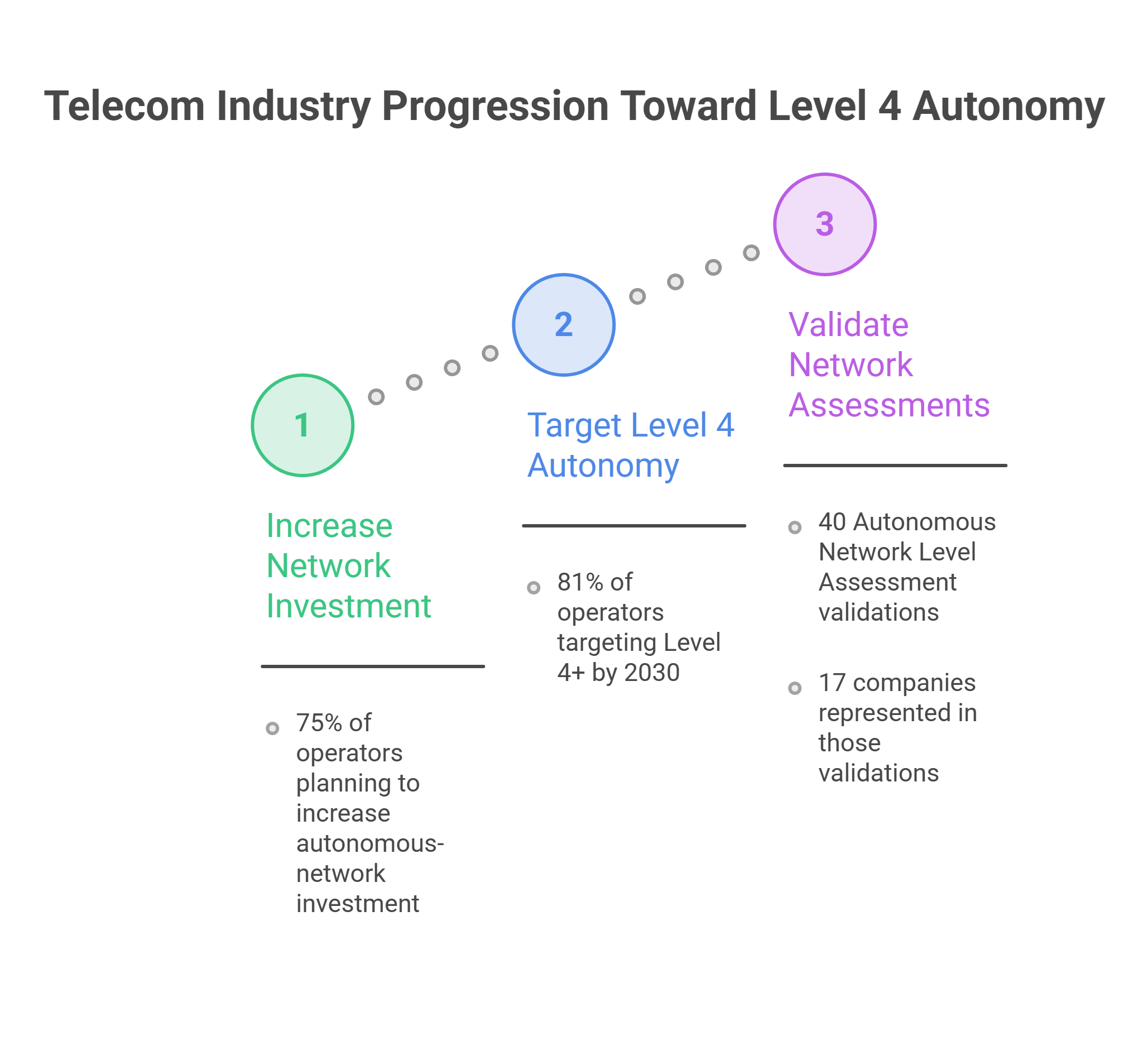
The telecom industry is already moving in this direction. TM Forum reported in June 2026 that 75% of operators planned to increase autonomous-network investment, while 81% aimed to reach Level 4 or above by 2030. It also reported 40 Autonomous Network Level Assessment validations across 17 companies, indicating that advanced autonomy is beginning to move from long-term roadmaps into production environments.
The figures do not mean that telecom networks are already fully autonomous. Most operators remain at earlier stages of the autonomy journey, while Level 4 capabilities are emerging in specific network domains. The more important shift is that autonomy is increasingly being treated as an operational investment rather than a distant 6G concept.
From Automation to Network Decision-Making
The difference becomes clearer during a network fault. Traditional automation might detect a predefined alarm and trigger a known remediation procedure. Agentic AI can potentially correlate multiple signals, determine the likely source of a problem, assess its effect on services and coordinate the next action across different network domains.
That capability is particularly relevant because telecom failures rarely stay within one system. An issue in radio access, transport or the core can eventually affect the service experienced by an enterprise or consumer. GSMA’s 2026 work on agentic networks highlights the growing need for AI agents that can support network optimisation, service operations and other tasks across increasingly complex infrastructure.
This is already being tested against real telecom environments. A current TM Forum Agentic NOC programme uses real operator network and OSS data to demonstrate intelligent fault correlation across radio and transport networks, alongside anomaly detection and service-impact analysis. The project involves operators and technology participants across North America, EMEA and Asia-Pacific, showing that the move toward agentic operations is not confined to one market.
The business case is becoming clearer as well. The same programme targets up to a 60% reduction in mean time to detect and repair, around 70% faster fault identification and approximately 40% fewer incidents escalated to human operators. These are programme targets based on validated operator data, not industry-wide averages, but they show where operators see the potential economic value.
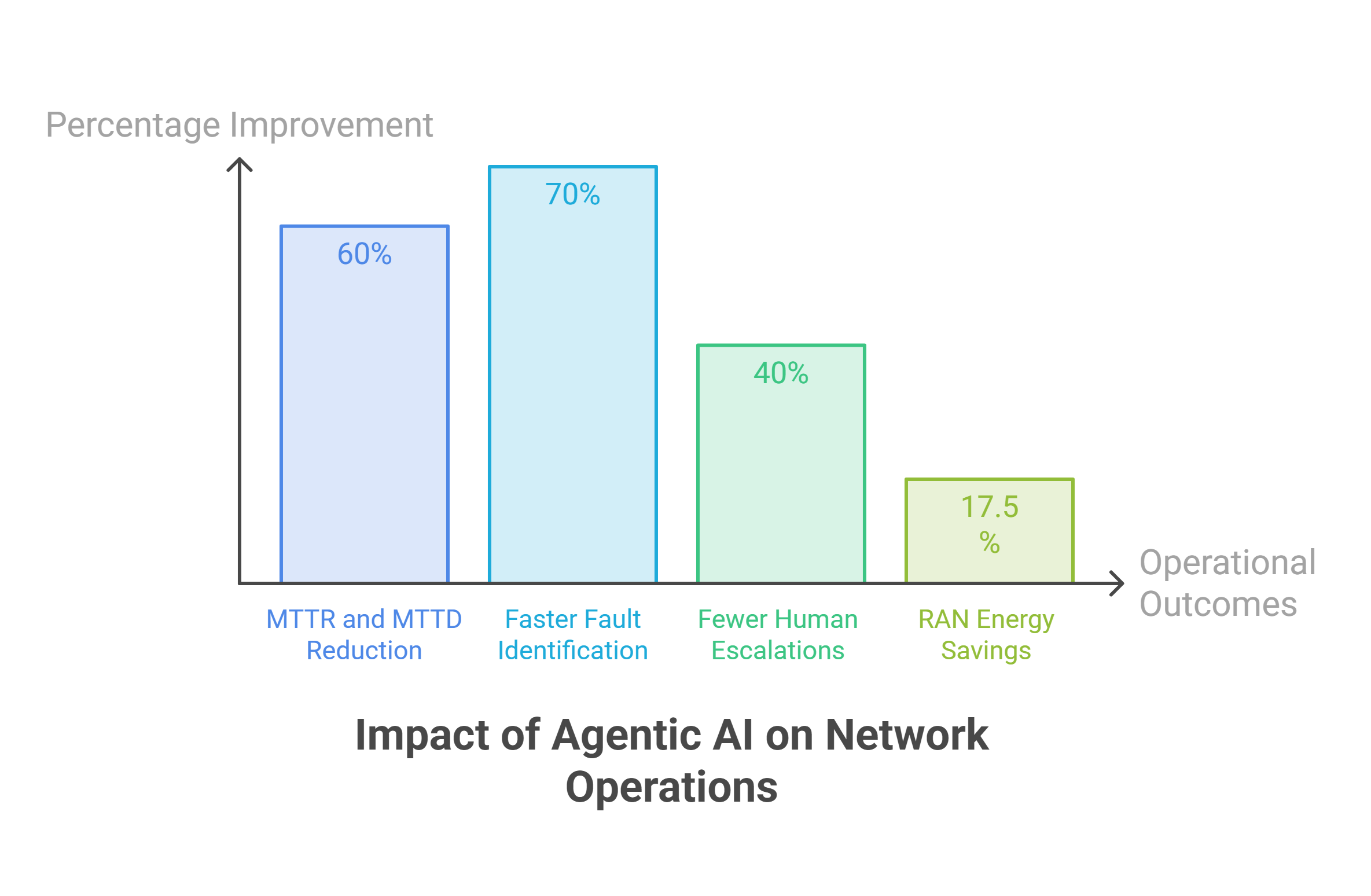
Key takeaway: Agentic AI is being tested not just for automation, but for measurable improvements in fault resolution, human workload and network efficiency.
Scaling Autonomy is Becoming the Hard Part
The technology may be advancing quickly, but moving from individual use cases to a genuinely autonomous network remains difficult. TM Forum’s global survey of 125 people across 80 companies found that cross-domain automation was the biggest deployment challenge: 60% of respondents rated it as very challenging, with another 35% calling it somewhat challenging. Legacy systems and organisational silos were identified as major contributors.
That matters because agents need access to data, network telemetry, operational systems and the tools required to make changes. If those systems cannot communicate, an intelligent agent can identify a problem without having the ability to resolve it.
TM Forum’s latest AI-native Open Digital Architecture work is therefore focused on creating a shared foundation for autonomous operations and moving operators away from fragmented AI deployments toward cross-domain autonomous flows.
There is also a governance question. Autonomous networks still need policies, permissions, auditability and human override, particularly when an AI system can change network configurations. The industry is therefore moving toward controlled autonomy, where agents can act within clearly defined boundaries rather than operating without supervision. Current autonomous-network blueprints explicitly incorporate governance and policy controls into the architecture.
The result is a gradual transition: Agentic AI is moving telecom networks beyond task automation, but the commercial value will depend on whether operators can connect those agents across the network and give them enough authority to act safely.
Conclusion
Agentic AI is moving telecom networks beyond predefined automation toward systems that can interpret network conditions, coordinate actions and respond to problems within defined boundaries. The immediate value is operational: faster fault resolution, fewer manual escalations, better resource use and potentially lower network operating costs.
But reaching higher levels of autonomy will depend on more than deploying AI agents. Operators still need integrated network architectures, reliable data, cross-domain connectivity, strong governance and clear human oversight. Current industry research shows that operators are investing heavily toward Level 4 autonomy, while cross-domain integration remains one of the biggest barriers to scaling it.
The long-term opportunity is larger than automation alone. As Agentic AI becomes capable of managing network operations around defined business and service objectives, telecom infrastructure could become more adaptive, efficient and increasingly autonomous.