



















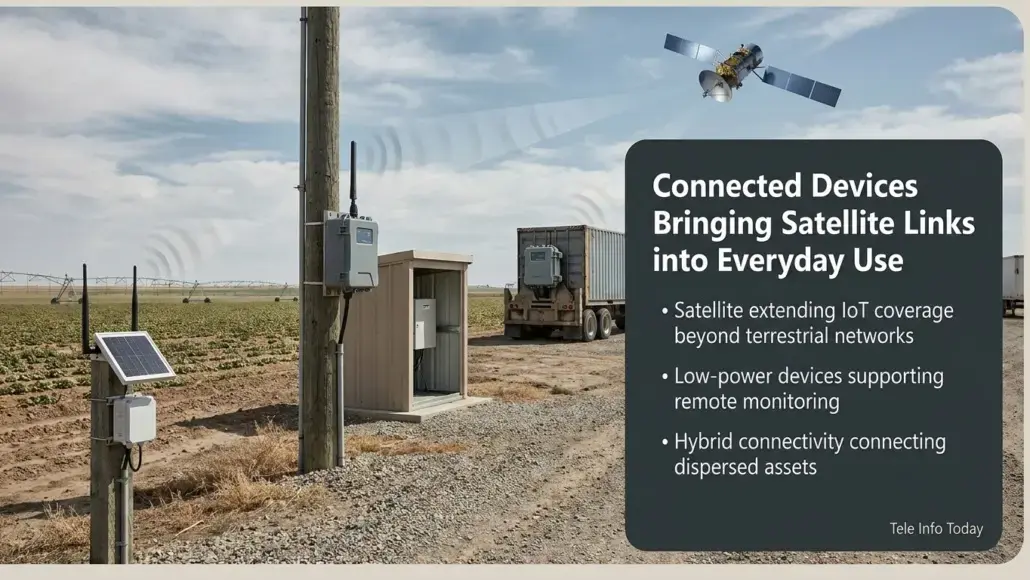
Connected devices are increasingly being designed to operate across both terrestrial and satellite networks, extending connectivity into locations where conventional cellular coverage may be limited or unavailable. The shift is particularly relevant to the Internet of Things (IoT), where asset trackers, utility equipment, agricultural systems and environmental sensors often need to exchange small amounts of data over large geographic areas. Satellite connectivity can provide an additional network path without requiring every deployment to rely on dedicated satellite-only equipment.
Recent demonstrations are showing how cellular IoT hardware can be adapted for non-terrestrial connectivity. A demonstration by Sateliot and Nordic Semiconductor used a commercial cellular IoT module to establish communication through a Low Earth Orbit (LEO) satellite using 3GPP-based Narrowband Internet of Things (NB-IoT) technology. Such developments point toward hybrid connectivity models in which the same device architecture can potentially operate across different coverage environments.
- Cellular IoT hardware can support terrestrial connectivity while gaining access to satellite networks where supported.
- Asset tracking can benefit from wider geographic coverage for equipment, freight and remote assets.
- Agriculture and environmental monitoring can use satellite links where terrestrial coverage is inconsistent.
- Utility infrastructure can maintain communication across dispersed or difficult-to-reach locations.
Hybrid Connectivity Supporting Remote IoT Deployments
The value of connected devices increasingly lies in their ability to remain reachable rather than in maintaining a constant high-bandwidth connection. Many IoT applications transmit limited amounts of location, status or sensor information at intervals, making satellite a potential complement to terrestrial cellular networks. The combination can allow a device to use terrestrial connectivity where it is readily available and rely on satellite access when it moves outside conventional coverage.
- Hybrid connectivity can reduce gaps in coverage for geographically distributed assets.
- Low-power IoT designs are suited to applications where devices may operate for long periods without maintenance.
- A single connectivity platform can simplify management across different coverage environments.
- Satellite access can extend visibility for assets operating in rural, offshore or otherwise remote areas.
As connected devices become more capable of switching between terrestrial and satellite access, the focus is shifting from isolated demonstrations toward practical hybrid deployments. The next challenge is applying this wider reach to the equipment, services and operating models that will define everyday satellite connectivity.
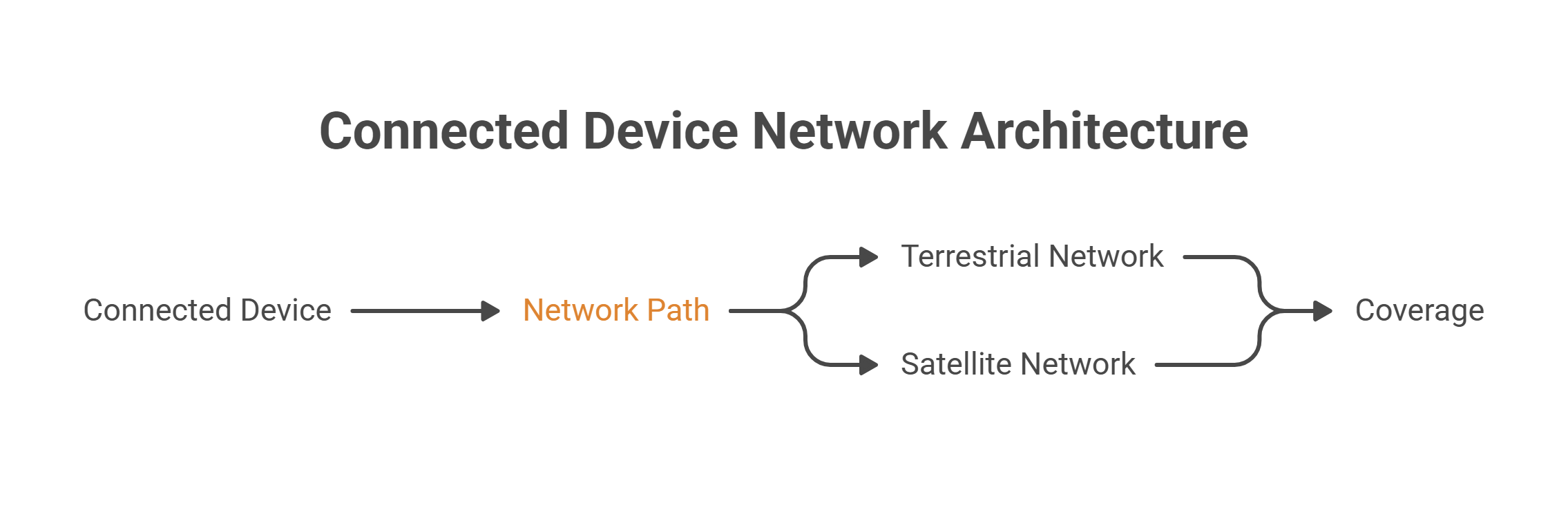
The visual illustrates how cellular IoT devices can use satellite connectivity as an additional network path when terrestrial coverage is unavailable.
Hybrid Connectivity Supporting Remote IoT Deployments
The expansion of connected devices into satellite networks is creating a hybrid connectivity model in which terrestrial cellular networks remain the primary access layer while satellite provides an additional path beyond conventional coverage. This is particularly relevant for Internet of Things (IoT) deployments, where devices may be distributed across farms, transport routes, utility networks or remote infrastructure. Instead of designing separate hardware and connectivity systems for different coverage environments, organisations can increasingly use devices capable of working across both network types.
- Terrestrial networks can handle routine connectivity where coverage is available.
- Satellite can provide an additional link when devices move beyond terrestrial coverage.
- Low-data applications can make satellite connectivity practical for remote monitoring.
- Hybrid connectivity can extend the geographic reach of existing IoT deployments.
Low-Power Devices Expanding Satellite IoT Applications
For connected devices, power consumption and hardware simplicity remain important because many IoT endpoints operate for long periods without physical maintenance. Satellite connectivity therefore needs to work within the constraints of low-power cellular technologies rather than requiring the capabilities of a conventional broadband terminal. Developments around Narrowband Internet of Things (NB-IoT) Non-Terrestrial Networks (NTN) are supporting this direction, while commercial initiatives are exploring single connectivity arrangements across terrestrial and satellite networks.
- Asset trackers can transmit location and status information from areas with limited cellular coverage.
- Agricultural sensors can communicate from remote fields and livestock operations.
- Utility and infrastructure equipment can remain connected across geographically dispersed sites.
- Environmental sensors can send periodic measurements without requiring continuous high-bandwidth access.
Vodafone IoT and Skylo’s hybrid satellite-cellular approach demonstrates how this model can extend into existing IoT platforms, including the use of a single Subscriber Identity Module (SIM) for cellular and satellite connectivity. The broader objective is to make satellite another network path within an existing device and connectivity environment rather than creating a completely separate satellite ecosystem.
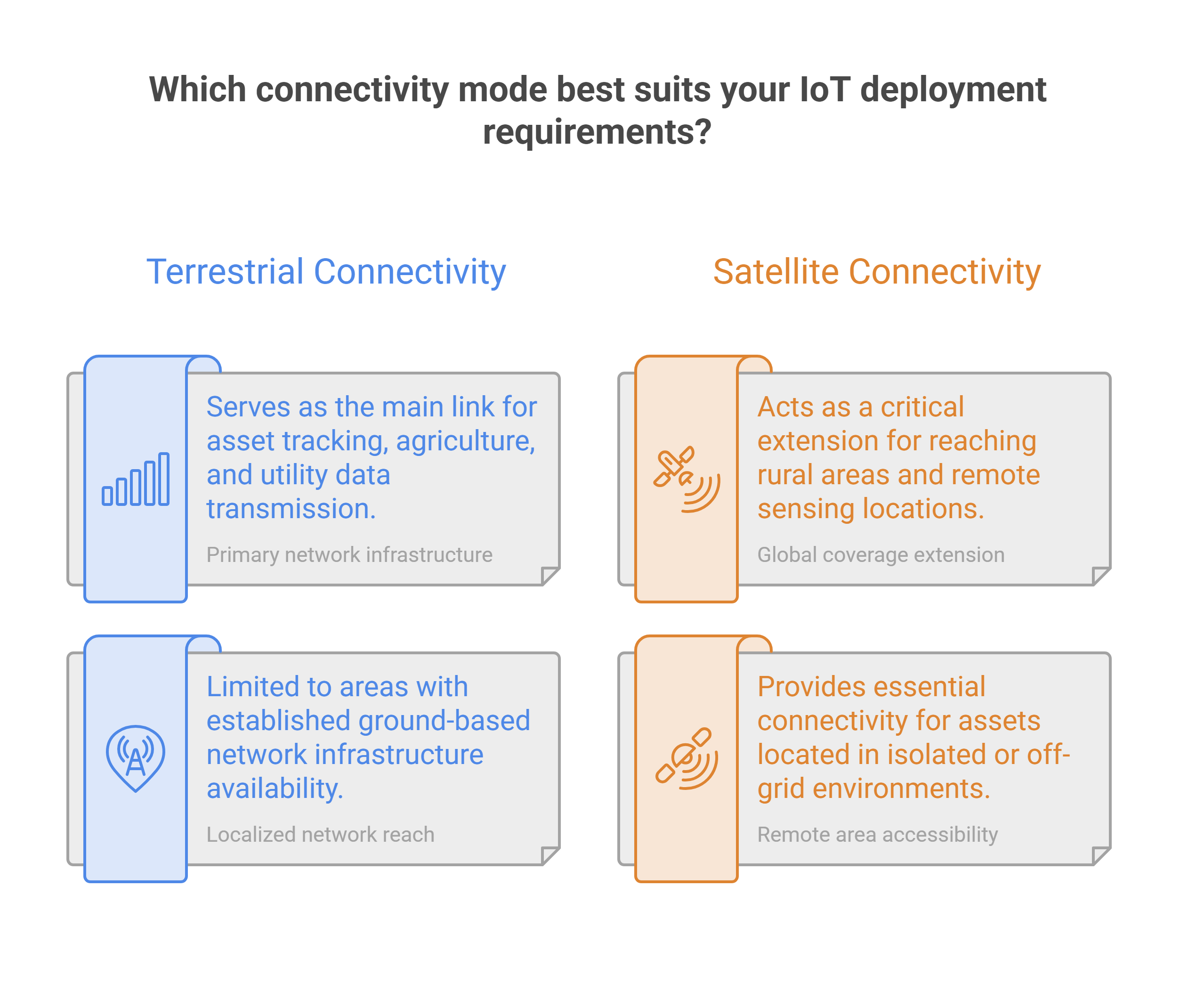

The matrix shows how satellite can be different from terrestrial connectivity across different low-data IoT metrics.
Connected devices are moving toward a model where satellite connectivity can complement terrestrial cellular access without requiring a separate device ecosystem. The combination is particularly relevant to remote and geographically distributed applications where continuous terrestrial coverage is difficult to provide. As standards, modules and connectivity platforms mature, satellite can become an additional network path for devices that need periodic data exchange rather than continuous high-bandwidth connectivity.
The model still has practical limitations. Device compatibility, power consumption, satellite availability, spectrum, service pricing and network integration will influence where satellite-enabled IoT becomes commercially viable. Terrestrial networks will remain the preferred option where coverage and capacity are readily available, while satellite can add reach where those networks become difficult to access.
The next stage moves from devices and connectivity paths toward the services that can be built around them: new satellite-enabled telecom services.
References
- GSMA – IoT Summit at MWC Barcelona 2026 – 2026
- GSMA – Building the Next Generation of Global IoT – 2026
- Vodafone IoT and Skylo – Global Hybrid Satellite-Cellular Connectivity – 2026
- Nordic Semiconductor and Sateliot – LEO Satellite IoT Connectivity Demonstration – 2025
- 3GPP – Release 19 IoT TN-to-NTN Redirection – 2026