


















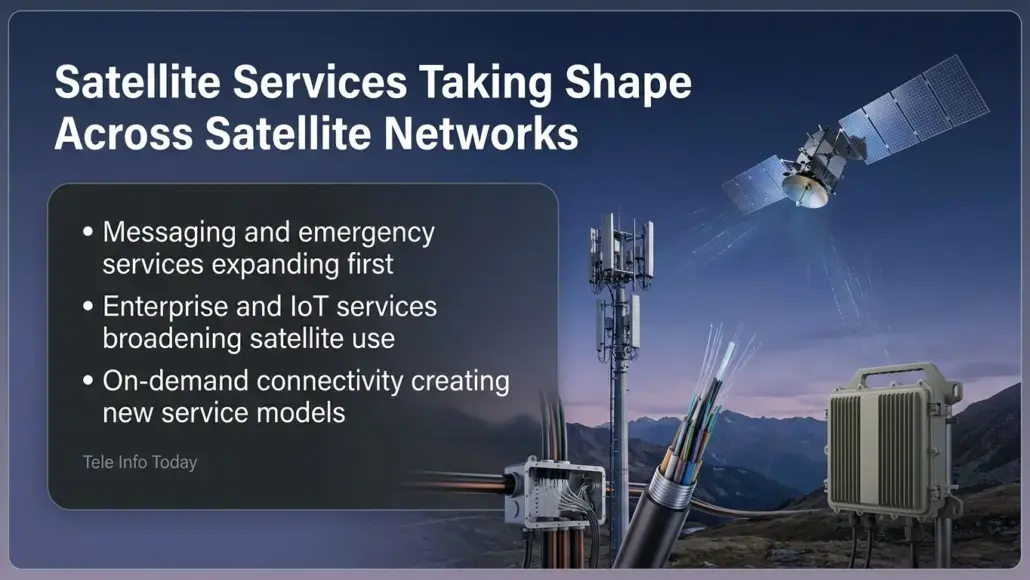

Satellite services are moving beyond the role of providing connectivity in areas without terrestrial coverage, as satellite networks become increasingly integrated with mobile operators, connected devices and enterprise networks. The shift is creating opportunities for telecom providers to build services around satellite access rather than offering satellite connectivity as a standalone product. Messaging, emergency communication, remote monitoring and network resilience are among the areas developing first, while broader voice and data applications remain part of the longer-term evolution.
This progression reflects the wider convergence between terrestrial and non-terrestrial networks (NTN). Improvements in standards, device compatibility, network integration and roaming are making it easier to incorporate satellite access into existing telecom environments. As a result, the service delivered to a customer can increasingly combine terrestrial and satellite connectivity without requiring a completely separate communications relationship.
- Messaging and emergency communication remain among the most practical early applications.
- Enterprise services can use satellite connectivity for remote operations and network resilience.
- Internet of Things (IoT) deployments can use satellite access for monitoring assets beyond terrestrial coverage.
- Automotive and wearable devices can extend communication and safety functions into areas with limited cellular access.
Consumer and Enterprise Models Expanding Around Satellite Connectivity
The development of satellite services is also creating different commercial models for operators and service providers. Satellite connectivity can be incorporated into existing mobile plans, offered as a premium capability or delivered as an enterprise service for organisations operating across remote or geographically dispersed locations. This allows the same underlying network infrastructure to support different applications without limiting satellite connectivity to a single market.
- Consumer services can add satellite messaging or emergency communication to existing mobile offerings.
- Enterprise services can provide an additional connectivity path for business continuity and remote operations.
- IoT services can use satellite networks for asset tracking, monitoring and periodic data transmission.
- Network platforms can increasingly coordinate terrestrial and satellite access as complementary connectivity layers.
The development of satellite services therefore points toward a telecom market in which satellite connectivity becomes embedded within broader communications offerings. Rather than being visible to users as a separate technology, satellite access can increasingly operate as another network capability supporting different services, devices and applications.
Service Models Expanding Across Consumer and Enterprise Networks
The development of satellite services is creating several paths for telecom providers to extend connectivity beyond conventional terrestrial networks. Consumer offerings can incorporate satellite messaging and emergency communication into existing mobile plans, while enterprise services can use satellite as an additional layer for remote operations, backup connectivity and business continuity. The distinction between the underlying network and the service delivered to the customer is becoming increasingly important as satellite access is incorporated into broader telecom platforms.
- Mobile operators can bundle satellite messaging and emergency communication with existing mobile services.
- Enterprise connectivity can use satellite as a supplementary path for remote or disrupted terrestrial networks.
- Internet of Things (IoT) services can use satellite connectivity for asset tracking and remote monitoring.
- Automotive and wearable applications can add communication and safety capabilities beyond terrestrial coverage.
API-Driven Connectivity Creating More Flexible Service Models
Beyond conventional customer plans, satellite services are also being explored through more flexible network models. Work linking non-terrestrial networks with GSMA Open Gateway application programming interfaces (APIs) has demonstrated how satellite bandwidth could be requested dynamically by applications. This could allow organisations to use satellite connectivity when and where it is required rather than maintaining a permanently active satellite connection. Such approaches remain at an emerging stage, but they point toward satellite becoming a configurable network resource within wider digital services.
- Application-driven access could make satellite capacity available according to operational requirements.
- Enterprise platforms could combine terrestrial and satellite connectivity based on coverage conditions.
- IoT applications could request satellite access for remote monitoring and geographically dispersed assets.
- Emergency-response services could use dynamically available connectivity when terrestrial infrastructure is disrupted.
The broader development of satellite services will depend on how effectively operators, satellite providers and technology vendors combine network access with existing service platforms. Interoperability, device compatibility, spectrum availability and commercial agreements will determine which models can move from demonstrations and partnerships into scalable services.
Satellite Becoming an Additional Telecom Service Layer
The expansion of satellite services is creating a broader role for non-terrestrial connectivity across consumer, enterprise, automotive and Internet of Things (IoT) applications. Messaging and emergency communications are among the most immediate uses, while satellite-enabled monitoring, remote connectivity and connected-vehicle services are extending the range of applications. Over time, the underlying satellite connection may become less visible to users as it is incorporated into existing mobile and digital service platforms.
The commercial direction will depend on more than satellite capacity alone. Device compatibility, spectrum access, regulation, interoperability, roaming arrangements and service economics will determine how quickly different models can scale. This leaves satellite positioned primarily as a complementary network layer, capable of supporting services where terrestrial networks are unavailable, congested or vulnerable.
The progression now moves from connectivity and devices toward the broader telecom offerings enabled by this convergence, satellite-enabled services across mobile networks.
References
- GSMA – Scaling Satellite Connectivity: Why Interoperability Matters for NTN’s Next Phase – 2026
- Global mobile Suppliers Association (GSA) – NTN & Satellite Connectivity – 2026
- GSMA – Satellite Direct-to-Device – 2026
- GSMA – Mobile Innovation Report 2026 – 2026
- GSMA – ESA × GSMA Foundry NTN Open Gateway Challenge – 2026
- GSMA – Regulatory Readiness for Direct-to-User LEO Satellite Services – 2026
- S&P Global – MWC 2026: Non-Terrestrial Networks Shift From Hype to Commercial Reality – 2026