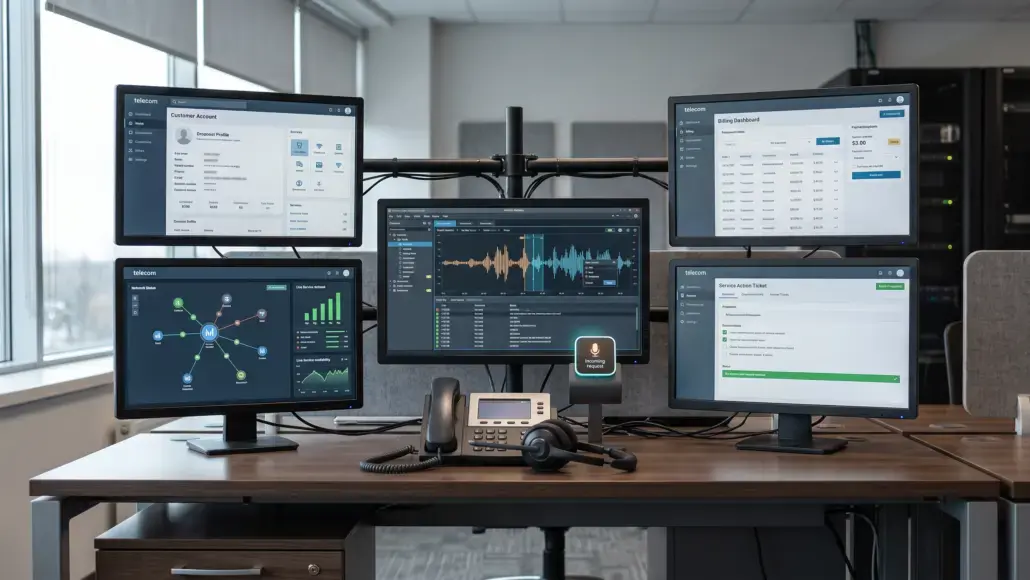
Telecom voice support is moving beyond traditional interactive voice response systems and scripted voice bots toward systems that can understand natural-language requests and participate in broader service workflows. Conventional IVR generally guides customers through predefined menus, while earlier voice bots were designed around narrower commands and scripted responses. Generative AI is changing that model by allowing voice systems to interpret more varied requests and maintain a more conversational interaction.
This is creating a broader role for AI voice agents in telecom customer service. Instead of simply identifying an intent and directing the caller toward another process, an agent can potentially understand the request, retrieve relevant information, use connected tools and continue through an authorised workflow. The important change is therefore not only more natural speech, but the ability to connect spoken interaction with service execution.
From Scripted IVR to Conversational Voice Support
Traditional IVR remains useful for predictable requests at scale, but its menu-based structure can create friction when a customer’s issue does not fit neatly into predefined options. Natural-language voice systems offer a different interaction model by allowing customers to describe a problem in their own words.
This is where AI voice agents can provide a more capable interface. A customer could explain that a recent bill appears higher than expected, report a connectivity problem or ask about an existing order without navigating through several layers of options. The system can interpret the request and determine which information, tools or workflows are relevant.
The development is also moving beyond speech recognition itself. A capable voice agent needs to combine voice interaction with access to business systems, defined procedures and operational tools. TM Forum’s 2026 Contact Center Voice Agent Implementation Guide identifies four capability areas: voice interaction, task completion, tool-calling and SOP compliance.
Voice Agents are Moving Toward Task Completion
The distinction between a voice bot and an agent becomes clearer when the system is expected to complete work rather than simply provide an answer. A billing interaction, for example, could involve checking the customer’s account, reviewing the relevant charge, explaining the result and initiating an approved follow-up action.
The same principle can apply to technical support. A caller reporting a connectivity problem may require checks against service status, account information and previous troubleshooting steps before the issue can be resolved. A connected voice agent can potentially coordinate those checks within the same conversation rather than transferring the customer between separate processes.
AI voice agents therefore represent an evolution in how telecom operators can use voice as a customer-service interface. The objective is not simply to make automated calls sound more natural. It is to connect spoken interaction with the data, tools and workflows required to deliver a useful outcome.
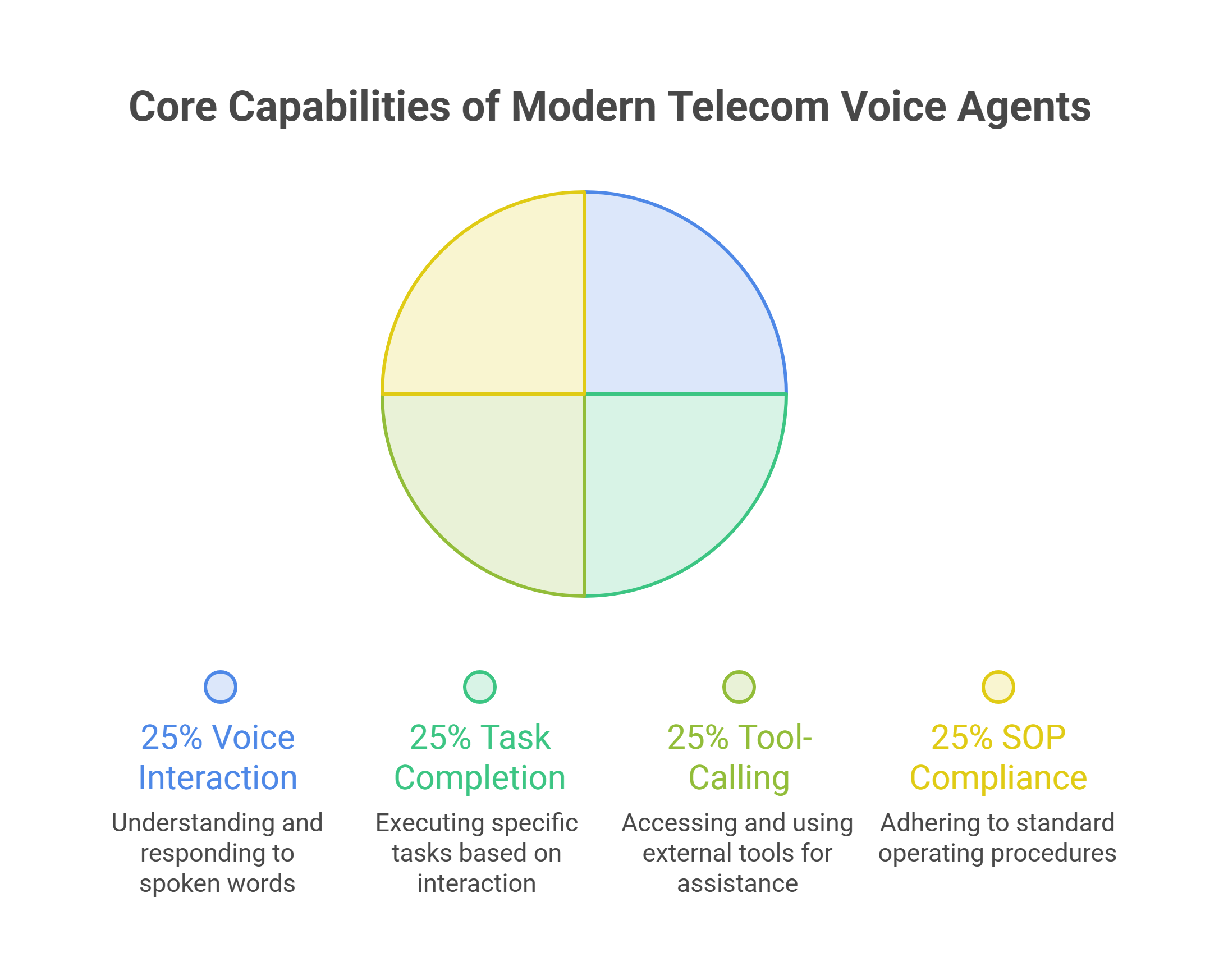
Key Takeaway: Telecom voice agents are being defined around more than conversational speech, with task completion, tool access and procedure compliance becoming core capabilities.
The direction is therefore toward voice systems that can participate in telecom service workflows rather than simply guide customers through them.
AI Agents are Extending Voice Services into Telecom Workflows
The move toward more capable voice support is closely linked to the ability of AI systems to connect speech with telecom data and operational tools. A customer may begin with a simple spoken request, but resolving it can require information from billing, customer accounts, order management or service-assurance systems. Connecting these systems allows the voice interaction to continue beyond recognition and response.
This is making AI voice agents more dependent on the same underlying data and system integrations that support agentic customer service across other channels. Voice becomes the interaction layer, while the systems behind it provide the information and actions required to complete the request.
Voice Interactions are Becoming More Action-Oriented
A customer contacting an operator about an unpaid bill may previously have been guided through an automated menu before being transferred to another service process. A more capable voice agent could potentially identify the account, retrieve the relevant billing information, explain the issue and initiate an authorised payment or follow-up workflow during the same interaction.
Technical support offers another example. A caller experiencing poor connectivity may need more than a generic troubleshooting response. The system could potentially check service status, identify a known incident, review previous support activity and determine whether additional troubleshooting is necessary.
This makes AI voice agents different from voice systems built primarily around intent recognition. Their effectiveness increasingly depends on whether they can access the right tools and use the information returned by those tools to determine the next step.
Telecom Voice Automation is Expanding Beyond the Call
There are already examples of telecom operators applying AI to outbound and inbound voice processes. In an Airtel and IBM deployment, an AI voice bot used for bill-payment reminder calls increased payment completion from 60% to 64%, while the team supporting the process could be reassigned to other activities. The example illustrates how voice automation can be connected to a defined business objective rather than being evaluated only through conversation volume.
The broader opportunity extends across customer-service workflows such as payment reminders, plan information, order updates, service troubleshooting and account-related requests. Different use cases require different levels of system access, which makes permissions and workflow controls important components of the architecture.
A voice agent that can retrieve information should not automatically have the authority to modify an account. Operators therefore need to distinguish between reading customer data, recommending an action and executing that action. This creates a controlled path between conversational AI and telecom operational systems.
Voice Agents are Becoming Part of the Service Architecture
The development also changes how voice services can fit into the wider customer-service environment. Instead of treating voice automation as a standalone IVR replacement, operators can increasingly position it as another interface to shared AI capabilities, customer data and business processes.
A customer could begin an interaction through voice, receive a response based on account and service context, and then be transferred to a human representative with the relevant information already available. This continuity can reduce the need to restart the interaction when automation reaches a point where human involvement is required.
The same architecture can potentially support other customer channels, allowing the underlying agent to work across voice, chat and digital interfaces while drawing on common data and tools. AI voice agents therefore have the potential to extend agentic customer service into situations where speaking remains a more natural or accessible way for customers to interact with their telecom provider.
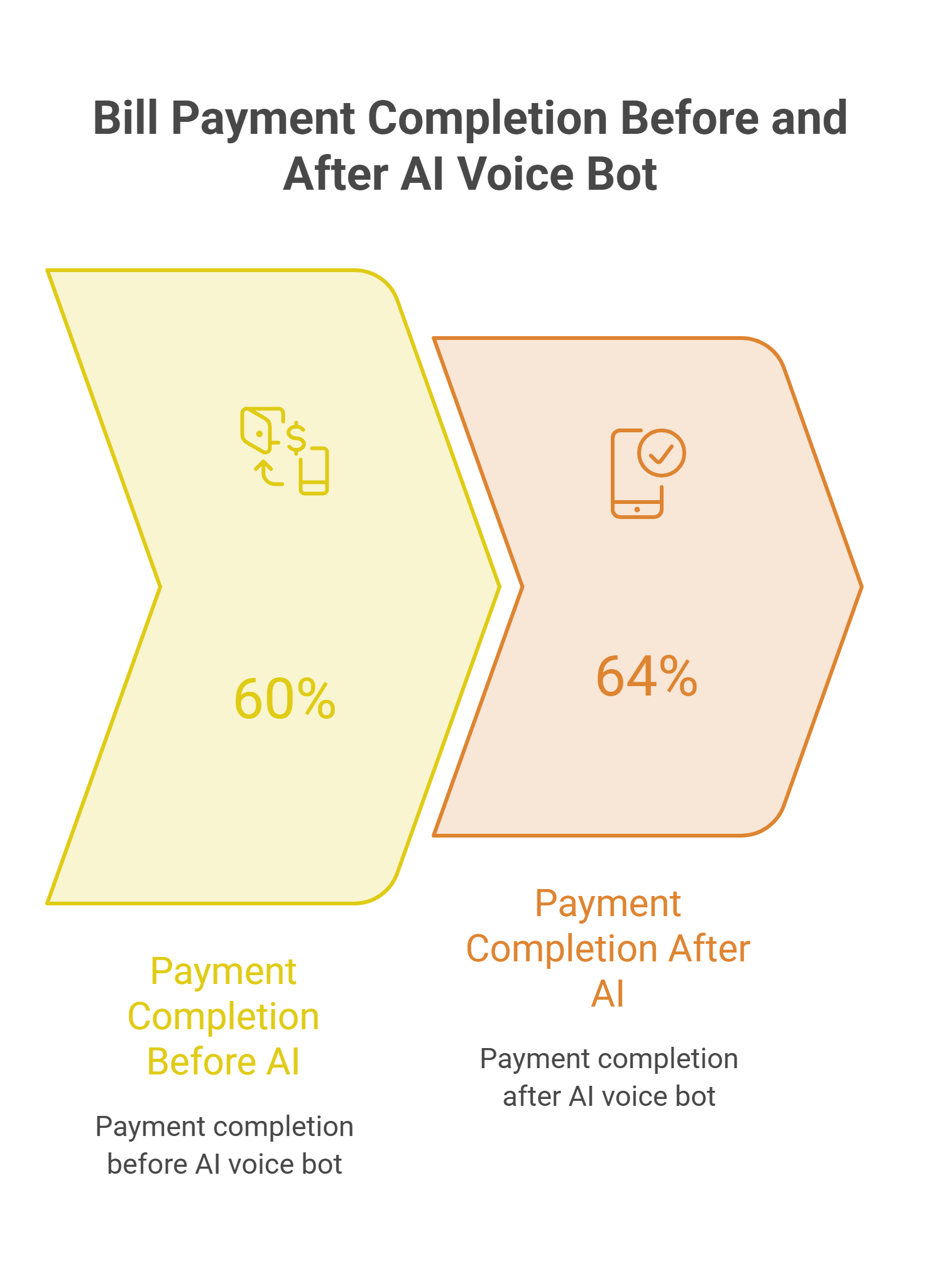
Key Takeaway: A telecom voice-AI deployment demonstrated measurable improvement in payment completion while reducing the operational effort required for the calling process.
The significance of these developments is that voice automation is becoming connected to measurable service outcomes. As telecom operators give voice systems access to more data and controlled tools, AI voice agents can move from answering spoken questions toward completing increasingly defined customer-service workflows.
Voice is Becoming a More Capable Telecom Service Interface
Telecom voice services are moving beyond scripted menus and basic voice bots toward systems that can understand natural-language requests, access relevant information and participate in defined service workflows. The change is therefore not only about making automated conversations sound more natural, but about connecting voice interaction with the systems needed to resolve customer requests.
This makes AI voice agents increasingly relevant as another interface for agentic customer service. Their effectiveness will depend on access to accurate data, connected tools, clear permissions and reliable escalation paths when automated handling is not appropriate.
As these capabilities mature, AI voice agents could make routine telecom interactions more direct by bringing conversation, information retrieval and approved service actions into the same workflow. Voice could consequently become an increasingly important channel for task-oriented customer care rather than simply a front end for traditional IVR.