














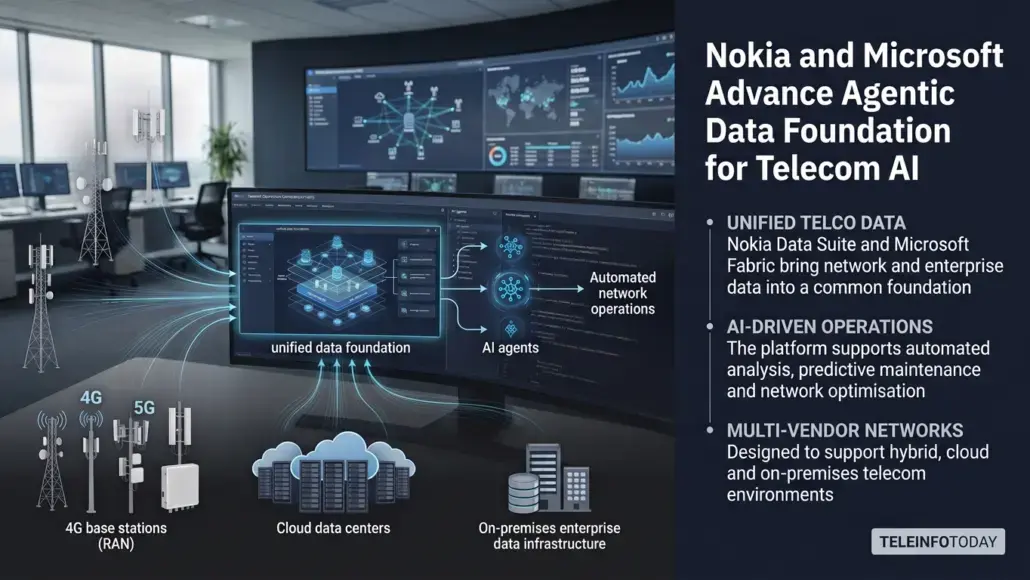

Nokia and Microsoft are developing an agentic, unified data foundation designed to help telecommunications providers accelerate telecom network automation and AI-driven operations. The collaboration combines Nokia Data Suite with Microsoft Fabric, bringing together telco-specific data products, analytics, governance and artificial intelligence capabilities across multi-vendor network environments.
The solution is intended to give operators faster access to trusted and unified data, reducing the time required to prepare information for operational use. Nokia said the integrated approach can make high-quality data available in minutes rather than weeks, addressing a key challenge for telecom providers seeking to scale telecom network automation across their network operations.
Unified Data Infrastructure Supports Network Automation
Nokia Data Suite provides prebuilt and reusable telco data products with data quality controls and telecom-specific semantic modelling. Microsoft Fabric contributes a unified data platform with OneLake storage, analytics tools and AI-enabled applications.
By combining the two platforms, telecom operators can connect network data with enterprise, IT and third-party information in a broader environment. The architecture is designed for multi-vendor and cross-domain networks and can support hybrid, cloud and on-premises infrastructure.
The companies said the approach can support use cases such as automated root-cause analysis and closed-loop operations. It also aims to reduce the data integration work traditionally required before AI applications can be introduced into network environments, supporting broader telecom network automation strategies.
The flexibility of the platform is intended to support operators that need to maintain regulatory requirements while expanding their use of AI and automation. Nokia and Microsoft are positioning the unified data foundation as an infrastructure layer for building agent-based solutions across different parts of the telecom network.
AI Use Cases Extend Across Telecom Network Operations
Initial use cases include autonomous Voice over New Radio, or VoNR, assurance, geo-experience and predictive maintenance and fault management. The VoNR capability is designed to identify service anomalies, conduct root-cause analysis and recommend actions using network, service and subscriber visibility.
The geo-experience capability combines subscriber, network and radio frequency data to map sessions to precise locations, identify degraded radio performance and locate coverage or capacity hotspots. AI agents can then analyse potential causes of radio access network issues and provide recommendations for corrective action across standard and network-sliced 4G and 5G services.
Predictive maintenance and fault management use historical and real-time data to identify potential network issues before they affect customers. These capabilities can contribute to telecom network automation by helping operational systems analyse conditions and support workflows with less manual intervention.
The collaboration also includes AI-driven operational assistants that provide network engineers with contextual insights, recommended actions and automated workflow execution. This approach is intended to support higher levels of telecom network automation while retaining human oversight within defined governance boundaries.
The solution is available now, with Nokia and Microsoft continuing to expand autonomous network use cases and customer deployments. The companies said the operating model is designed to allow AI systems to take on increasingly complex network responsibilities while maintaining human oversight.