
















Telecom infrastructure is only as reliable as the systems protecting it. When you are responsible for designing or managing networks that must operate continuously supporting data, emergency services, utilities and smart city applications durability is not optional. It is foundational.
High-density polyethylene (HDPE) conduit improves durability in telecom infrastructure projects by creating continuous, resilient pathways that resist failure at the most common weak points, such as joints, environmental stress and long-term degradation.
HDPE conduit delivers a combination of flexibility, strength and life cycle performance that traditional materials struggle to match. For industrial and municipal developers, this translates into fewer outages, lower maintenance costs and infrastructure that performs reliably for decades.
Understanding HDPE Conduit in Telecom Infrastructure
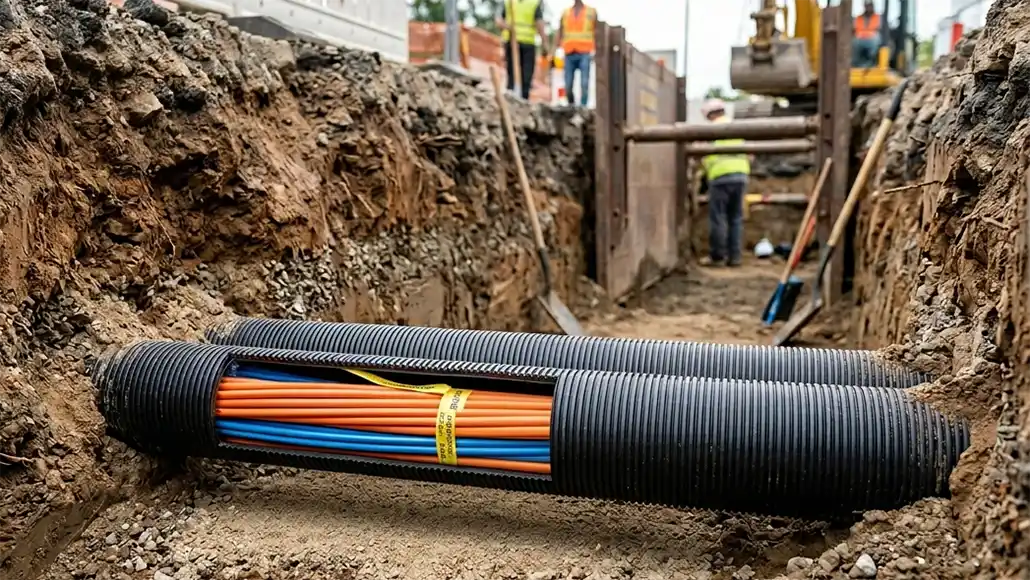
HDPE conduit is a flexible plastic piping system designed to house and protect fiber-optic and communication cables. Unlike rigid alternatives, it is typically installed in long, continuous runs, often supplied in coils or reels, minimizing the number of connections required in the field.
In telecom infrastructure, conduit does more than provide a pathway. It acts as a protective barrier against:
- Soil movement
- Moisture intrusion
- Mechanical damage
- Temperature fluctuations
Because modern communication networks rely heavily on fiber optics, which is sensitive to physical stress and environmental exposure, the conduit system becomes a critical component of overall network durability.
Reliability Starts at the Joints
One of the most important advantages of HDPE conduit is its ability to handle connections. According to Viaflex, most pipeline failures occur at the joints where sections connect, shift or degrade over time.
Traditional conduit materials often rely on mechanical couplings or gasketed joints, each introducing a potential failure point. Meanwhile, HDPE conduit systems can be heat-fused. This process creates a continuous system where each joint is as strong as the conduit itself and is designed to be leak-free.
For telecom infrastructure, this translates into a reduced risk of water ingress that can damage cables, fewer maintenance interventions over time and stronger system integrity under stress. Because HDPE systems require fewer joints, they also introduce fewer potential failure points, resulting in a more dependable network without constant monitoring or frequent repairs.
Flexibility That Reduces Risk and Complexity
Rigid conduit systems require frequent fittings to navigate terrain, avoid obstacles or change direction, and each additional fitting increases cost, labor and the risk of failure. HDPE conduit changes that equation by offering the flexibility to install longer continuous runs, bend around obstacles without extra fittings and adapt to complex routes with fewer components.
Viaflex highlights that this flexibility often reduces total installed cost, even when material costs appear higher up-front. The reason is fewer parts, less labor and fewer opportunities for something to go wrong. In large-scale telecom infrastructure projects, especially in urban or industrial environments, this flexibility can significantly streamline installation while improving long-term performance.
Built for Ground Movement and Environmental Stress
Telecom networks are rarely installed in ideal conditions. Over time, they are exposed to soil settlement, freeze-thaw cycles, seismic activity, traffic loads and vibration.
Rigid conduit materials can crack or separate under these conditions, especially at joints. However, HDPE conduit is designed to flex without failing. This ability to absorb movement is one of its most valuable characteristics. Instead of resisting environmental forces until failure, HDPE accommodates them. For municipal and industrial developers, this means:
- Reduced likelihood of conduit breaks
- Greater resilience in unstable soils
- Improved performance in regions with extreme weather conditions
When infrastructure must last decades, this kind of adaptability is essential.
Corrosion Resistance for Long-Term Performance
Corrosion is a silent threat to underground infrastructure. While metals are especially vulnerable, even some plastic materials can degrade when exposed to aggressive soils or chemicals. HDPE conduit offers strong resistance to both corrosion and chemical exposure, making it well-suited for demanding environments such as industrial sites with chemical exposure, coastal areas with high salinity and urban settings with contaminated soils.
Viaflex emphasizes the use of advanced resin formulations such as PE4710, which enhance durability and resistance to slow crack growth. This ensures that the conduit maintains structural integrity over long service periods. In telecom infrastructure, corrosion resistance directly translates into reliability. The less you need to account for environmental degradation, the more predictable your system becomes.
Supporting Trenchless Installation Methods
Modern telecom infrastructure projects increasingly rely on trenchless installation techniques such as horizontal directional drilling, microtrenching and plowing. These methods reduce surface disruption, accelerate timelines and minimize restoration costs, but they also place greater demands on conduit materials.
HDPE conduit is particularly well-suited for trenchless applications due to its flexibility and tensile strength, resistance to abrasion during installation, and ability to withstand pulling forces over long distances. This combination allows you to deploy telecom infrastructure efficiently in dense urban environments, across roadways or through environmentally sensitive areas without compromising durability.
Lower Life Cycle Costs and Maintenance Demands
Focusing only on up-front material cost can be misleading. As Viaflex points out, the real cost of infrastructure is experienced over time through:
- Easier maintenance and reduced repairs
- Fewer service interruptions
- Less labor and equipment for emergency fixes
- Longer replacement cycles
HDPE conduit helps control these costs by reducing the likelihood of failure in the first place. Key life cycle benefits include fewer repairs due to leak-free joints, reduced downtime for telecom networks, lower maintenance labor requirements and a longer service life compared to many alternatives. These savings are significant for municipalities managing public infrastructure or industrial operators relying on continuous connectivity.
Why Viaflex Is a Trusted Authority in HDPE Solutions
When evaluating HDPE conduit, the manufacturer matters as much as the material. Viaflex positions itself as a partner to developers and managers by offering high-quality, U.S.-made HDPE products and custom solutions tailored to complex project requirements.
Viaflex provides responsive customer service and technical support. It designs product formats to reduce installation downtime and risk. The provider’s focus on durability, service and innovation aligns with the needs of modern telecom infrastructure projects, where performance and reliability cannot be compromised.
Frequently Asked Questions
Learn more about HDPE conduit for telecom infrastructure projects.
How does HDPE conduit improve durability in telecom infrastructure?
HDPE conduit improves durability by creating a continuous, flexible system with fewer joints, which are the most common failure points. Its resistance to corrosion, ground movement and environmental stress helps protect sensitive telecom cables and reduces the likelihood of damage over time.
How does HDPE compare to traditional conduit materials, such as PVC?
While PVC can be effective for stable, straightforward installations, HDPE generally performs better in dynamic conditions. It is more flexible, more resistant to cracking and better suited for applications prioritizing long-term reliability and reduced life cycle costs.
Building Durable Telecom Infrastructure With Confidence
HDPE conduit gives you a more reliable foundation for telecom infrastructure by reducing joint failures, adapting to environmental stress and lowering long-term maintenance demands. When durability, uptime and predictable costs matter, this practical helps ensure your network performs consistently for decades.