



















Friday, August 28, 2026
CIOE 2026

Network APIs are Becoming Infrastructure for AI Agents

Note* - All images used are for editorial and illustrative purposes only and may not originate from the original news provider or associated company.

Related stories

Digital Twins Become Critical to Autonomous Networks

As telecom networks become more software-driven and increasingly autonomous,...

AI Network Slicing Moves into 5G-Advanced

Network slicing is moving into a more intelligent phase...

Edge AI is Turning Telecom Sites into Compute...

Artificial intelligence is changing what telecom infrastructure needs to...

Telecom networks have traditionally been built to connect people, devices and applications. As artificial intelligence becomes more capable of acting on information rather than simply analysing it, that role is beginning to expand. AI systems increasingly need access to network information and capabilities in real time, creating demand for a more programmable interface between applications and telecom infrastructure.

This is where network APIs are becoming important. APIs can expose capabilities that have traditionally remained inside operator systems, including device location, identity verification, device status, network quality and access to edge resources. Instead of building separate integrations with individual operators, developers can use standardised interfaces to access these capabilities across participating networks. The GSMA Open Gateway programme is designed around this model.

The scale of the initiative is significant. In March 2026, GSMA said 86 operator groups, representing more than 300 networks and around 80% of global mobile connections, were aligned around Open Gateway. It also reported more than 60 channel partners commercialising network APIs.

For AI applications, standardisation matters because an agent cannot efficiently operate across hundreds of different network interfaces. A common API layer gives software a consistent way to discover and request network capabilities, while operators retain control over how those capabilities are exposed.

The Network is Becoming Programmable for AI

Network APIs are moving beyond the idea of simply providing data to applications. Some interfaces can allow software to request specific characteristics from the network, making connectivity itself more programmable.

Quality on Demand is one example. It enables applications to request specific communication-quality characteristics, such as more stable latency or prioritised throughput, rather than treating network performance as entirely fixed. Edge Discovery provides another example by helping applications identify an appropriate operator edge location for a connected device.

These capabilities become particularly relevant as AI applications become more dependent on real-time information. An AI system operating an industrial application, for example, may need to understand where a device is located, whether it is reachable or which edge location can support the workload. Access to network information can allow the application to make those decisions using current network conditions rather than relying only on static infrastructure assumptions.

The technical architecture needed to support this is also developing. In January 2026, CAMARA published work on combining its standardised telecom APIs with the Model Context Protocol, or MCP. The approach allows AI applications to discover and invoke network capabilities through a common tool interface, including capabilities such as device location, Quality on Demand and edge discovery.

That is an important step because it brings telecom capabilities closer to the operating environment of AI agents. Instead of requiring every AI application to understand the underlying complexity of an operator’s network, standardised interfaces can present specific capabilities in a form that software can access and interpret.

The change is already moving beyond architectural proposals. In 2026, Orange demonstrated a CAMARA MCP provider implementation exposing network APIs for capabilities including device location, SIM-swap detection, identity verification and quality of service to compatible AI assistants and agents.

The significance is broader than a new developer interface. Network APIs are becoming part of the software layer through which AI systems can interact with next-generation telecom infrastructure, making the network more visible, programmable and accessible to machine-driven applications.

AI Agents Need a New Interface to the Network

The value of network APIs becomes clearer as AI agents move from generating information to carrying out tasks. An agent may need more than access to an application database. In a telecom environment, it may need current information about a connected device, the quality of the network serving it, its location or the availability of a nearby edge resource. Standardised APIs give that intelligence a defined way into the network.

This is where CAMARA and GSMA Open Gateway become important. CAMARA is developing operator-agnostic APIs so developers do not have to create a different integration for every telecom provider. GSMA Open Gateway is using those standardised interfaces to create a broader cross-operator environment. By March 2026, 86 operator groups representing more than 300 networks and 80% of global mobile connections were aligned with the Open Gateway framework. More than 60 channel partners were commercialising network APIs.

The breadth of the API layer is also expanding. The current Open Gateway catalogue lists 17 APIs across authentication and fraud prevention, location services, device information, communication quality, payments and charging, and computing services. That includes capabilities such as device location, device reachability, Quality on Demand and Simple Edge Discovery.

For an AI application, this means the network can become a source of live operational context rather than an invisible transport layer. A system could, for example, verify a device’s location, determine whether it is reachable or identify an appropriate edge location before deciding how an application should proceed.

Model Context Protocol Is Connecting AI to Network Capabilities

The next development is making these network capabilities easier for AI systems to discover and use.

In January 2026, CAMARA published a white paper describing how Model Context Protocol (MCP) can work with CAMARA APIs. The proposed architecture uses an MCP server to translate a CAMARA network API into an AI-readable tool, allowing AI applications and agents to discover and call network capabilities while retaining policy, consent and security requirements.

The significance is architectural. A traditional software integration usually depends on developers knowing which endpoint to call and how to handle its response. An AI agent needs a more discoverable tool layer because it may determine during its reasoning process that network information or a network capability is relevant to the task.

That approach is already moving into implementation. In July 2026, Orange contributed the first provider implementation to CAMARA’s MCP Enablement initiative, exposing network capabilities including device location, SIM-swap detection, identity verification and quality of service as tools that compatible AI assistants and agents can invoke.

The infrastructure challenge now extends beyond making APIs available. Telecom operators need to make those interfaces reliable, secure and predictable enough for machine-driven consumption. CAMARA’s work is therefore also addressing API design, security, consent requirements and AI-readable definitions, while its technical proposals call for authoritative MCP tool definitions to remain aligned with corresponding CAMARA API versions.

That matters because AI agents could generate a very different usage pattern from conventional applications. An agent may make API requests dynamically and potentially at high frequency as it works through a task. GSMA has highlighted this shift toward more high-frequency and non-deterministic API behaviour, making governance, security, capacity and policy controls increasingly important parts of the network API architecture.
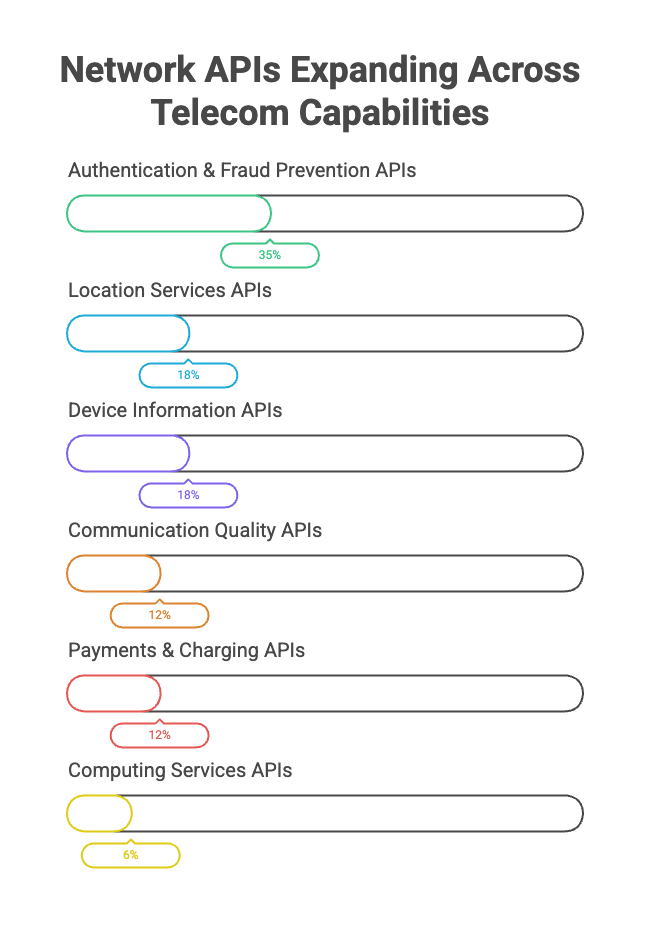
Key takeaway: Network APIs are expanding beyond identity and authentication into network-aware capabilities such as location, device intelligence, quality of service and edge discovery.

The longer-term significance is that network APIs can become the controlled software interface through which AI agents interact with telecom infrastructure. As that interface becomes more standardised, the network itself can become increasingly accessible to intelligent, machine-driven applications without exposing the underlying complexity of the operator infrastructure.

Conclusion

Network APIs are becoming an important part of next-generation telecom infrastructure as AI agents require more direct access to network information and capabilities. Standardised interfaces can allow AI applications to work with functions such as device location, quality of service, identity and edge discovery without requiring a separate integration for every operator.

The technology is still developing, but the direction is becoming clearer. CAMARA, GSMA Open Gateway and emerging MCP integrations are creating the foundations for more machine-readable and programmable networks, while security, consent, interoperability and policy controls remain essential as AI systems become more active network users.

As AI agents become increasingly capable of making decisions and carrying out tasks, the network API layer could become the bridge that allows those systems to interact safely with real telecom infrastructure.

Tele Info Today brings together the global telecoms industry — from network operators and connectivity providers to technology innovators and digital services leaders — through trusted editorial, market intelligence, and digital engagement.

Our 2026 Media Pack offers integrated solutions to reach your audience:

  • Magazine & Digital Editions Showcase your brand within premium telecoms industry coverage read by executives and decision-makers worldwide.
  • Industry Insights & Reports Align with data-driven analysis, trend reports, and regional roundups across the global telecommunications and digital services value chain.
  • Brand Authority & Credibility Position your company as a thought leader through expert commentary, interviews, and special features.

Subscribe

- Never miss a story with notifications

- Gain full access to our premium content

- Browse free from any location or device.

Media Packs

Expand Your Reach With Our Customized Solutions Empowering Your Campaigns To Maximize Your Reach & Drive Real Results!

– Access the Media Pack Now

– Book a Conference Call

Leave Message for Us to Get Back

Latest stories

Related stories

Digital Twins Become Critical to Autonomous Networks

As telecom networks become more software-driven and increasingly autonomous,...

AI Network Slicing Moves into 5G-Advanced

Network slicing is moving into a more intelligent phase...

Edge AI is Turning Telecom Sites into Compute...

Artificial intelligence is changing what telecom infrastructure needs to...

SK Telecom Launches SK Horizon AI Infrastructure Platform

South Korea's largest wireless telecom operator SK Telecom plans...

Subscribe

- Never miss a story with notifications

- Gain full access to our premium content

- Browse free from any location or device.

Media Packs

Expand Your Reach With Our Customized Solutions Empowering Your Campaigns To Maximize Your Reach & Drive Real Results!

– Access the Media Pack Now

– Book a Conference Call

Leave Message for Us to Get Back

Translate »