















Friday, August 28, 2026
CIOE 2026

Digital Twins Become Critical to Autonomous Networks

Note* - All images used are for editorial and illustrative purposes only and may not originate from the original news provider or associated company.

Related stories

Network APIs are Becoming Infrastructure for AI Agents

Telecom networks have traditionally been built to connect people,...

AI Network Slicing Moves into 5G-Advanced

Network slicing is moving into a more intelligent phase...

Edge AI is Turning Telecom Sites into Compute...

Artificial intelligence is changing what telecom infrastructure needs to...

As telecom networks become more software-driven and increasingly autonomous, operators face a basic problem: artificial intelligence needs to make decisions about infrastructure that is too important to use as a testing ground. Changing network parameters, routing, capacity or service configurations directly on a live network can affect performance for large numbers of users. Digital twins are emerging as a way to give AI a realistic environment in which to model those changes, assess their likely effects and refine decisions before they reach production infrastructure.

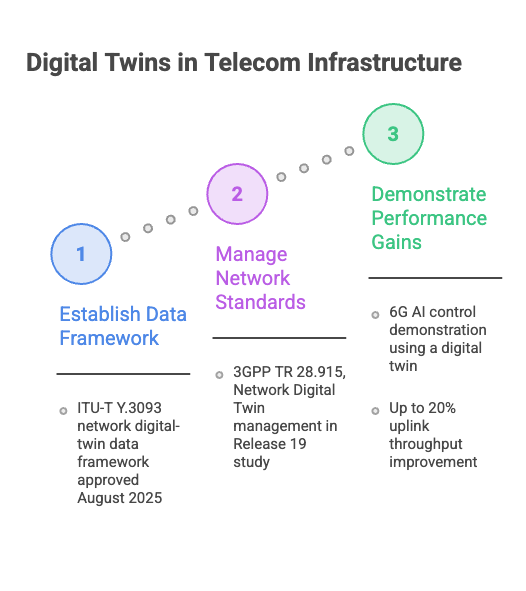
A network digital twin is more than a visual copy of a network. It is a virtual representation that can reflect the physical and operational state of the real network using data such as equipment configuration, device status, events, topology, performance and service information. The ITU’s Y.3093 recommendation, approved in August 2025, establishes requirements for the data domain supporting network digital twins and specifically highlights real-time interaction between physical and virtual networks.

That real-time relationship is what makes digital twins relevant to autonomous telecom infrastructure. A static model can show what a network looks like, but an operational twin can help represent what the network is doing now and how it may respond to a proposed change. AI can then use that environment to test configurations, evaluate possible outcomes and identify a preferred action without immediately applying every experiment to the live network.

The Network Needs a Virtual Environment for AI

The need becomes more important as networks move toward higher levels of autonomy. An autonomous system has to do more than detect a fault. It needs to understand the network state, evaluate possible responses and determine whether a change could create a new problem somewhere else.

A digital twin can support that process by bringing different network data sources into one environment. ITU’s framework includes historical and operational data, device status, network topology, performance information, events and service data, while also requiring compatibility with existing databases, data lakes and physical network equipment.

This creates a foundation for AI-driven simulation and optimisation. Instead of making a network change first and observing the result afterwards, operators can increasingly test potential decisions against a virtual representation of the infrastructure.

The concept is already moving into next-generation network research. Work on network digital twins is now part of formal 3GPP standardisation, with the Release 19 study TR 28.915 focused specifically on the management aspects of Network digital twins.

Research demonstrations are also beginning to show measurable performance benefits. A 2026 6G RAN study using digital-twin-based AI control reported up to 20% improvement in uplink throughput in its demonstrated scenario. The digital twin was used to evaluate and validate the AI-driven network-control approach before applying it to the real-world environment.

The significance is not the 20% figure alone, which comes from a specific demonstration rather than an industry benchmark. It is that a virtual representation of the network can become part of the process through which AI decisions are evaluated.
Key takeaway: Digital twins are moving from a modelling concept toward a defined part of telecom architecture, with standards work and AI-driven network-control demonstrations already developing around them.

The broader shift is therefore not simply about creating a digital copy of a telecom network. digital twins are becoming a potential operating layer between AI decision-making and live infrastructure, giving autonomous networks a way to test, predict and validate changes before those decisions affect the physical network.

Digital Twins are Becoming Part of the Autonomous Network Stack

As autonomous networks move beyond isolated automation, the role of a Digital Twin is becoming more important. An autonomous network has to continuously interpret its environment, predict what could happen next and decide how infrastructure should respond. Doing that safely requires more than live telemetry. It requires a virtual representation of the network that can be used to test and validate potential decisions before they affect production systems.

That is why digital twins are moving from planning and simulation toward the operational architecture of autonomous networks. A high-fidelity twin can represent the network’s physical and logical state, including topology, configuration, performance and faults. AI can then use that representation to analyse relationships between network elements, compare possible actions and predict their consequences. Current research describes a real-time digital twin as a critical building block for Level 4 and Level 5 autonomous-network operations.

The distinction matters. A conventional network-management system primarily observes what is happening. A digital twin can provide a controlled environment in which the network’s likely response to a proposed change can also be evaluated. That becomes increasingly valuable as autonomous systems gain more authority to modify network behaviour.

From Simulation Tool to Autonomous Network Infrastructure

The industry’s standardisation work reflects this shift. In 2026, 3GPP moved its Network Digital Twin management work into Release 19 specifications, while a separate Release 20 study is extending work on the management aspects of Network digital twins. The focus is not simply on visualising networks, but on how digital twins can be managed as part of network operations.

ETSI is also developing a Network Digital Twin for Testing framework. Its current work covers deterministic and reproducible virtual representations of network functions, with use cases including interoperability testing, functional and behavioural verification, closed-loop operational verification and support for autonomous-network decision-making.

That is an important development because it places digital twins directly inside the control and validation cycle of next-generation networks.

A virtual environment can be used to test a proposed routing change, examine how a configuration adjustment could affect neighbouring network elements or evaluate an autonomous response before it is applied to live infrastructure. This reduces the need to use the production network itself as the place where new AI-driven decisions are tested.

The role of the twin is also becoming more dynamic. Recent network architectures describe digital twins as temporal representations capable of capturing the network’s current state while retaining historical states. That allows AI systems to examine how the network changed over time and use that history for fault diagnosis and prediction.

This is particularly relevant to complex telecom environments where faults can cross multiple layers. A problem that appears in the radio access network may have roots in transport, edge computing or the core. A digital twin that represents these layers together can give AI a broader context for understanding the problem rather than analysing each domain independently.

The infrastructure challenge is substantial, however. A useful twin depends on fresh and reliable data, accurate models and interoperability across different network components. Recent standardisation work is therefore focusing not only on the twin itself, but also on its data models, interfaces, orchestration and lifecycle management. ITU-T’s 2026 Y.3094 recommendation, for example, defines requirements for digital-twin model types, orchestration, management and unified interfaces.

That makes the technology increasingly relevant to the architecture of autonomous networks. The digital twin is becoming the environment in which AI can simulate, validate and refine network decisions, helping bridge the gap between an intelligent model and changes made to live telecom infrastructure.

The more autonomous the network becomes, the more important that validation layer is likely to become.

Tele Info Today brings together the global telecoms industry — from network operators and connectivity providers to technology innovators and digital services leaders — through trusted editorial, market intelligence, and digital engagement.

Our 2026 Media Pack offers integrated solutions to reach your audience:

  • Magazine & Digital Editions Showcase your brand within premium telecoms industry coverage read by executives and decision-makers worldwide.
  • Industry Insights & Reports Align with data-driven analysis, trend reports, and regional roundups across the global telecommunications and digital services value chain.
  • Brand Authority & Credibility Position your company as a thought leader through expert commentary, interviews, and special features.

Subscribe

- Never miss a story with notifications

- Gain full access to our premium content

- Browse free from any location or device.

Media Packs

Expand Your Reach With Our Customized Solutions Empowering Your Campaigns To Maximize Your Reach & Drive Real Results!

– Access the Media Pack Now

– Book a Conference Call

Leave Message for Us to Get Back

Latest stories

Related stories

Network APIs are Becoming Infrastructure for AI Agents

Telecom networks have traditionally been built to connect people,...

AI Network Slicing Moves into 5G-Advanced

Network slicing is moving into a more intelligent phase...

Edge AI is Turning Telecom Sites into Compute...

Artificial intelligence is changing what telecom infrastructure needs to...

SK Telecom Launches SK Horizon AI Infrastructure Platform

South Korea's largest wireless telecom operator SK Telecom plans...

Subscribe

- Never miss a story with notifications

- Gain full access to our premium content

- Browse free from any location or device.

Media Packs

Expand Your Reach With Our Customized Solutions Empowering Your Campaigns To Maximize Your Reach & Drive Real Results!

– Access the Media Pack Now

– Book a Conference Call

Leave Message for Us to Get Back

Translate »