





















Radio access networks have traditionally relied on predefined rules, engineering thresholds and manual intervention to manage changing traffic and radio conditions. That approach remains important, but the increasing complexity of 5G networks is creating demand for systems that can respond continuously to changing conditions. Artificial intelligence is beginning to address this gap by analysing network data in real time and supporting decisions around resource allocation, scheduling, link adaptation, beamforming and energy use.
This is shifting AI RAN network optimization from a longer-term technology concept toward a practical network-management capability. Rather than waiting for engineers to identify performance problems and adjust parameters, AI-based systems can analyse large volumes of network information, identify patterns and determine how particular conditions are likely to affect performance.
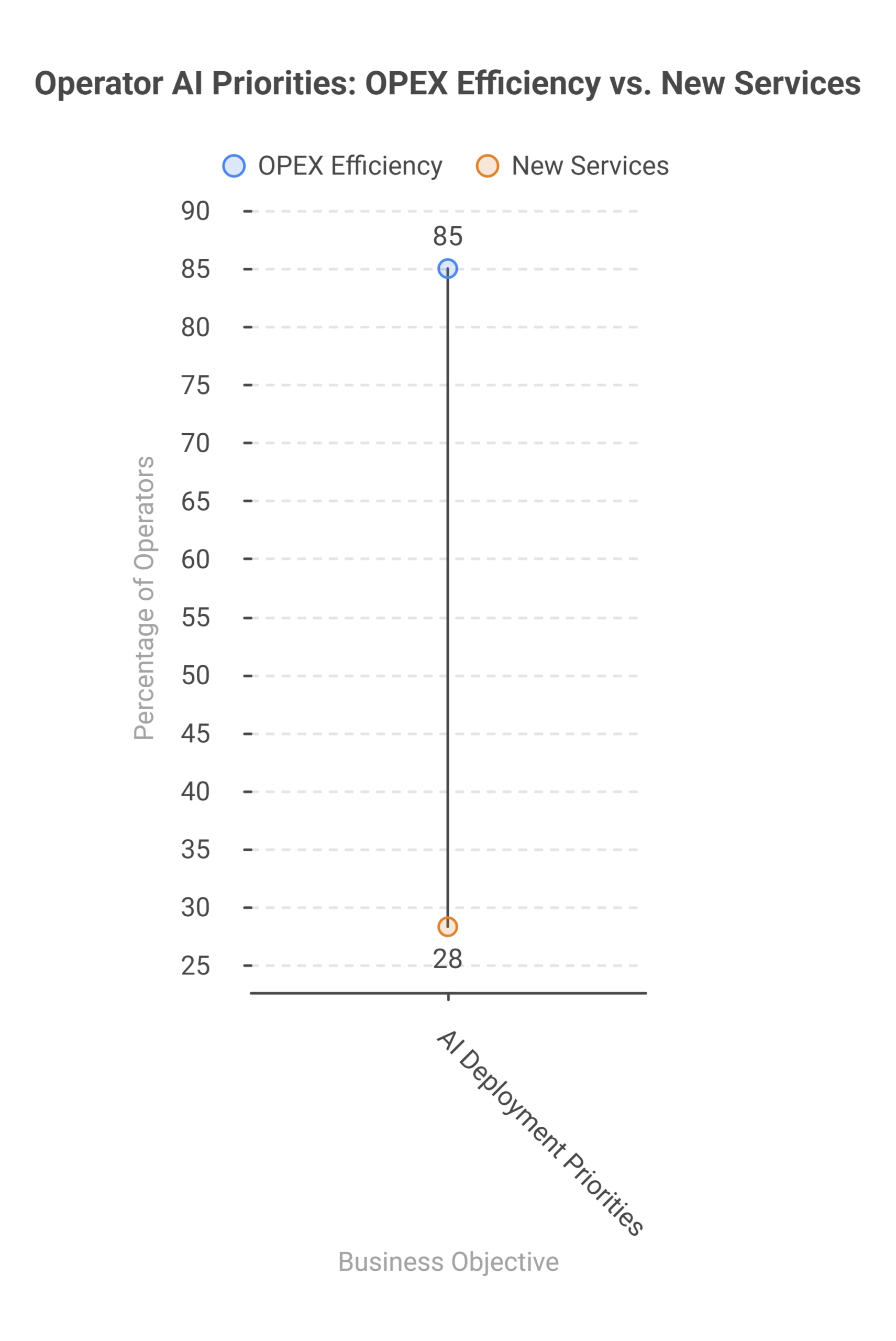
The commercial motivation is increasingly clear. GSMA Intelligence’s 2026 Network Transformation research found that 85% of operators identified operating-expenditure efficiencies as a priority business objective for deploying AI in their networks. The figure was almost three times the proportion focused on using AI to deliver new services, indicating that near-term operator interest is primarily centred on improving network economics and operational performance rather than generating entirely new revenue streams.
Market forecasts also indicate that AI is becoming a significant part of future RAN investment. Dell’Oro forecasts cumulative AI RAN revenue of approximately $35 billion between 2026 and 2030. Its analysis expects the initial market to be centred on AI-for-RAN applications, single-purpose deployments, non-GPU architectures, distributed RAN and 5G, rather than immediately shifting toward large-scale GPU-based RAN.
AI is Changing How RAN Performance is Managed
The difference between conventional optimisation and AI-driven optimisation lies in how network decisions are generated. Traditional systems generally depend on predefined rules that determine how a network should respond to specific conditions. AI models can instead learn from historical and real-time network data, allowing them to identify relationships between radio conditions and performance outcomes.
Link adaptation is one example. Radio conditions can change rapidly as users move, interference fluctuates and traffic patterns shift. AI models can use these changes to predict appropriate transmission parameters rather than relying entirely on static rules.
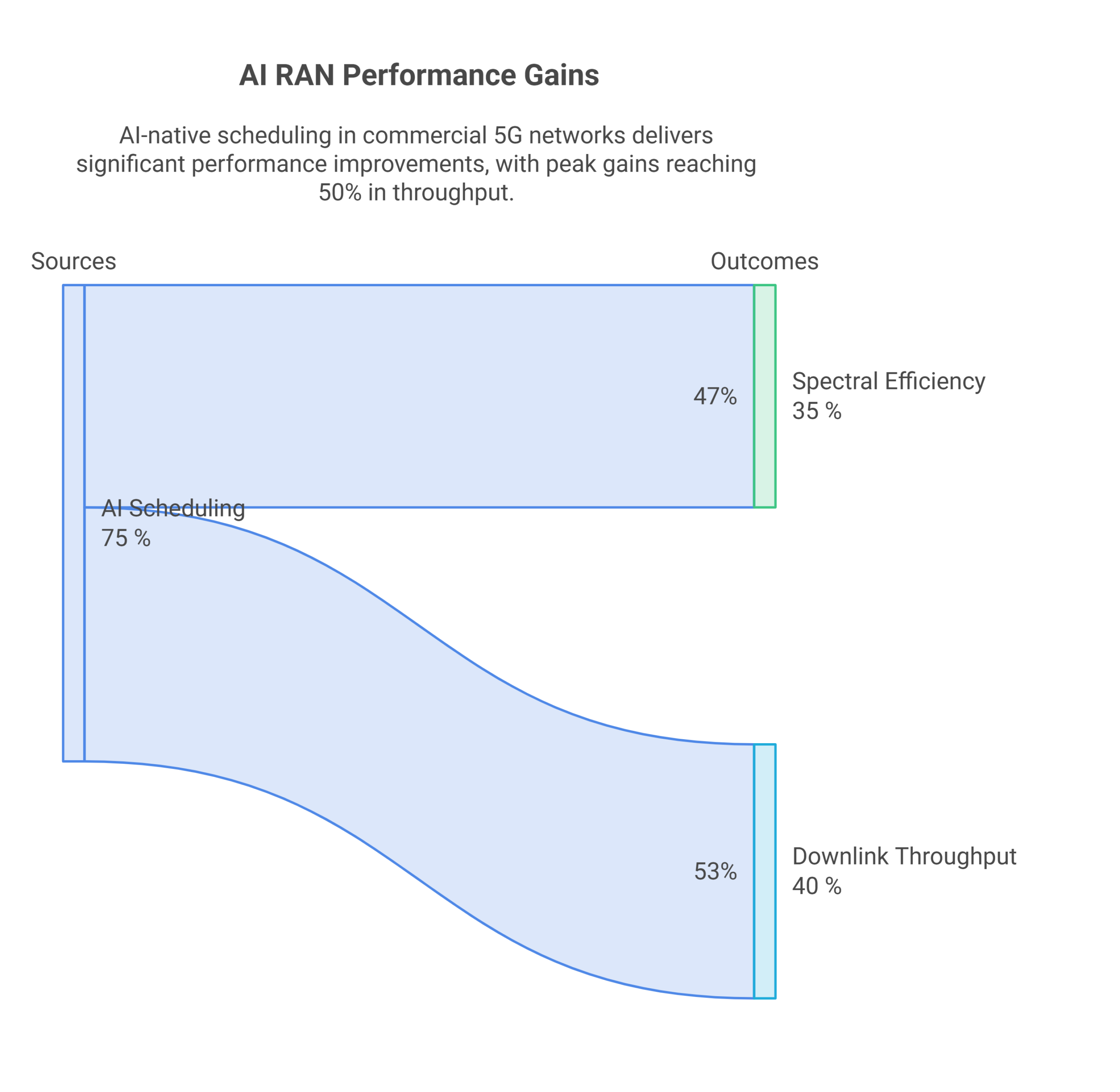
Recent commercial-network testing demonstrates the potential. A 2026 validation of an AI-native scheduler for link adaptation reported close to a 10% increase in spectral efficiency and up to a 15% increase in downlink throughput compared with legacy rule-based methods. These results came from a specific network validation and should not be treated as an industry-wide benchmark, but they demonstrate how AI can influence RAN performance at the operational level.
The role of AI RAN network optimization also extends beyond individual radio parameters. AI can support traffic forecasting, anomaly detection, energy management and broader resource allocation, allowing multiple network variables to be considered together.
AI is Improving Performance, Efficiency and Network Autonomy
The value of AI in the RAN is increasingly being measured through specific operational outcomes rather than broad claims about automation. Network operators are testing AI models for link adaptation, beamforming, traffic management, energy optimisation and other functions where conditions can change continuously. This is moving AI RAN network optimization toward a more measurable stage, where improvements can be assessed through throughput, spectral efficiency, energy consumption and resource utilisation.
The shift is also being reflected in the development of the O-RAN architecture. The O-RAN ALLIANCE’s Release 5, completed in 2026, introduced enhanced AI and machine learning workflow services connecting the Non-Real-Time RAN Intelligent Controller and Near-Real-Time RAN Intelligent Controller. The release also added capabilities for massive MIMO optimisation and energy saving, providing a standardised architecture through which AI and machine learning applications can influence RAN operations.
Real Time AI is Improving Radio Performance
Link adaptation provides one of the clearest examples of what this technology can achieve. Radio conditions can change rapidly because of interference, user movement, traffic congestion and variations in signal quality. Traditional approaches use rule-based algorithms and predefined parameters to determine how the network should respond.
Recent commercial-network testing shows how AI can change this process. A 2026 validation of an AI-native scheduler operating within a 5G commercial network reported improvements of up to approximately 25% in spectral efficiency and 50% in downlink user throughput compared with conventional technology. Across all evaluated locations, the average improvement was approximately 10% for both measures. The results came from a specific commercial-network validation and should not be treated as an industry-wide benchmark, but they demonstrate the potential for AI to make real-time RAN decisions based on changing radio conditions.
The technical challenge is that AI decisions must be produced quickly enough to remain useful. RAN functions can operate under extremely tight timing requirements, meaning an accurate model may still be unsuitable if inference introduces excessive latency. This makes model size, hardware acceleration and execution efficiency important alongside prediction accuracy.
Energy Efficiency is Becoming Another AI Use Case
Performance is not the only objective. Mobile networks consume substantial amounts of energy, and traffic levels can vary considerably throughout the day. AI can help identify periods of lower demand and adjust network resources accordingly while maintaining service requirements.
The O-RAN Release 5 specifications specifically include network energy-saving improvements, alongside support for O-RU-specific energy-saving functions. This shows that energy management is becoming part of the standardised intelligent RAN architecture rather than an isolated optimisation application.
Commercial deployments are also testing this approach. Nokia reports that AI-based energy-management systems have achieved reductions in power consumption while maintaining network performance, demonstrating the potential for AI to balance network capacity and energy use dynamically. These results are deployment-specific, but they reinforce the broader move toward using AI to manage resources according to real-time demand.
AI is Moving Toward Closed Loop Network Control
The next stage is moving beyond recommendations toward automated action. A conventional analytics system may identify congestion and alert an engineer. A more advanced AI system can predict the problem, determine an appropriate response and apply the change automatically within predefined operational limits.
This is where the RAN Intelligent Controller becomes important. The O-RAN architecture separates longer-timescale optimisation in the Non-Real-Time RIC from near-real-time control through the Near-Real-Time RIC, creating a framework for applications that can influence network behaviour at different timescales. Release 5 further strengthens this architecture through AI and machine-learning workflow services.
Recent industry development is also moving toward agentic approaches in which multiple AI agents can monitor network conditions, analyse potential actions and coordinate changes. The objective is not simply to automate an individual parameter but to create a continuous decision cycle in which the network can respond to changing conditions with less manual intervention.

AI RAN is Moving Toward Adaptive Network Control
The role of AI in radio access networks is moving beyond analytics and performance reporting toward continuous network control. As operators gain access to more real time network data, AI systems can increasingly identify changing conditions, predict their impact and support adjustments to network resources.
The next stage will depend on how reliably these systems can operate within strict latency, performance and energy constraints. AI models must respond quickly, remain stable under changing radio conditions and work alongside existing network-management systems without creating additional operational complexity.
The broader direction is toward networks that can continuously adjust capacity, radio parameters and energy use according to demand. AI RAN network optimization will therefore become less about isolated AI applications and more about creating an adaptive operating model in which prediction, decision making and network control are increasingly connected.