Radio resource management is becoming a more important application for artificial intelligence as mobile networks become more dynamic and traffic patterns become harder to predict. Operators must continuously balance limited spectrum, radio capacity, transmission power and physical resources against changing user demand, mobility and interference. Traditional RRM approaches depend largely on predefined rules and optimisation algorithms, but increasingly variable network conditions are creating an opportunity for more adaptive decision making. This is where AI Radio resource management is beginning to gain importance.
The objective is not simply to monitor network performance. AI can analyse radio measurements and help determine how available resources should be allocated across users and cells. Scheduling, link adaptation, beam management and interference coordination are among the areas where machine learning can identify relationships that may be difficult to capture through fixed rules.
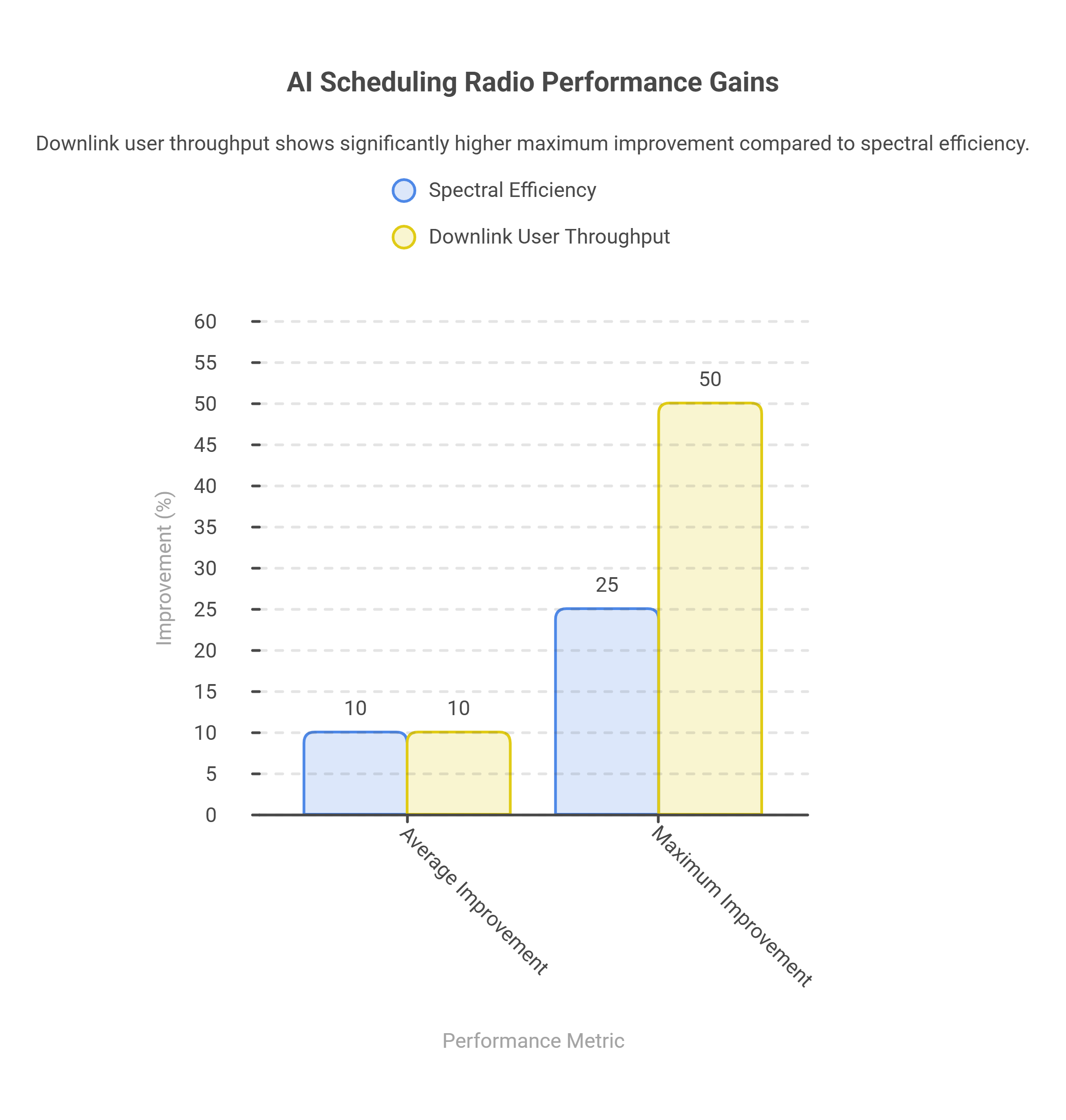
Recent commercial testing provides evidence that this approach is moving into live network environments. A 2026 commercial 5G validation of an AI native scheduler focused on link adaptation reported maximum improvements of approximately 25% in spectral efficiency and 50% in downlink user throughput. Average gains across evaluated locations were approximately 10% for both measures. The results are specific to the tested deployment, but they demonstrate how AI can influence radio decisions with measurable performance effects.
Scheduling is Becoming More Adaptive
Scheduling is one of the clearest applications because the network must continuously determine how available radio resources are distributed between users. Demand can change rapidly between cells, while users can experience very different channel conditions at the same time. AI models can process current measurements alongside historical patterns to support allocation decisions that adapt to those changes.
Link adaptation is closely connected to scheduling. The network needs to select transmission conditions that maximise data rates without increasing error rates beyond acceptable levels. AI can incorporate signal quality, interference, mobility and previous performance to support more responsive decisions.
The O RAN Alliance is incorporating these capabilities into its evolving architecture. Its 2026 Release 5 introduced enhancements for massive MIMO optimisation and AI and machine learning workflows connecting the Non Real Time RAN Intelligent Controller and Near Real Time RAN Intelligent Controller. These developments provide a framework for intelligent applications to influence network optimisation across different timescales.
The potential therefore extends beyond throughput. AI Radio resource management can be designed to balance competing objectives such as latency, reliability, energy consumption and user fairness. That becomes more important as a single network supports services with different performance requirements and increasingly variable traffic patterns.
Key Takeaway: AI based scheduling and link adaptation can improve radio performance, although results vary by location and operating conditions.
AI is Making Radio Resource Allocation More Adaptive
The next stage of AI Radio resource management is moving from isolated optimisation functions toward coordinated control across the RAN. The O RAN architecture provides a framework for this through the Non Real Time RAN Intelligent Controller and Near Real Time RAN Intelligent Controller, allowing applications to operate at different timescales. This is important because resource decisions range from longer term traffic planning to near real time scheduling, beam management and slice allocation.
The O RAN Alliance’s Release 5, completed in 2026, strengthened this architecture through enhanced AI and machine learning workflow services connecting the two RIC environments. The release also introduced improvements for massive MIMO optimisation and network energy saving, showing that intelligent control is expanding across several dimensions of RAN resource management.
Closed Loop Control is Bringing AI Closer to the Radio
The objective is increasingly to create a continuous decision cycle. Network conditions can be measured, an AI application can identify a potential optimisation, the change can be applied and its effect can then be measured again. This creates a closed loop rather than a process where network data is simply reviewed before an engineer decides what to do.
Research is also moving toward more adaptive resource allocation. A September 2026 study proposed a fuzzy logic based xApp for dynamic physical resource block allocation in O RAN network slicing. The research addresses fluctuating traffic and different service requirements across eMBB, URLLC and mMTC, demonstrating how resource allocation can respond to changing network conditions instead of depending entirely on static policies.
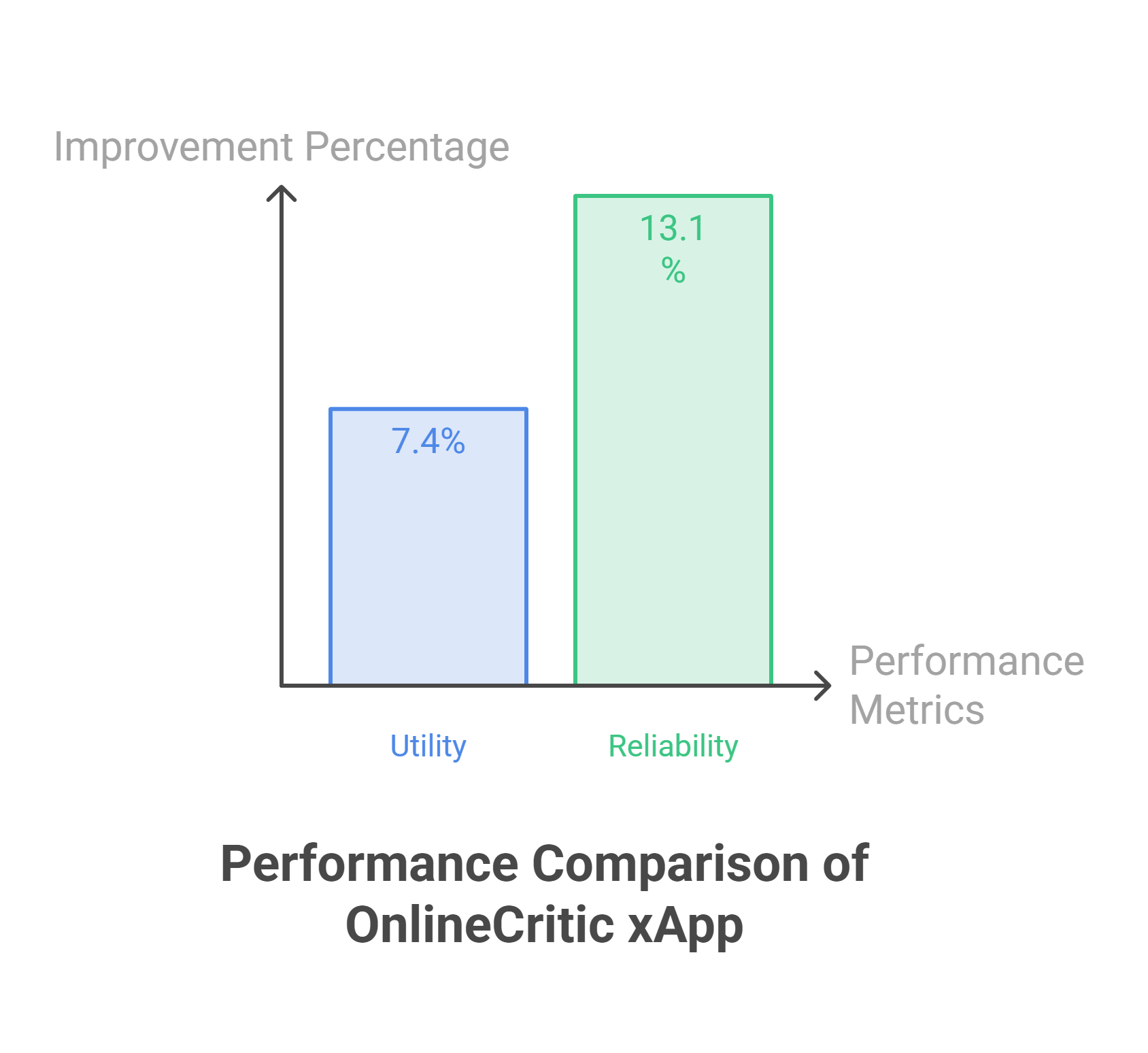
Another IEEE INFOCOM 2026 study tested OnlineCritic xApp for RAN slice resource management under non stationary traffic and changing channel conditions. Its simulations showed up to 7.4% higher average utility and 13.1% higher reliability compared with proportional physical resource block allocation. These results are simulation based rather than commercial network measurements, but they provide evidence of the direction of research into adaptive RRM.
AI is Expanding Resource Allocation Beyond Throughput
A conventional optimisation system may prioritise aggregate throughput, but modern networks increasingly need to balance several objectives simultaneously. A service requiring very low latency may need a different resource allocation strategy from a high bandwidth application, while energy sensitive workloads can introduce another constraint.
This makes AI Radio resource management particularly relevant to network slicing. AI models can consider traffic demand, channel conditions and service requirements together, potentially allowing physical resource blocks, power and scheduling opportunities to be adjusted according to changing priorities.
Research is also addressing the problem of multiple intelligent applications operating at the same time. A 2026 ITU Journal study examined an ML driven network orchestrator designed to resolve conflicts between multiple xApps in the Near Real Time RIC. The researchers identified overlapping control commands and competition for network resources as potential problems when several applications attempt to influence the RAN simultaneously.
Key Takeaway: AI assisted resource allocation can improve utility and reliability under changing traffic and channel conditions, although the reported results are based on simulation rather than commercial network deployment.
The progression toward AI Radio resource management is therefore creating a more adaptive approach to scarce radio resources. Instead of optimising each parameter independently, intelligent applications can increasingly consider several network objectives together and adjust allocations as conditions change. This also means that orchestration and coordination will become more important, since multiple AI applications must operate within defined limits without producing conflicting actions.
The O RAN Alliance’s continuing work reinforces this direction. Its 2026 specification activity includes AI and machine learning workflows, massive MIMO optimisation, spectrum efficiency improvements and interfaces supporting intelligent network functions.
The result is a RAN in which resource management is becoming increasingly software driven and adaptive. AI Radio resource management is moving closer to the operational control layer, but its success will depend on whether these systems can deliver useful decisions quickly, maintain reliability and operate safely within the strict constraints of live mobile networks.
AI is Moving RRM Toward Continuous Optimisation
Radio resource management is moving from fixed optimisation rules toward more adaptive systems that can respond to changing traffic, interference, channel conditions and service requirements. The growing use of AI in scheduling, link adaptation, beam management and network slicing is giving operators new ways to manage limited radio resources while balancing performance, reliability and energy efficiency.
The next challenge is making these systems reliable enough for continuous network control. AI models must produce decisions within strict latency requirements, work with accurate and consistent network data, and remain predictable when conditions change. They also need safeguards to prevent conflicting or incorrect automated actions from affecting live networks.
This makes AI Radio resource management increasingly important to the development of intelligent RAN architectures. The objective is not simply to automate existing processes, but to create systems that can continuously evaluate network conditions, allocate resources and adjust their decisions as requirements evolve. As RAN intelligence develops, the ability to combine AI with real time control could become an increasingly important part of network performance and resource efficiency.