















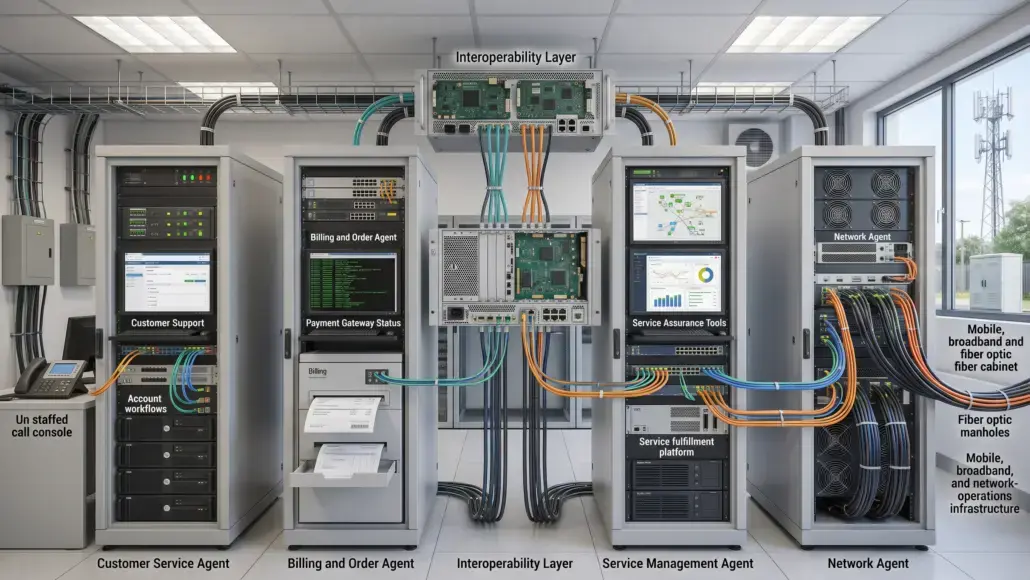

Telecom operators are moving from individual AI deployments toward environments in which multiple agents may need to work across customer service, billing, service management and network operations. A customer-service agent may identify an issue but require information from a network agent, while a service agent may need to coordinate with billing or order-management systems before a request can be completed. This creates a new requirement beyond the capabilities of any individual AI system: the agents must be able to work together.
This is making telecom agent interoperability increasingly important as agentic systems expand across telecom operations. Interoperability can allow agents to exchange requests, share relevant context and coordinate tasks without requiring every agent to use the same underlying model, application or vendor platform.
Telecom Agents are Expanding Across Multiple Domains
A customer interaction can involve several operational domains even when the initial request appears simple. A connectivity complaint, for example, may require a customer-service agent to obtain service information, determine whether a network incident exists and then coordinate with a technical workflow. Keeping each function inside an isolated AI application can limit how far automation can extend.
Agent-to-agent frameworks are emerging to address this problem. TM Forum’s Agent to Agent Protocol for Telecoms, or A2A-T, is designed to support communication and collaboration between agents operating across different telecom domains. Its 2026 version focuses on enabling agents to exchange information and coordinate activities across services, network functions and business processes.
This gives telecom agent interoperability a practical role in multi-step customer-service workflows. Instead of one agent attempting to access every system directly, it can potentially request a specific task from another specialised agent. The receiving agent can then use its own tools and permissions to complete that part of the workflow and return the relevant result.
Agent Collaboration is Becoming an Architectural Requirement
The need for interoperability increases as operators deploy more specialised agents. Billing, customer experience, network operations and service assurance may each require different capabilities, data access and operating controls. A common interaction layer can allow these agents to collaborate while preserving their individual roles.
TM Forum’s broader AI-Native ODA work similarly identifies fragmented AI platforms and incompatible agent frameworks as barriers to scaling agentic operations. The objective is to create a more modular and composable environment in which different AI capabilities can participate in shared workflows.
Telecom agent interoperability therefore is not simply about connecting two AI applications. It is about creating a framework through which specialised agents can discover capabilities, exchange structured information and coordinate actions across telecom domains.
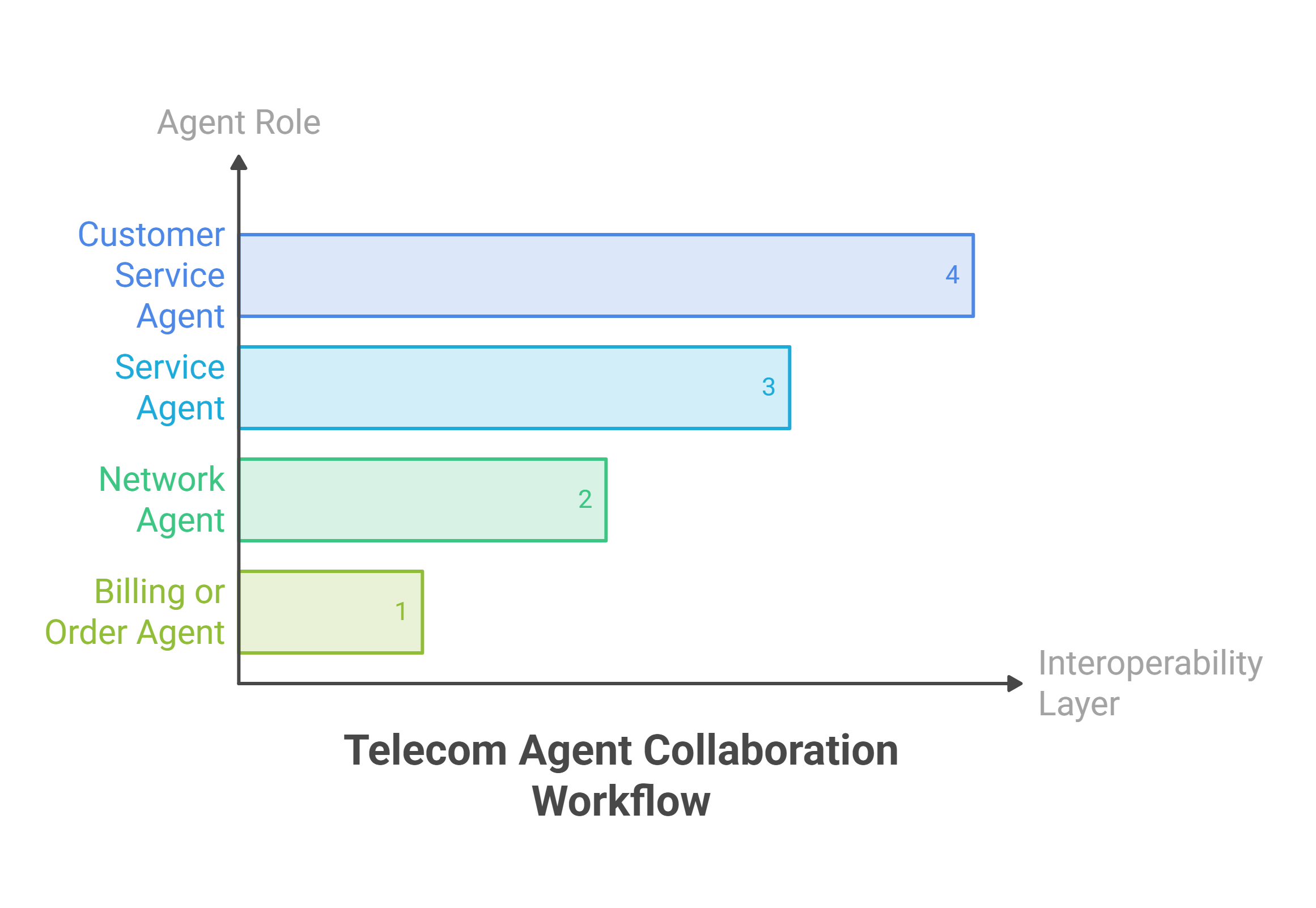
Key Takeaway: Telecom agent ecosystems require interoperable mechanisms that allow specialised agents to coordinate tasks across customer, service, network and business domains.
The emergence of these interconnected workflows marks a shift from isolated AI applications toward collaborative agent environments. Telecom agent interoperability will increasingly determine whether individual agents can operate as parts of a wider telecom service ecosystem.
Shared Semantics are Becoming Critical to Telecom Agent Collaboration
Communication between agents is only useful when the systems can interpret the information being exchanged in a consistent way. Telecom environments contain specialised terminology, service relationships and operational states that may be represented differently across platforms. An agent may be able to send a request to another agent, but differences in data structures or meaning can still prevent the receiving system from acting on it correctly.
This makes telecom agent interoperability dependent on more than a common communication protocol. Agents also need shared definitions for customers, services, network conditions, incidents, orders and actions. Without this semantic layer, interoperability can remain technically connected while operational workflows continue to break down.
Agents Need a Common Understanding of Telecom Context
Consider a customer-service agent identifying a network-related issue. It may send information about the affected service to a network agent, which then needs to understand the service identifier, location, fault condition and requested action in the same way as the originating system.
This is why TM Forum’s 2026 work on the Internet of Agents places significant emphasis on ontology-driven semantics. The initiative is designed to support interoperable collaboration by giving agents a common understanding of the entities and relationships involved in digital-service interactions. TM Forum’s related work on operationalising ontologies for AI-native autonomous networks similarly focuses on semantic interoperability and contextual reasoning across network operations.
For telecom agent interoperability, this semantic consistency can be as important as the communication mechanism itself. A shared meaning allows one agent to interpret another agent’s request without relying on bespoke translations for every connection.
Open Architectures are Reducing Agent Fragmentation
The challenge becomes larger as operators deploy agents from multiple vendors and across different operational domains. A proprietary customer-service agent may need to work with a network agent supplied by another technology provider, while both interact with existing telecom systems.
TM Forum’s AI-Native ODA roadmap addresses this fragmentation by promoting a more modular architecture in which AI capabilities and agents can be composed across domains rather than remaining isolated inside proprietary platforms. The approach brings together agentic AI, data architecture, security and governance as parts of the same operating environment.
This also creates an important distinction between interoperability and standardisation. Operators do not necessarily need every agent to use the same model or implementation. They need common mechanisms for discovering capabilities, exchanging relevant information and maintaining consistent meanings across those implementations.
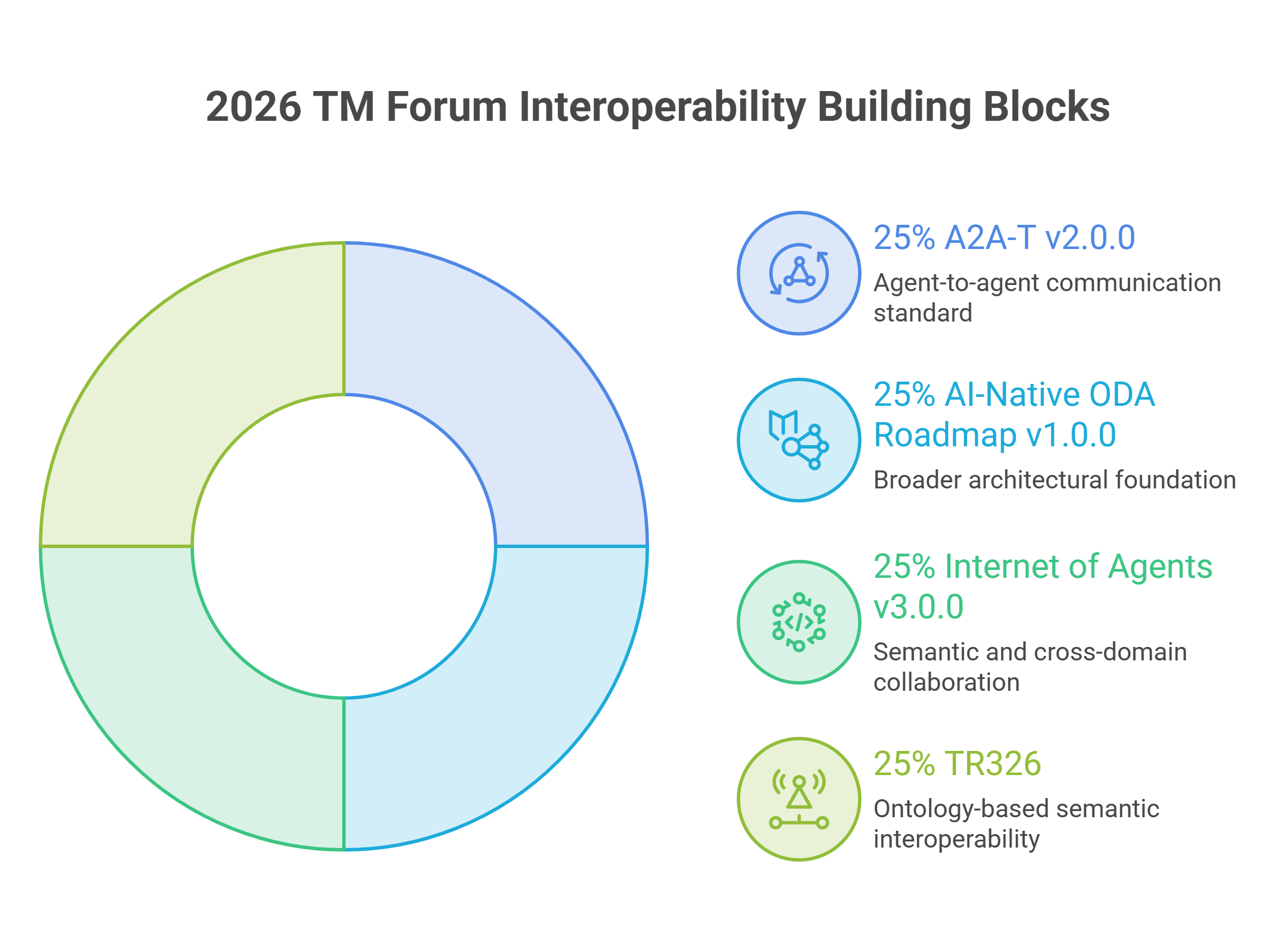
Key Takeaway: Telecom interoperability is developing across multiple layers, from agent communication and architecture to shared semantics and operational context.
The emerging model is therefore broader than simply allowing agents to communicate. Telecom agent interoperability requires a combination of protocols, architectural standards and shared semantics so that different agents can collaborate without creating new integration silos.