




















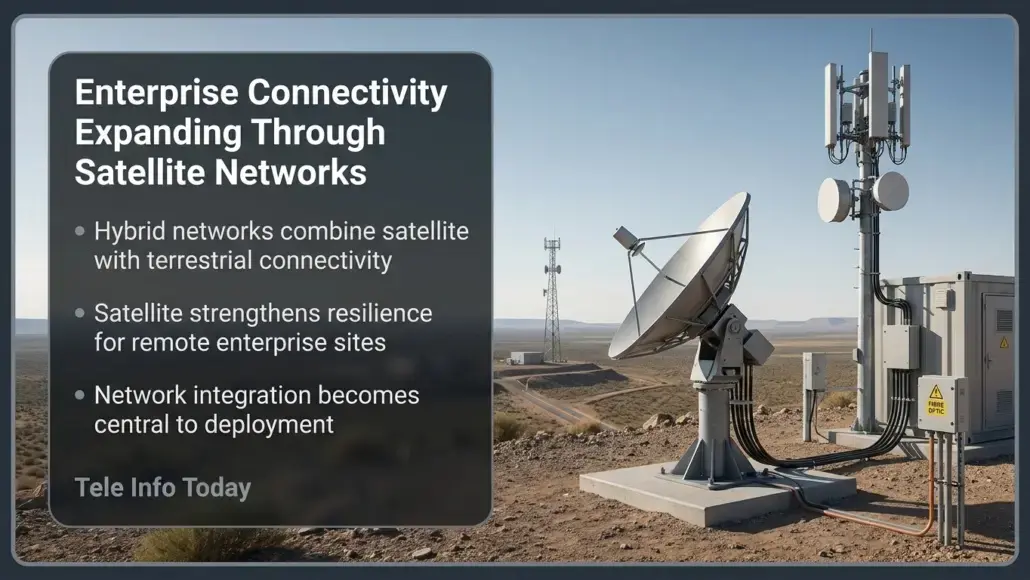

Enterprise connectivity is increasingly being designed around multiple access technologies rather than a single network path. Fibre, cellular, microwave and satellite can serve different roles within the same architecture, allowing organisations to maintain communications across remote or infrastructure-constrained environments. This is changing enterprise satellite connectivity from a specialist service into a component that can sit alongside established terrestrial networks.
Recent satellite developments illustrate that shift. The three developments already covered in this series show different versions of the same movement: satellite being added to existing telecom infrastructure, tested alongside terrestrial connectivity in a moving environment, and introduced through an established national connectivity ecosystem. The wider market evidence points in the same direction. The Global mobile Suppliers Association (GSA) reported in August 2026 that community and enterprise broadband accounted for 38% of partnerships announced between satellite network operators and telecom operators. It also reported growth in satellite-backhaul partnerships as operators seek resilience and wider deployment where fibre expansion is difficult or expensive.
Satellite Becoming a Complementary Network Layer
For enterprises, the significance is not simply that a satellite can reach a remote location. The more important development is the ability to incorporate that link into an existing network strategy. A remote site can remain connected to central applications and cloud services through multiple access technologies, with satellite providing an alternative path where needed. The practical priorities are becoming clearer:
- Network continuity where an outage on the primary terrestrial path could interrupt operations.
- Faster site connectivity where permanent fibre or fixed infrastructure requires longer deployment periods.
- Distributed access across facilities, assets or operating locations with different terrestrial conditions.
This makes enterprise satellite connectivity relevant to network planning as much as coverage planning. The question is increasingly where satellite fits within the wider architecture.
Enterprise Connectivity Moving Beyond Coverage
The architectural shift also changes how enterprises assess connectivity options. Instead of asking whether satellite can replace a terrestrial connection, network planners increasingly need to determine where it adds value to the existing system. That assessment can include:
- Whether satellite should serve as a primary or secondary access path.
- Which applications require continuous connectivity and which can tolerate switching between networks.
- How remote sites can connect into centralised enterprise and cloud environments.
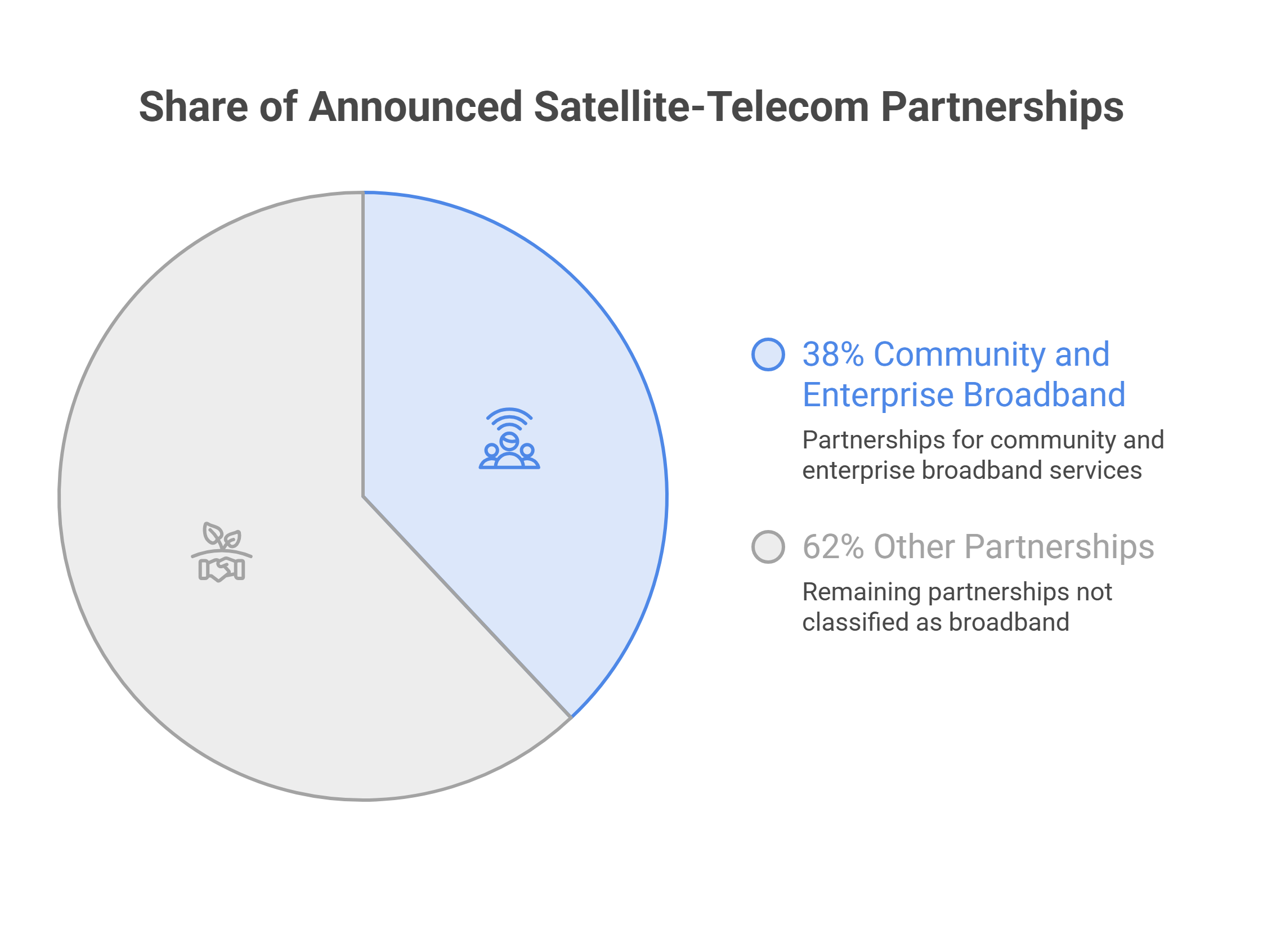
The 38% share shows that community and enterprise connectivity represents a substantial part of announced satellite–telecom partnership activity.
As enterprise satellite connectivity becomes another access layer, the next challenge is making it work reliably with the infrastructure underneath it. That brings terminals, gateways and terrestrial handoffs into sharper focus through satellite ground infrastructure.
Satellite Links Becoming Part of Enterprise Network Design
The growing role of satellite in enterprise networks is less about adding another standalone connection and more about managing multiple access paths as one connectivity environment. An enterprise may use fibre for its primary connection, cellular networks for mobility and satellite where terrestrial infrastructure is unavailable, difficult to extend or vulnerable to disruption. This makes enterprise satellite connectivity an architectural consideration rather than simply a coverage solution.
The Organisation for Economic Co-operation and Development (OECD) said in its 2026 assessment that low Earth orbit (LEO) constellations are reshaping satellite connectivity by enabling higher-speed, lower-latency services and supporting use cases in mobility, resilience and direct-to-device connectivity. The report also highlights growing dependence on space-enabled infrastructure, making resilience an important consideration for downstream users.
For enterprises, successful integration requires the satellite link to become part of existing network management rather than operate independently. Remote facilities may need access to centralised applications, cloud platforms and operational systems, meaning satellite must feed into the same routing, security and monitoring framework as other access technologies. That creates several operational requirements:
- Traffic routing should determine the most suitable connectivity path according to availability, performance and application priority.
- Security controls need to extend across satellite and terrestrial access.
- Network monitoring needs visibility across terminals, gateways and terrestrial handoffs so failures can be identified and managed quickly.
Enterprise Networks Balancing Access, Resilience and Cost
Enterprise economics also become more nuanced as satellite moves into this integrated role. The price of a satellite connection cannot always be compared directly with fibre or cellular service. For remote facilities, the decision can include the cost of extending terrestrial infrastructure, deployment time and the operational impact of losing connectivity. That makes the business case increasingly dependent on the role assigned to the satellite link:
- Primary access where terrestrial infrastructure is unavailable or uneconomic.
- Backup access where continuity has a higher business value than the additional connectivity cost.
- Temporary access for newly established sites awaiting permanent infrastructure.
- Distributed connectivity across remote facilities with different terrestrial conditions.
The distinction matters because enterprise satellite connectivity does not necessarily compete with terrestrial infrastructure. In many cases, its value comes from complementing it. OECD research similarly describes satellite connectivity as a complement to terrestrial infrastructure and points to hybrid satellite-terrestrial services as an emerging direction.
As enterprise satellite connectivity becomes embedded in these multi-access architectures, the challenge increasingly moves below the service itself. Terminals, gateways, ground networks and terrestrial handoffs determine how effectively satellite connectivity integrates with existing enterprise infrastructure.
Enterprise Connectivity Moving from Backup Toward Network Strategy
Satellite is increasingly being evaluated as one component within a broader enterprise connectivity architecture. Recent deployments and market activity point less to replacing terrestrial networks than to adding complementary access paths for remote operations, resilience and faster deployment. The strategic priorities are increasingly centred on:
- Resilience when the primary terrestrial route is disrupted.
- Reach where conventional infrastructure is difficult to extend.
- Integration with existing network, cloud and operational environments.
- Flexibility to combine different access technologies as network requirements change.
For enterprises, enterprise satellite connectivity therefore represents a network-design decision rather than simply another connectivity product. Its long-term value will depend on how effectively satellite services integrate with terminals, gateways, terrestrial networks and enterprise systems while maintaining a sound economic case.
References
- Global mobile Suppliers Association – NTN & Satellite Connectivity – August 2026 – 2026
- OECD – The Space Economy at a Glance 2026 – 2026
- SES – Enterprise Connectivity Solutions – 2026