


















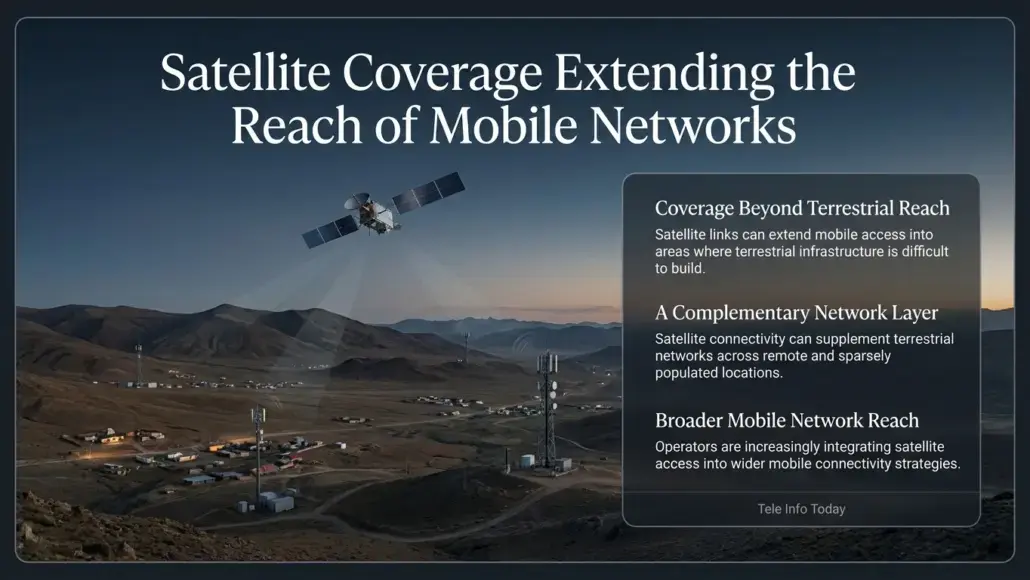
Satellite connectivity is moving closer to the structure of mainstream mobile networks as operators look beyond the limits of terrestrial infrastructure. satellite coverage is increasingly being positioned as a complementary access layer for areas where towers, fibre and backhaul are difficult or uneconomic to extend.
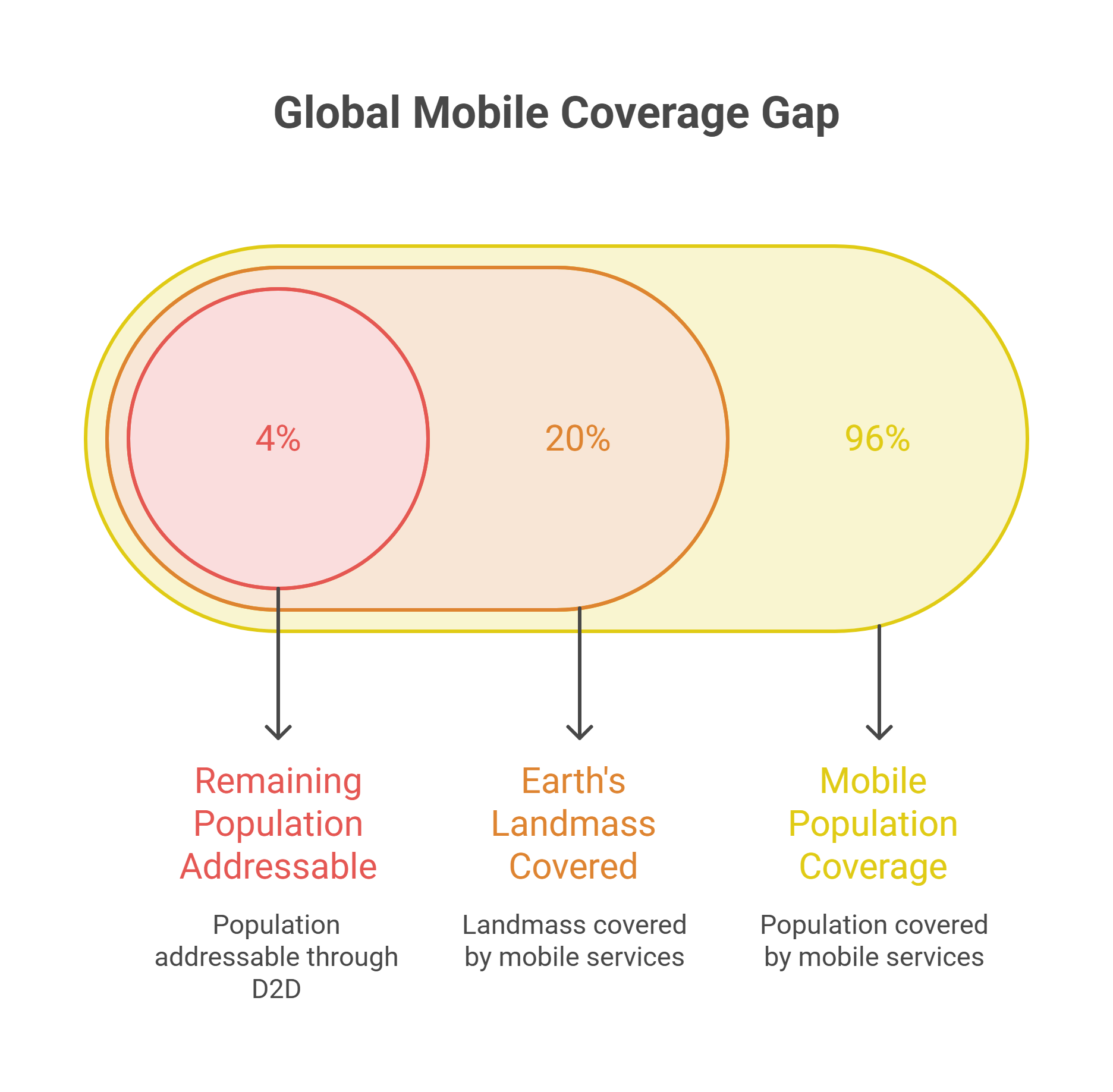
The shift is important because the global connectivity gap is increasingly geographical rather than simply population based. The International Telecommunication Union (ITU) reported in April 2026 that mobile services covered about 96% of the world’s population but only around 20% of its landmass.
Terrestrial Networks Leaving Difficult Geographies Behind
The difference between population reach and geographical reach explains where satellite coverage can add the most value. Remote mountains, deserts, oceans, isolated islands and sparsely populated regions can require infrastructure investments that are difficult to justify against limited subscriber density. Satellite links can provide an additional path to users without requiring every coverage gap to be filled through new terrestrial sites. The strongest near term applications are emerging around locations where conventional networks have clear physical or economic limitations:
- Remote communities where tower deployment and backhaul remain difficult
- Maritime and offshore areas outside conventional mobile footprints
- Disaster affected locations where terrestrial infrastructure has been damaged
- Remote transport routes and industrial areas with limited network infrastructure
This does not make satellites a substitute for terrestrial networks. Their role is instead shaped by where terrestrial infrastructure becomes difficult to deploy or maintain.
Mobile Operators Building a Broader Access Layer
The industry is already moving from isolated demonstrations toward commercial integration. The Global mobile Suppliers Association reported in August 2026 that 283 operator satellite partnerships had been announced across more than 100 countries and territories, including 123 publicly announced satellite to cellphone partnerships. Twenty three of those partnerships had launched services by June 2026.
That activity suggests operators increasingly view satellite connectivity as part of a broader network architecture rather than a standalone service. At the same time, capacity remains a constraint. GSMA notes that satellite beams cover much larger areas than terrestrial cells, limiting the amount of capacity available within a given geographic area. That makes satellite coverage particularly suited to extending reach rather than replacing dense terrestrial networks.
The next stage of this development will depend on how operators coordinate satellite access with terrestrial infrastructure, including shared spectrum between satellite and mobile networks, which will increasingly influence how these systems coexist.

Satellite Networks Moving from Trials into Operational Coverage
The transition from demonstration to live service is changing the role of satellite coverage within mobile network planning. Operator and satellite partnerships are increasingly moving toward services that connect ordinary mobile devices beyond terrestrial coverage, while the underlying network architecture remains tied to existing mobile systems. GSMA reported in September 2026 that 151 operators had satellite services live, in testing or planned, representing an addressable footprint of around six billion mobile connections.
The development is also becoming visible in live deployments. The Global mobile Suppliers Association reported that satellite to cellphone services had launched in 17 countries by May 2026, while Kyivstar’s service with Starlink had surpassed five million connections and transmitted more than seven million SMS messages. These developments indicate that satellite links are beginning to operate as part of mobile service delivery rather than remaining limited to technical trials. Several factors determine where this model can provide meaningful value:
- Sparse populations can make additional terrestrial sites difficult to justify economically.
- Remote transport routes and offshore locations can remain outside conventional mobile footprints.
- Satellite links can provide an alternative communications path when terrestrial infrastructure is disrupted.
- Existing operator relationships can allow satellite services to be integrated into established customer and network systems.
Hybrid Connectivity Expanding the Reach of Mobile Networks
The emerging model is therefore less about replacing towers and fibre and more about extending the overall access architecture. satellite coverage can fill specific geographical gaps while terrestrial networks continue to provide the majority of high capacity connectivity in populated areas.
Regulation is beginning to reflect this hybrid approach. In the UK, Ofcom approved licence variations in 2026 allowing mobile operators to provide direct to device satellite connectivity using existing mobile spectrum, including 900 MHz and 1800 MHz bands. The regulator also established an exemption framework for qualifying services. This demonstrates how satellite connectivity is increasingly being incorporated into national mobile network frameworks rather than treated entirely as a separate service. The practical value of satellite coverage will depend on several network conditions:
- Service availability will vary according to satellite constellation, spectrum arrangements and regulatory authorisation.
- Capacity is more constrained over large satellite footprints than within dense terrestrial cells.
- Device compatibility and network integration determine whether users can move between access layers effectively.
- Service quality will differ between messaging, voice and higher bandwidth applications.
These constraints make the emerging architecture complementary by design. The next challenge is not simply reaching more locations, but coordinating satellite access with terrestrial networks so that coverage expansion becomes an integrated network capability rather than an isolated connectivity layer.
Coverage Expansion Becoming Part of Network Planning
Satellite connectivity is increasingly being positioned as an additional access layer for mobile networks, particularly where extending terrestrial infrastructure remains difficult. The evidence points toward a complementary model in which satellite coverage helps close geographical gaps while terrestrial networks continue to carry most high capacity traffic. The direction of travel is becoming clearer:
- Coverage strategies are expanding beyond fixed terrestrial footprints.
- Operator and satellite partnerships are moving services toward live deployment.
- Regulatory and standards work is creating pathways for deeper network integration.
The remaining challenge is balancing wider reach with capacity, spectrum, device compatibility and service quality. These constraints mean satellite connectivity is unlikely to replace terrestrial networks, but it can broaden where mobile services remain viable.
References
- International Telecommunication Union – Direct to device services: Poised for the leap to 6G – 2026
- GSMA – Scaling satellite connectivity: why interoperability matters for NTN’s next phase – 2026
- Global mobile Suppliers Association – 5G Non Terrestrial Networks (NTN) – 2026
- Ofcom – Direct to Device licence exemption regulations update – 2026