
















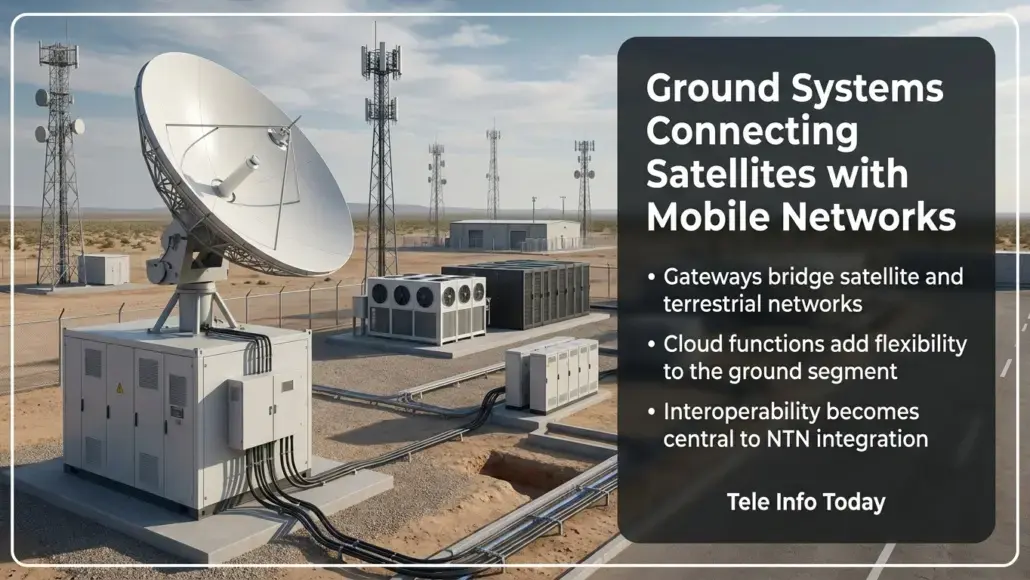

Ground systems are becoming increasingly important as satellite connectivity moves closer to the architecture of mobile networks. A satellite can provide the radio link beyond terrestrial coverage, but the service still needs infrastructure on the ground to carry traffic into mobile and enterprise networks. Gateways, feeder links, network functions and terrestrial connections therefore form the bridge between the space segment and the wider communications ecosystem.
This is particularly relevant to Non-Terrestrial Network (NTN) development, where satellite access is being designed to work with established mobile architectures rather than operate as an isolated service. The International Telecommunication Union’s 2026 NTN architecture places the gateway between the satellite payload and terrestrial network functions, showing how satellite traffic can move from the space segment into the same broader infrastructure used by mobile services.
Gateways Connecting Space and Terrestrial Network Functions
The role of ground systems extends beyond receiving signals from satellites. They provide the physical and network interfaces through which satellite traffic can reach terrestrial radio and core-network infrastructure. This makes the ground segment a critical part of how satellite connectivity can be integrated into existing telecom environments. The main functions include:
- Traffic transfer: Moving communications between satellite payloads and terrestrial network infrastructure through feeder links and gateways.
- Network integration: Connecting satellite traffic with radio access, core-network and enterprise connectivity functions.
- Service continuity: Supporting the transition between satellite and terrestrial access paths where hybrid connectivity is required.
As satellite services become more closely aligned with mobile networks, ground systems also have to become more flexible. Fixed gateway infrastructure alone may not be sufficient for services that require changing traffic patterns, multiple satellite links or closer integration with cloud-based network functions.
Ground Infrastructure Moving Toward Greater Flexibility
The emerging architecture is therefore becoming increasingly software-driven. European Space Agency (ESA) research, including its MiRAGE project, is examining cloud-native ground infrastructure in which virtualised Radio Access Network (RAN) and 5G Core functions can work alongside satellite connectivity. This points toward a model where computing, network orchestration and resource allocation become part of the ground segment itself. The priorities are expanding accordingly:
- Scalability: Infrastructure must support additional satellite capacity and growing numbers of connected devices.
- Interoperability: Satellite components need to communicate with terrestrial network functions and different technology environments.
- Automation: Network resources increasingly need to be managed dynamically as traffic and satellite conditions change.
The result is a gradual shift in which the ground segment becomes less of a supporting satellite facility and more of an active part of the telecom network.
Cloud-Native Ground Infrastructure Supporting Mobile Integration
As satellite networks become more closely integrated with terrestrial mobile services, ground systems are taking on functions that extend beyond traditional satellite gateways. The ground segment increasingly has to connect satellite traffic with Radio Access Network (RAN) functions, 5G Core infrastructure, cloud resources and enterprise systems. This creates a more flexible architecture in which satellite connectivity can be managed as part of a wider communications network.
The European Space Agency (ESA) is examining this direction through projects such as MiRAGE, which is developing a cloud-native ground segment for 5G services over Non-Terrestrial Networks (NTN). Its architecture includes virtualised RAN and selected 5G Core functions, alongside dynamic resource allocation and adaptations for satellite-specific network conditions. The development points toward a model in which software and computing become as important to the ground segment as physical gateway infrastructure. The priorities are therefore expanding:
- Virtualisation: Network functions can run on shared computing infrastructure rather than relying entirely on dedicated hardware.
- Resource management: Capacity and network functions can be adjusted as satellite availability, traffic and service requirements change.
- Scalability: Cloud-based infrastructure can provide a more flexible foundation as satellite services expand across operators and applications.
Gateways Integrating Satellite Traffic with Terrestrial Networks
The role of ground systems also extends into interoperability. A gateway has to connect the satellite segment with the appropriate terrestrial network functions while maintaining routing, security and service continuity. This becomes more complex when several satellite systems, mobile operators or network technologies are involved. A standards-based architecture can be viewed through the following sequence:
- User equipment: Communicates with the satellite through the service link.
- Satellite payload: Transfers traffic toward the ground through a feeder link.
- NTN gateway: Provides the bridge into terrestrial network infrastructure.
- RAN and 5G Core: Process and route traffic into mobile or enterprise services.
This architecture makes ground systems central to the convergence of space and terrestrial networks. The industry is also exploring shared infrastructure models: the Space42 and Viasat Equatys initiative, for example, is designed around shared space-and-ground infrastructure for satellite-enabled mobile connectivity. Such models indicate that gateways and supporting infrastructure could increasingly become shared network assets rather than being duplicated by every satellite operator.
That raises a broader interoperability challenge. Ground infrastructure must support different satellite architectures while connecting into established mobile environments, making 3GPP standards for satellite-mobile integration an important next layer in the development.
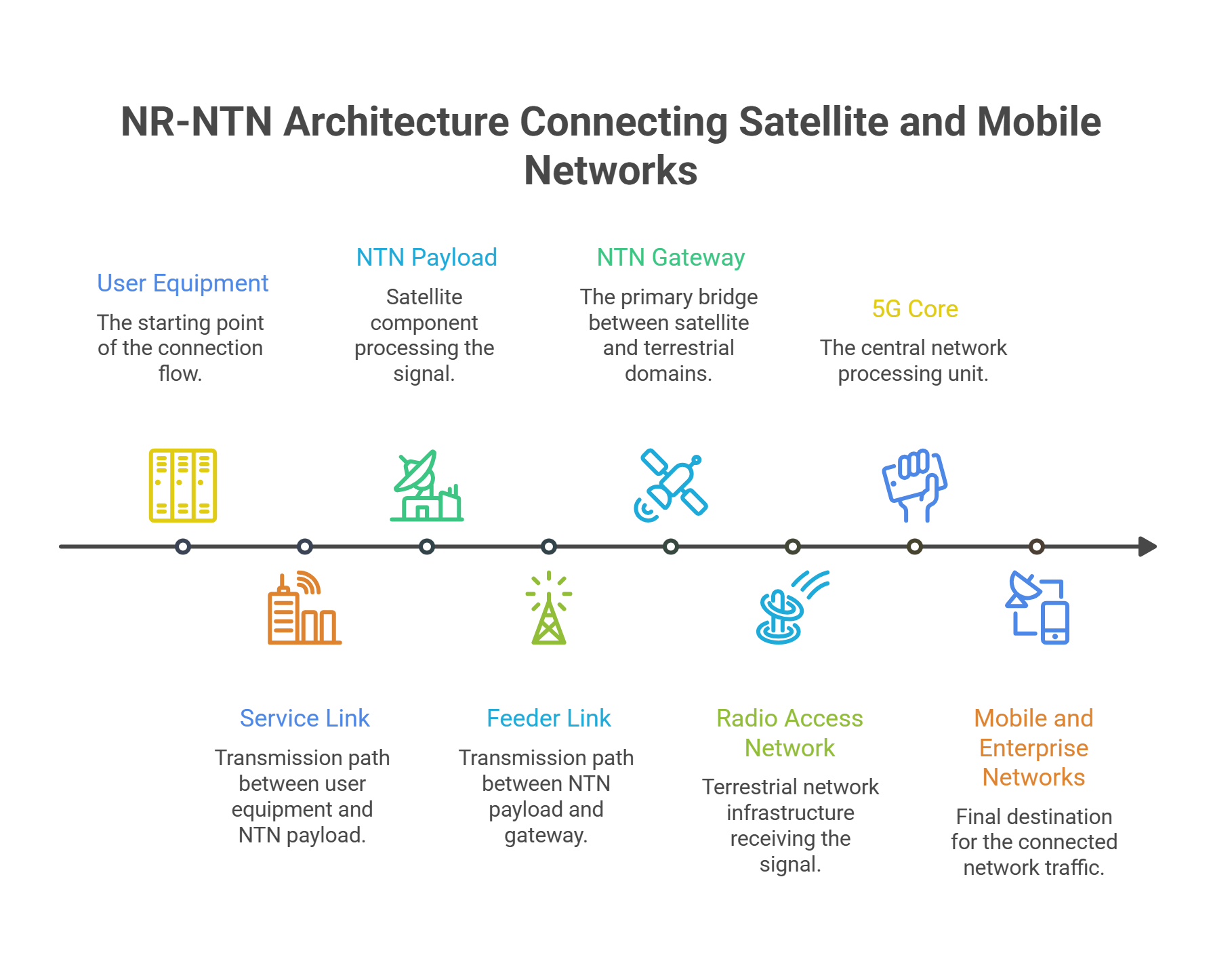
The architecture demonstrates how satellite traffic is transferred through the ground segment into established terrestrial mobile-network functions.
Ground Integration Becoming Central to Satellite-Mobility Convergence
The growing integration of satellite and terrestrial networks is making the ground segment a strategic part of telecom architecture. Gateways, feeder links, virtualised network functions and terrestrial connections determine how effectively satellite capacity can enter existing mobile and enterprise environments. The development is therefore shifting attention from orbital coverage alone toward the infrastructure required to make satellite services interoperable and scalable. The priorities are increasingly centred on:
- Integration: Connecting satellite traffic with established Radio Access Network (RAN), 5G Core and enterprise infrastructure.
- Flexibility: Using virtualised and cloud-native functions to adapt capacity and network resources.
- Interoperability: Enabling different satellite and terrestrial systems to operate within a broader communications ecosystem.
Ground systems will therefore become increasingly important to the commercial development of Non-Terrestrial Networks (NTN), particularly as operators move toward more integrated satellite-mobile services. The next stage of the series can examine the standards work that defines how those satellite links and terrestrial networks communicate.
References
- International Telecommunication Union – Recommendation ITU-R M.2177-0: Detailed specifications of the satellite radio interfaces of International Mobile Telecommunications-2020 (IMT-2020) – 2026 Pasted markdown(8)
- European Space Agency – MiRAGE: 5G Satellite Communications with a Cloud-Native Ground Segment – 2026
- GSMA – GSMA Foundry and ESA Announce Access to New Funding Worth Up to €100m for AI, NTN, D2D and 6G – 2026
- Viasat – Space42 and Viasat Sign Binding Agreement to Co-Found Equatys – 2026