
















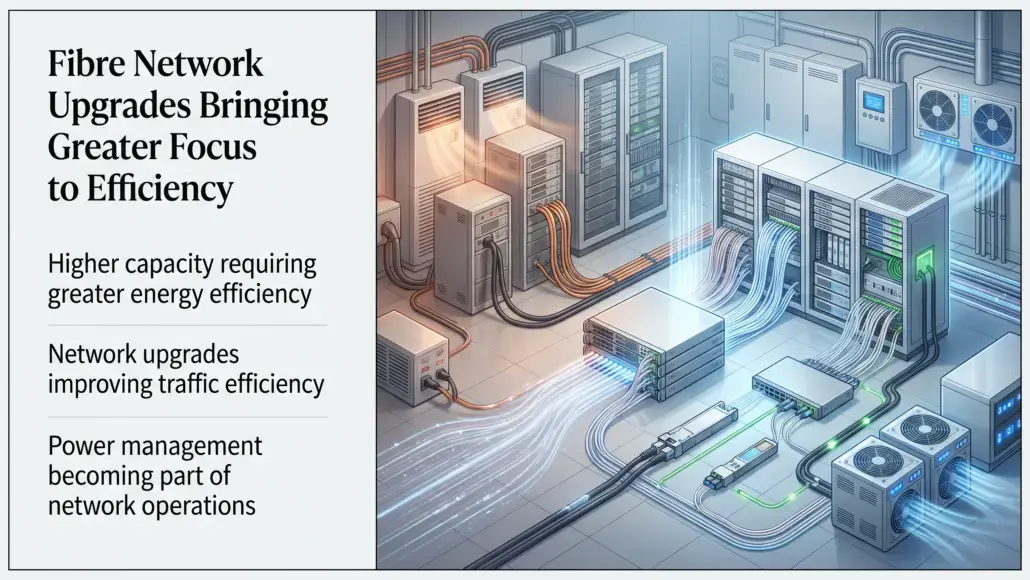

The expansion of fibre infrastructure is bringing a new efficiency question into network planning: how can operators carry substantially more traffic without allowing energy consumption to rise at the same pace? Fibre network efficiency is becoming increasingly important as network traffic grows and operators replace older systems with higher capacity optical equipment. The focus is shifting from absolute electricity consumption toward how much information a network can transport for each unit of energy used. This distinction matters because a network can consume more power in total while still becoming more efficient when traffic increases faster than energy demand.
Telefónica provides a useful illustration of this relationship. Between 2015 and 2025, the operator reported that its data traffic increased twelvefold while total network energy consumption fell by 12%. It also reported a 92% reduction in energy consumption per unit of traffic, reaching 29 MWh per petabyte in 2025. The figures indicate how network modernisation can improve fibre network efficiency even while overall traffic expands sharply. Fibre, newer radio and transport technologies, automation and the shutdown of legacy systems can each contribute to this change, although the effect varies according to network architecture and operating conditions.
Traffic Growth Increasing Pressure on Network Efficiency
As networks carry more data, energy use becomes a more significant part of infrastructure planning. Higher capacity optical systems can move more traffic through individual interfaces, while consolidation can reduce the number of active platforms required across the network. These changes can improve fibre network efficiency by increasing the amount of traffic supported by a given equipment and site footprint. The relevant measure is therefore not simply whether an operator’s electricity consumption rises or falls, but whether energy use grows more slowly than the traffic being carried.
The same principle is becoming relevant across access, transport and data centre connectivity, where higher capacity equipment can increase traffic density while introducing additional power and cooling requirements. Operators therefore need to evaluate efficiency at both equipment and network level rather than relying on a single power consumption figure.
Energy Per Bit Becoming a More Important Network Measure
International standards work is also placing greater emphasis on energy efficiency as an optical network characteristic. The ITU’s ION 2030 framework defines efficiency around the relationship between information transmitted or received and energy consumption, while energy saving mechanisms in optical access standards allow equipment to adapt power states to traffic conditions. This is moving fibre network efficiency beyond a hardware specification toward a broader network design objective that includes equipment selection, consolidation and traffic aware operation.
Optical Upgrades Improving Capacity Per Unit of Energy
Higher capacity optical systems are changing the way operators assess fibre network efficiency across transport and access infrastructure. Newer optical components can increase the amount of traffic carried through individual interfaces while reducing the energy or physical space required for a given capacity level. Ciena, for example, reports that its WaveLogic 6 Extreme technology can reduce space and power per bit by 50% compared with its previous generation 800G technology. Such figures are vendor specific, but they illustrate how equipment design is increasingly being evaluated not only by throughput but also by the efficiency of delivering that throughput.
Network consolidation can reinforce these gains. Replacing older platforms, reducing duplicated equipment and simplifying network architecture can lower the number of active systems that need to be powered and maintained. Vodafone has reported improvements from network modernisation, equipment replacement, power-saving functions and consolidation across parts of its fixed network and data-centre estate. The combined effect means fibre network efficiency depends on decisions made at both component and network level, rather than on the power consumption of an individual optical module alone.
Dynamic Power Management Changing Network Operations
Efficiency is also moving into network operations. ITU T work on optical access includes power-saving mechanisms that allow equipment to enter controlled low-power states when traffic demand falls, while its ION 2030 framework discusses real-time adjustment of energy-saving parameters according to network traffic. This creates a model in which fibre network efficiency can be influenced by how equipment behaves during periods of different demand, rather than remaining fixed regardless of network utilisation.
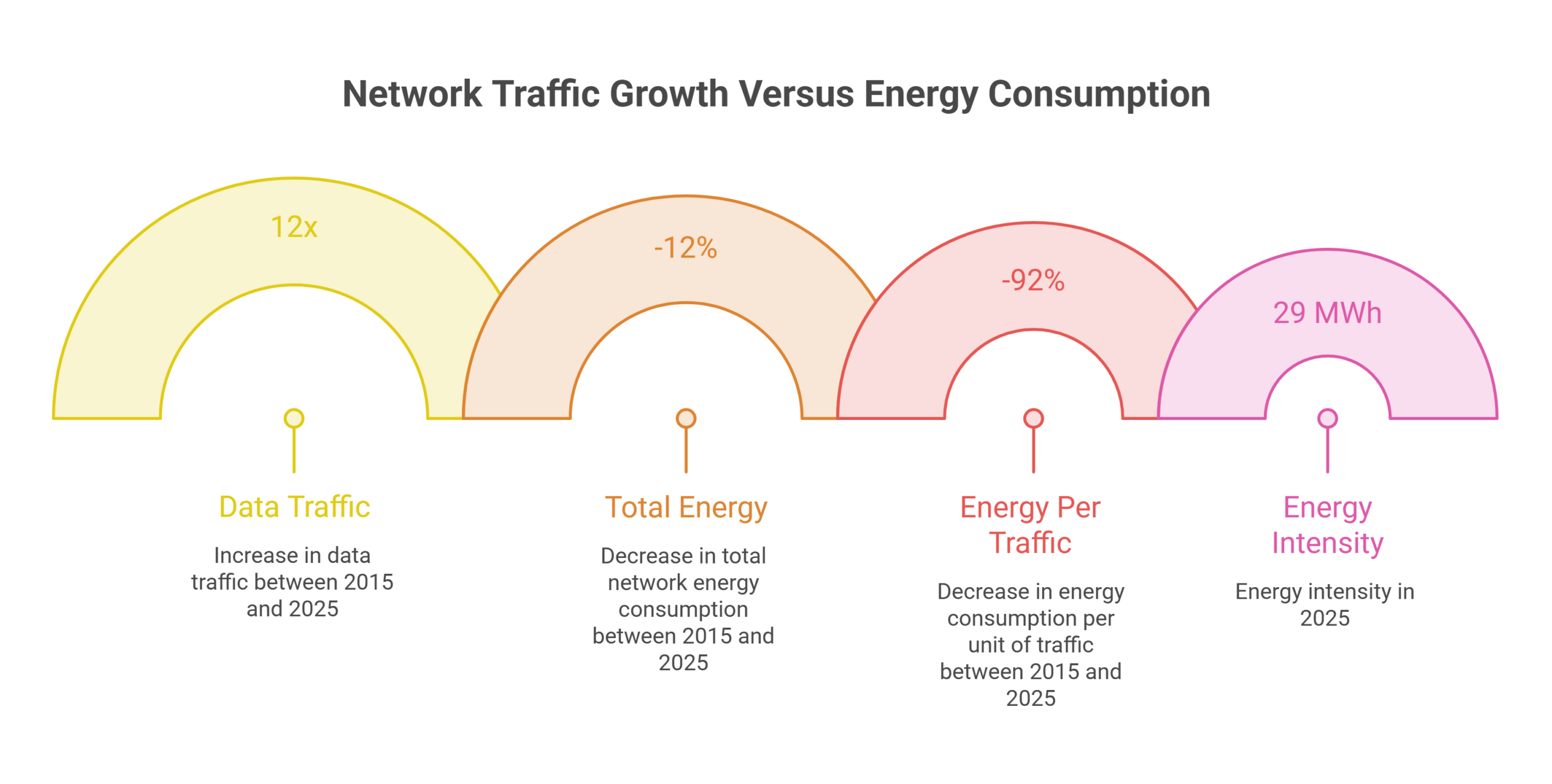
Network traffic can grow substantially while energy intensity declines, making energy consumed per unit of traffic an increasingly relevant measure of network efficiency.
The operational challenge is to capture these gains without compromising service quality. Power-saving states must be coordinated with traffic levels, while higher equipment density can introduce additional cooling requirements at network sites. Operators therefore need to consider equipment power, site requirements, traffic patterns and service performance together. As networks scale to support more demanding services, this broader approach also makes network resilience, increasingly relevant, since efficiency improvements must operate alongside the need for dependable connectivity.